 Indian Images are for illustrative purposes only, may be inaccurate, and do not guarantee the presence or absence of specific ingredients.
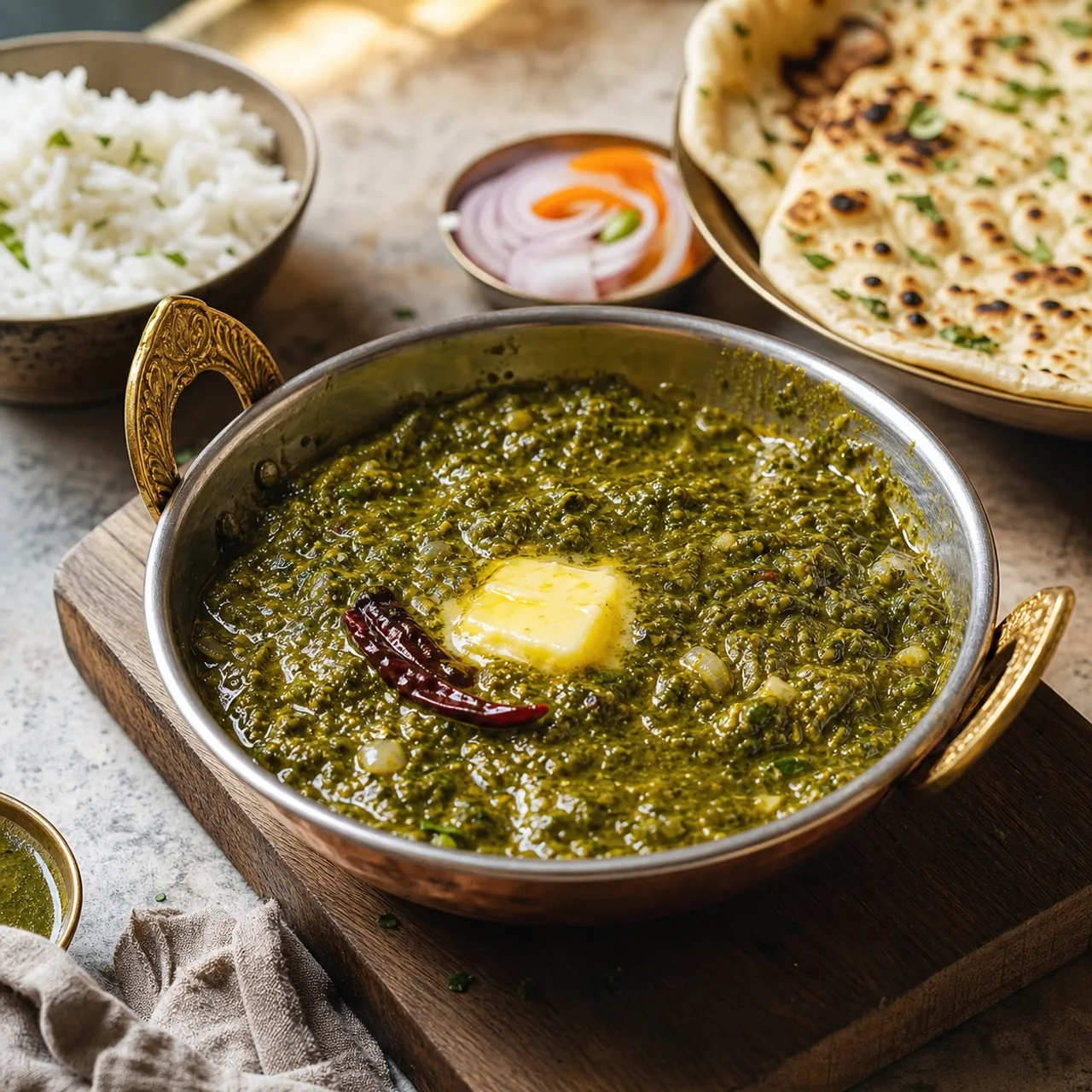
 Sarson Ka Saag
A hearty Punjabi winter classic of slow-simmered mustard and spinach greens finished with a sizzling ghee tempering.
Contains common allergens
In the app, Listahan checks these against your household automatically.
Instructions
6 steps- 1
Place the chopped mustard greens, spinach, slit green chili, and 1 cup water in a heavy pot, bring to a boil, then cover and simmer over medium-low heat for 35 to 40 minutes until the greens are completely tender.
- 2
Whisk the cornmeal into 1/4 cup cold water until smooth, then stir it into the simmered greens and cook another 10 minutes to thicken, stirring often so it does not stick to the bottom.
- 3
Using an immersion blender or traditional wooden masher, blend the mixture to a coarse, rustic puree, leaving some texture rather than making it perfectly smooth.
- 4
In a small pan, heat 3 tbsp ghee over medium heat, add the chopped onion and ginger-garlic paste, and saute for 5 to 6 minutes until deep golden and fragrant.
- 5
Pour this tempering over the greens, stir in the salt and red chili powder, and simmer everything together for a final 5 minutes.
- 6
Serve piping hot with a melting pat of butter on top, traditionally alongside makki di roti.
Listahan Family Score™
63/100
Works for many families
Score reflects how well this recipe fits a typical busy household. In the app, your Family Score is personalized to your household's allergens, kids, and pantry.
Nutrition
per serving210
Calories
7 g
Protein
16 g
Carbs
14 g
Fat
Estimated per serving. Actual values depend on the brands and portions you use.
Listahan cooking guide
Chef notes & practical guide
Technique notes, ingredient swaps, serve-alongside ideas, storage guidance, and equipment for this recipe.
Cultural context
Sarson ka saag is a Punjabi winter classic built from slow-simmered mustard greens, traditionally cooked over long hours in a clay pot and paired with makki di roti, a cornmeal flatbread. The dish reflects the seasonal rhythm of Punjab's mustard harvest, when fresh greens are abundant and this hearty, slow-cooked dish becomes a household staple.
Listahan note
This version blends the greens to a coarse, rustic texture rather than perfectly smooth, keeping some bite that a fully pureed version loses, and finishes with a separate ghee tempering for a burst of aroma right before serving.
Technique cues
- Simmering the greens low and slow for a full 35-40 minutes fully softens their tough fibers, which is what allows them to blend into a cohesive, spoonable saag rather than staying stringy.
- Whisking the cornmeal into cold water before adding it to the pot prevents lumps, since dry cornmeal added directly to hot liquid clumps immediately.
- Blending to a coarse, rustic texture rather than perfectly smooth preserves some of the greens' natural texture, which is closer to how the dish is traditionally made with a wooden masher.
Kitchen flow
- Parallel prep
- Prepare the ghee tempering while the greens finish their final simmer, so it's hot and ready to pour over right at the end.
- Make-ahead
- The blended greens can be made a day ahead; add a fresh ghee tempering just before serving for the best aroma.
- Leftover move
- Stir leftover saag into rice or lentils for a quick, flavorful side the next day.
- Cleanup rhythm
- Use one heavy pot for simmering and blending the greens, then a small separate pan just for the tempering, to keep dishes minimal.
Ingredient brief
Role, handling, and swap guidance for each key ingredient.
Fresh mustard greens
Main vegetable
Purpose: Their slightly bitter, peppery flavor is the defining character of the dish.
Handling: Remove the tough stems and chop roughly before simmering, since the leaves need time to break down fully.
Adaptation: A mix of mustard greens with a bit more spinach mellows the bitterness for those new to the flavor.
Fresh spinach
Balancing green
Purpose: It softens the mustard greens' sharpness and adds body to the finished puree.
Handling: Chop roughly along with the mustard greens so both cook down together.
Adaptation: Collard greens can stand in for some of the spinach for a different, slightly heartier texture.
Cornmeal (makki ka atta)
Thickener
Purpose: It gives the saag its traditional thick, hearty body, distinguishing it from a thinner cooked-greens dish.
Handling: Whisk into cold water until smooth before stirring into the simmered greens, to avoid lumps.
Adaptation: A small amount of chickpea flour can work as a thickener if cornmeal isn't available, though the flavor will differ slightly.
Ghee, onion, and ginger-garlic paste
Tempering (tadka)
Purpose: Fried separately and poured over the finished greens, this tempering adds a burst of aroma and richness right before serving.
Handling: Sauté the onion and ginger-garlic paste in the ghee until deep golden before pouring over the greens.
Adaptation: Butter can replace ghee for the tempering if that's what's on hand, though ghee's higher smoke point and flavor are traditional here.
Technique notes
- Simmer the greens the full recommended time; rushing this step leaves the fibers tough and the dish underdeveloped in flavor.
- Blend to a coarse texture, not perfectly smooth, since some texture is part of what makes saag feel homemade rather than like a soup.
- Pour the tempering over the greens right before serving so its aroma is at its most pronounced when it reaches the table.
Ingredient swaps
- Milder direction
- Increase the ratio of spinach to mustard greens for a gentler, less bitter version.
- Dairy-free direction
- Use a neutral oil instead of ghee for the tempering for a dairy-free version.
- Spicier direction
- Add an extra green chili or a pinch more red chili powder for more heat.
Serve alongside
- Makki di roti
- Steamed rice
- Sliced radish
- Lassi
- Masala chai
- Buttermilk
Serving suggestions only — check pairings for your household's allergens.
Storage & reheating
- Refrigerate in an airtight container for up to 4 days.
- Reheat gently on the stovetop, adding a splash of water if it's thickened too much in the fridge.
- Freeze for up to 2 months; the texture holds up reasonably well after thawing and reheating.
Equipment
- Heavy pot
- Immersion blender or wooden masher
- Small pan for the tempering
Make this household-aware
Listahan Pro checks this recipe against your household's allergens, finds pantry-aware swaps, builds the shopping list, and helps you plan the week around it.
Plan it in Listahan
Add Sarson Ka Saag to your week, check it against your household's allergens, and build the shopping list automatically.
More Indian recipes
 Indian Lens Verified Images are for illustrative purposes only, may be inaccurate, and do not guarantee the presence or absence of specific ingredients.
 Chicken Tikka Masala
Indulge in succulent, yogurt-marinated chicken chunks roasted to perfection and enveloped in a luscious, deeply spiced tomato-cream sauce.
 Indian Lens Verified Images are for illustrative purposes only, may be inaccurate, and do not guarantee the presence or absence of specific ingredients.
 Garlic Naan
Tear into this piping hot, blistered flatbread packed with aromatic garlic and brushed generously with irresistible melted butter.
 Indian Lens Verified Images are for illustrative purposes only, may be inaccurate, and do not guarantee the presence or absence of specific ingredients.
 Lamb Pasanda
A rich Mughlai dish made with flattened lamb steaks in a creamy almond sauce.