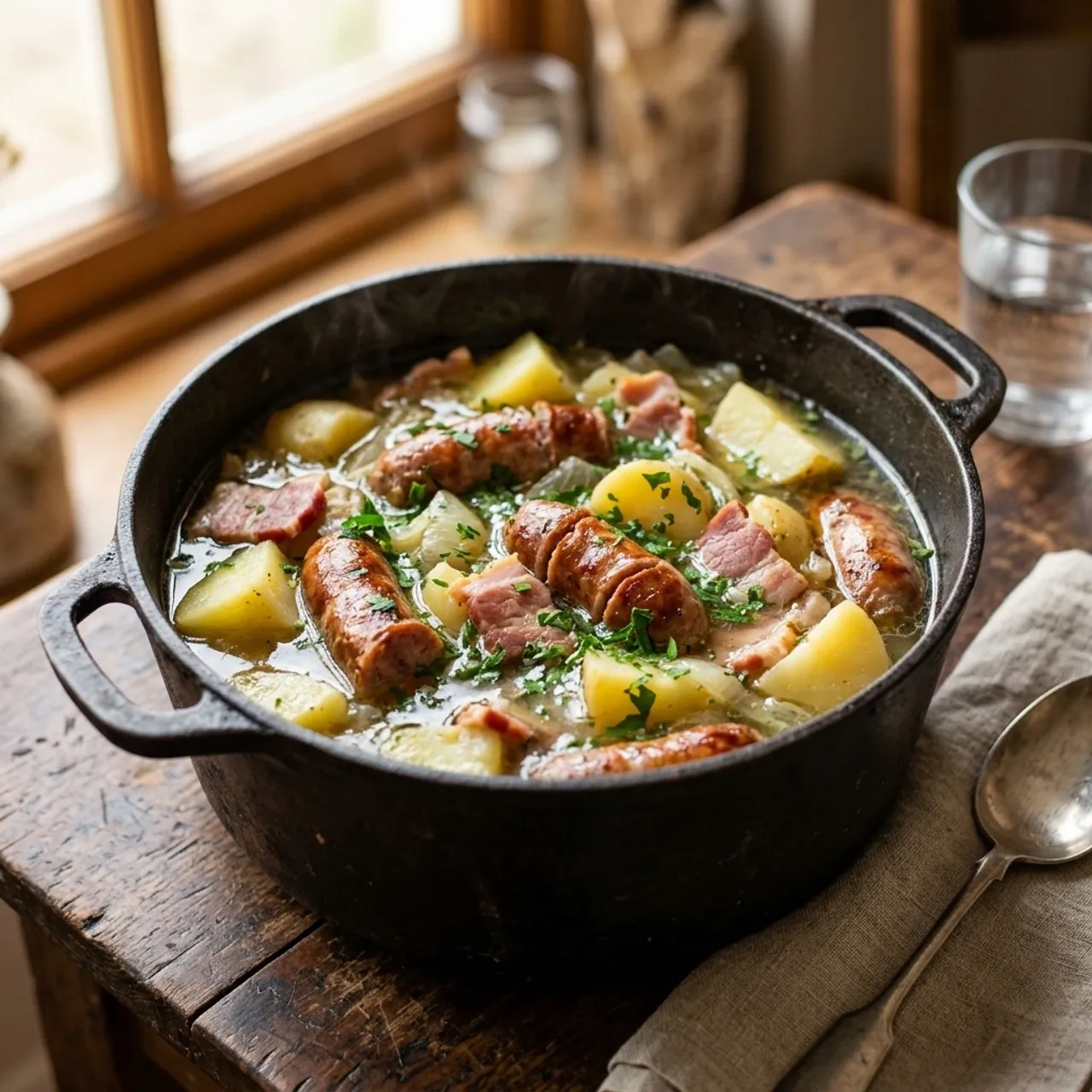
 British & Irish Images are for illustrative purposes only, may be inaccurate, and do not guarantee the presence or absence of specific ingredients.
 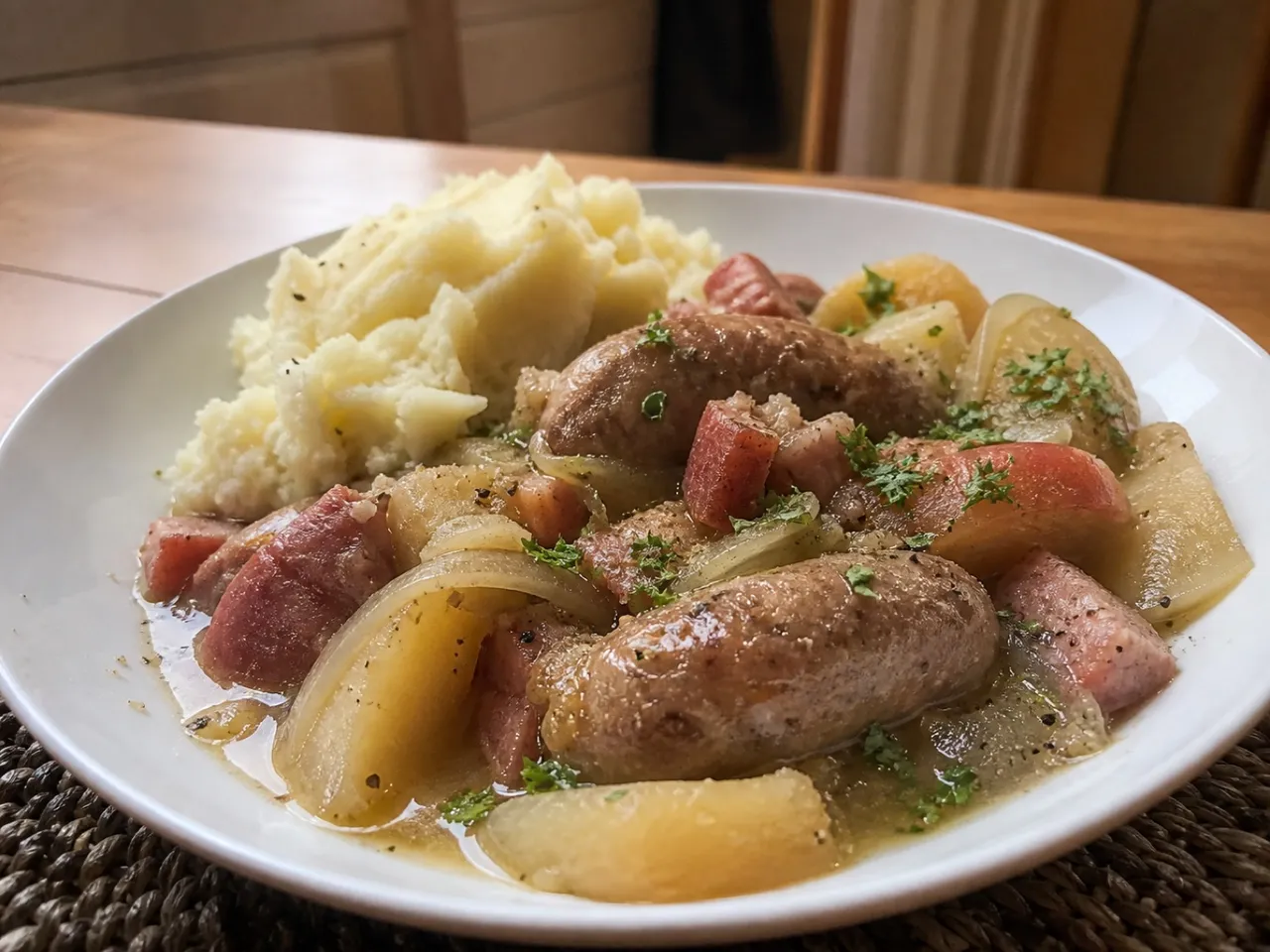 Serving Images are for illustrative purposes only, may be inaccurate, and do not guarantee the presence or absence of specific ingredients.
 Dublin Coddle
A warming Dublin one-pot of layered pork sausages, rashers, and potatoes simmered in a savory, herby broth until meltingly tender.
No common allergens detected
Based on this recipe's ingredient list. Always verify with your own brands and labels.
Instructions
6 steps- 1
Prep the meats: In a dry frying pan over medium heat, briefly sear the sausages and diced bacon just to give them some color. Do not cook them through. Slice the sausages in half diagonally.
- 2
Layer the pot: In a large, heavy-bottomed pot or Dutch oven, start with a layer of the sliced onions, followed by a layer of potatoes, then add half the bacon and sausages.
- 3
Repeat layers: Repeat the layering process, finishing with a neat, overlapping layer of sliced potatoes on top. Season generously with black pepper between layers (do not add salt yet, as the bacon is salty).
- 4
Add the stock: Pour the stock over the layers. It should come about halfway up the contents of the pot.
- 5
Simmer slowly: Bring to a gentle simmer on the stove. Cover tightly with a lid, reduce the heat to the lowest setting, and simmer gently for 1.5 to 2 hours. The steam will cook the top potatoes.
- 6
Serve: Check that the potatoes are tender and the liquid has reduced to a savory broth. Taste and add salt if needed. Garnish with chopped parsley and serve with crusty bread.
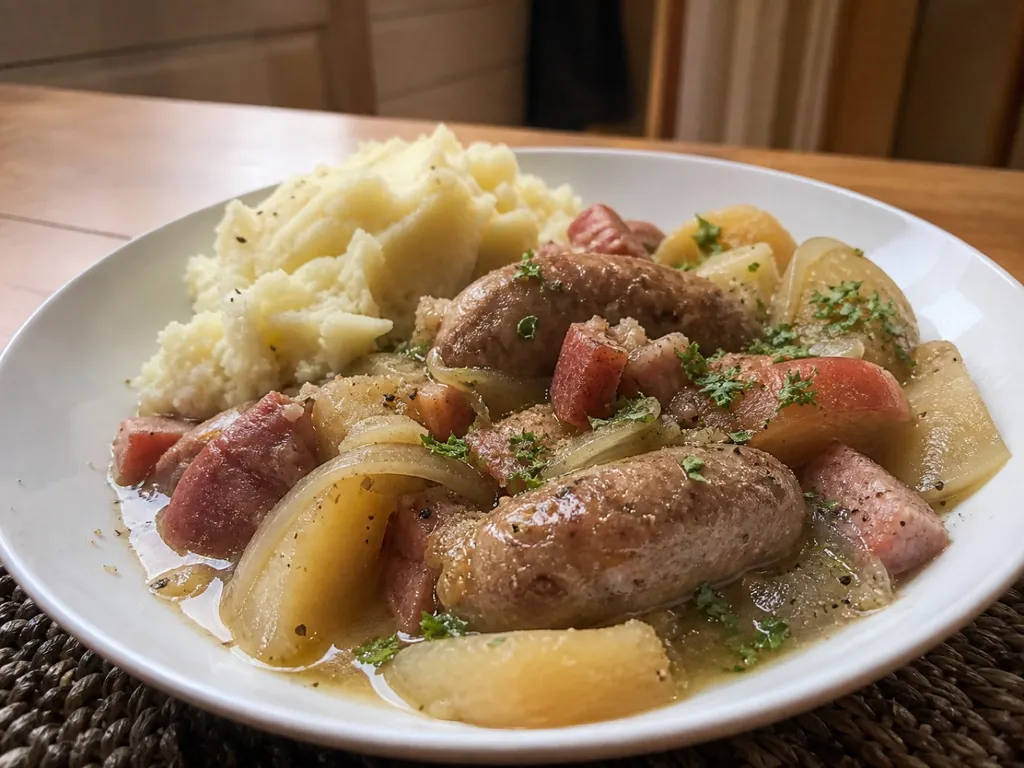 Images are for illustrative purposes only, may be inaccurate, and do not guarantee the presence or absence of specific ingredients.
 Listahan Family Score™
73/100
Good fit for most families
Score reflects how well this recipe fits a typical busy household. In the app, your Family Score is personalized to your household's allergens, kids, and pantry.
Nutrition
per serving445
Calories
36 g
Protein
21 g
Carbs
24 g
Fat
Estimated per serving. Actual values depend on the brands and portions you use.
Listahan cooking guide
Chef notes & practical guide
Technique notes, ingredient swaps, serve-alongside ideas, storage guidance, and equipment for this recipe.
Cultural context
Dublin Coddle is one of the most genuinely working-class dishes in Irish cuisine, traditionally made on Thursday nights from whatever pork scraps — sausages, rashers, leftover bacon — remained before the Catholic abstinence from meat on Friday. The word 'coddle' likely derives from the French 'caudle,' a warm, spiced drink, or from the Old English 'coddle,' meaning to cook gently. Jonathan Swift and Sean O'Casey both documented the dish in their Dublin writings, and it remains a deeply local Dublin food rather than a nationally recognised Irish dish, often eaten with a pint of stout and soda bread.
Listahan note
This version cooks the coddle low and slow without a lid at the end so the broth reduces slightly, concentrating the pork flavor into a rich, salty-sweet cooking liquor rather than a watery pot.
Technique cues
- Do not brown the sausages or rashers before adding them to the pot — Dublin coddle is traditionally a pale dish, slow-cooked in water rather than browned and braised, which gives it its distinctive, mild, deeply savory flavor.
- Layer the ingredients rather than mixing: potatoes on the bottom, then onions, then sausages and rashers, then repeat — the layering ensures the potatoes absorb the pork fat dripping from above as they cook.
- Cook at the barest simmer, barely a bubble, for at least 1 hour; aggressive boiling breaks up the potatoes and makes the broth cloudy rather than clear.
Kitchen flow
- Parallel prep
- There is minimal active prep — this is a layering dish; peel and slice the potatoes and onions while the pot heats, then assemble and walk away.
- Make-ahead
- Coddle actually improves overnight as the flavors meld; make 1-2 days ahead and reheat gently on the stovetop.
- Leftover move
- Serve leftover coddle with a fresh side of soda bread; the broth is even better on day 2 and the potatoes are more deeply flavored.
- Cleanup rhythm
- A single heavy pot is all you need; soak it immediately after serving and it comes clean easily.
Ingredient brief
Role, handling, and swap guidance for each key ingredient.
pork sausages
primary protein
Purpose: Thick, coarse-textured pork sausages are the centerpiece; they release fat into the broth that becomes the foundation of the coddle's flavor.
Handling: Leave whole and unbrowned; the traditional method adds them raw to the pot.
Adaptation: Smoked pork sausages add more depth; avoid highly seasoned or spiced varieties which can unbalance the delicate broth.
back bacon rashers
secondary protein and smoky depth
Purpose: Rashers add a cured, smoky note that gives the broth its characteristic savory depth.
Handling: Cut into large pieces or leave whole; add alongside the sausages.
Adaptation: Pancetta cubes provide a similar salty, cured pork contribution.
floury potatoes
starch and body
Purpose: Potatoes form the base of the pot and absorb the pork fat as it renders down through the layers, becoming extraordinarily flavorful.
Handling: Peel and cut into thick slices or halve smaller potatoes; thinner slices will disintegrate in the long cook.
Adaptation: Waxy potatoes hold their shape better but absorb less fat and flavor; a 50/50 mix is a good compromise.
onions
aromatic and sweetness
Purpose: Onions cooked slowly in the pork fat release their sugars into the broth and add a sweetness that balances the saltiness of the cured meats.
Handling: Slice into rings and layer between the potato and meat layers.
Adaptation: Leeks provide a more delicate flavor and are a common variation.
Technique notes
- The broth is the soul of the dish — taste it 30 minutes in and decide if it needs a little salt; the saltiness of rashers varies widely between brands.
- Finish with a generous handful of fresh flat-leaf parsley stirred in off the heat; this is one of the few herbs used in traditional coddle and it brightens the otherwise beige bowl considerably.
- A pint of Guinness poured into the pot instead of some of the water is a common Dublin variation that adds a slightly bitter, roasted note.
Ingredient swaps
- Gluten-free direction
- Dublin coddle is naturally gluten-free as long as the sausages used are gluten-free — many pork sausages contain rusk, so check labels carefully.
- Lower-sodium direction
- Use low-salt sausages and rinse the rashers briefly before adding; taste the broth before adding any extra salt.
- Heartier version
- Add a handful of pearl barley with the potatoes — it swells and absorbs the broth, turning the coddle into a thicker, more substantial stew.
Serve alongside
- Soda bread or soda farls for dipping in the broth
- Simple green salad
- Pickled cabbage
- Guinness stout
- Strong Irish tea
Serving suggestions only — check pairings for your household's allergens.
Storage & reheating
- Keeps refrigerated for up to 4 days; the flavor improves each day.
- Freezes well for up to 2 months; add a splash of water when reheating as some liquid absorbs into the potatoes on freezing.
Equipment
- Deep heavy-bottomed pot with a lid (Dutch oven or similar)
- Slotted spoon for serving so broth can be ladled separately
- Sharp knife for peeling and slicing potatoes evenly
- Ladle for serving the broth at the table
Make this household-aware
Listahan Pro checks this recipe against your household's allergens, finds pantry-aware swaps, builds the shopping list, and helps you plan the week around it.
Plan it in Listahan
Add Dublin Coddle to your week, check it against your household's allergens, and build the shopping list automatically.
More British & Irish recipes
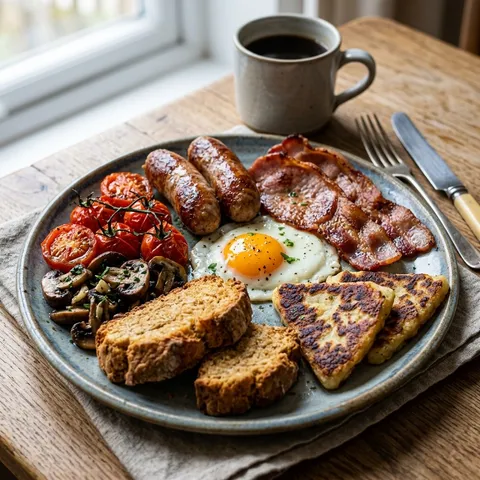 British & Irish Lens Verified Images are for illustrative purposes only, may be inaccurate, and do not guarantee the presence or absence of specific ingredients.
 Ulster Fry
Northern Ireland's legendary fry-up: bacon, sausages, eggs, black pudding, potato bread, and soda bread — fuller and heartier than its English cousin.
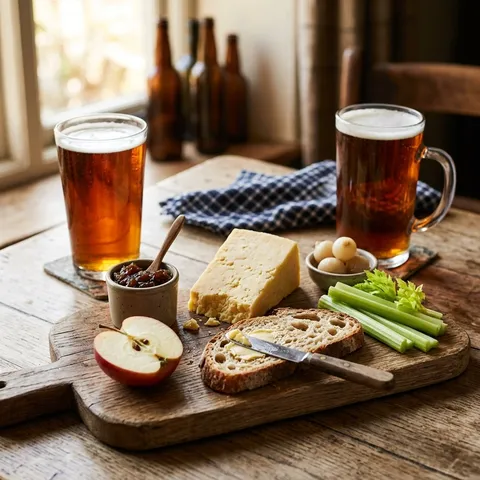 British & Irish Lens Verified Images are for illustrative purposes only, may be inaccurate, and do not guarantee the presence or absence of specific ingredients.
 Ploughman's Lunch
Sharp aged cheddar, crusty bread, tangy Branston pickle, and a boiled egg — a beloved no-cook British lunch that's greater than the sum of its parts.
 British & Irish Lens Verified Images are for illustrative purposes only, may be inaccurate, and do not guarantee the presence or absence of specific ingredients.
 Treacle Tart
A sweet, sticky tart filled with golden syrup and fresh breadcrumbs, with a gently caramelized top and a hint of lemon — Harry Potter's favorite dessert.