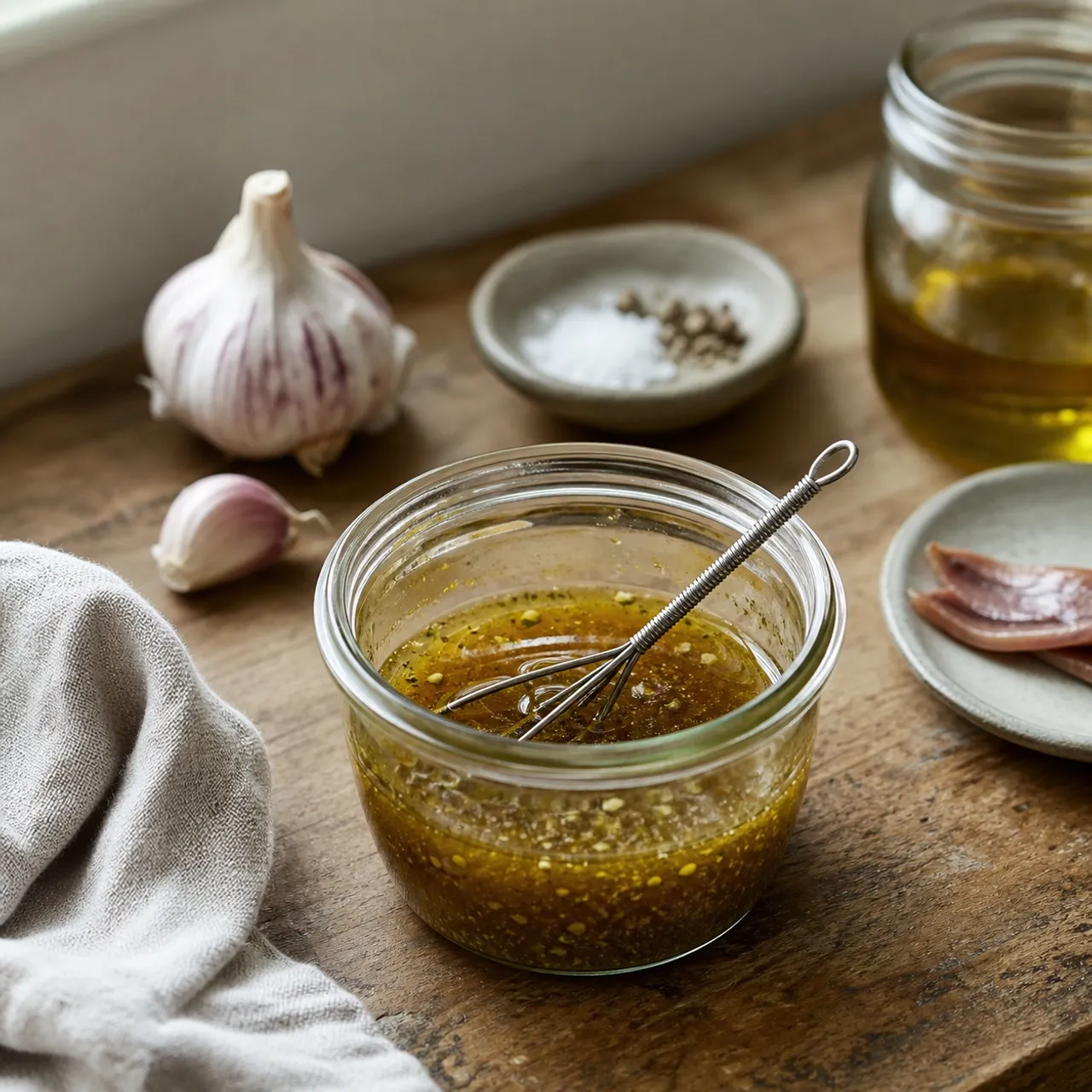
 Sauces & Dressings Images are for illustrative purposes only, may be inaccurate, and do not guarantee the presence or absence of specific ingredients.
 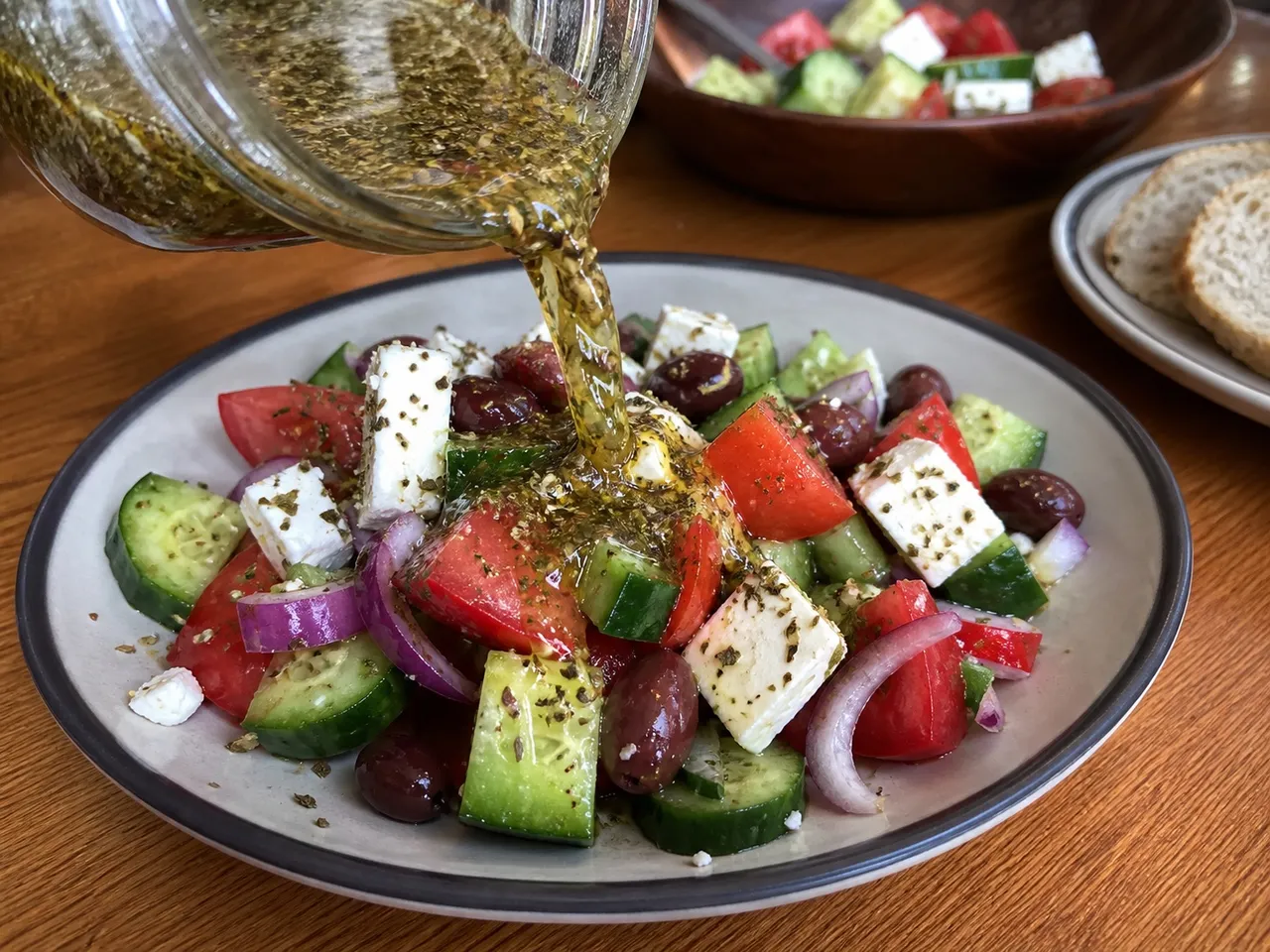 Serving Images are for illustrative purposes only, may be inaccurate, and do not guarantee the presence or absence of specific ingredients.
 Outstanding Greek Salad Dressing
A bold, garlicky red wine vinaigrette with a savory anchovy backbone, perfect for crisp Greek salads.
Contains common allergens
In the app, Listahan checks these against your household automatically.
Good to know
- Ready in under 30 minutes
Matched from this dish's own ingredients and timing. Browse more: 30-minute meals
Instructions
4 steps- 1
Place the garlic, red wine vinegar, salt, black pepper, and cayenne in a blender or food processor fitted with a metal blade. Blend until smooth and well combined.
- 2
With the motor running, gradually add the olive oil, drop by drop at first and then in a thin, steady stream, until the dressing emulsifies and thickens.
- 3
Add the anchovy fillets or anchovy paste and blend again until fully incorporated. Taste and adjust salt as needed.
- 4
Use right away, or cover and let stand at room temperature for up to 1 day. For longer storage, refrigerate and bring back to room temperature before serving.
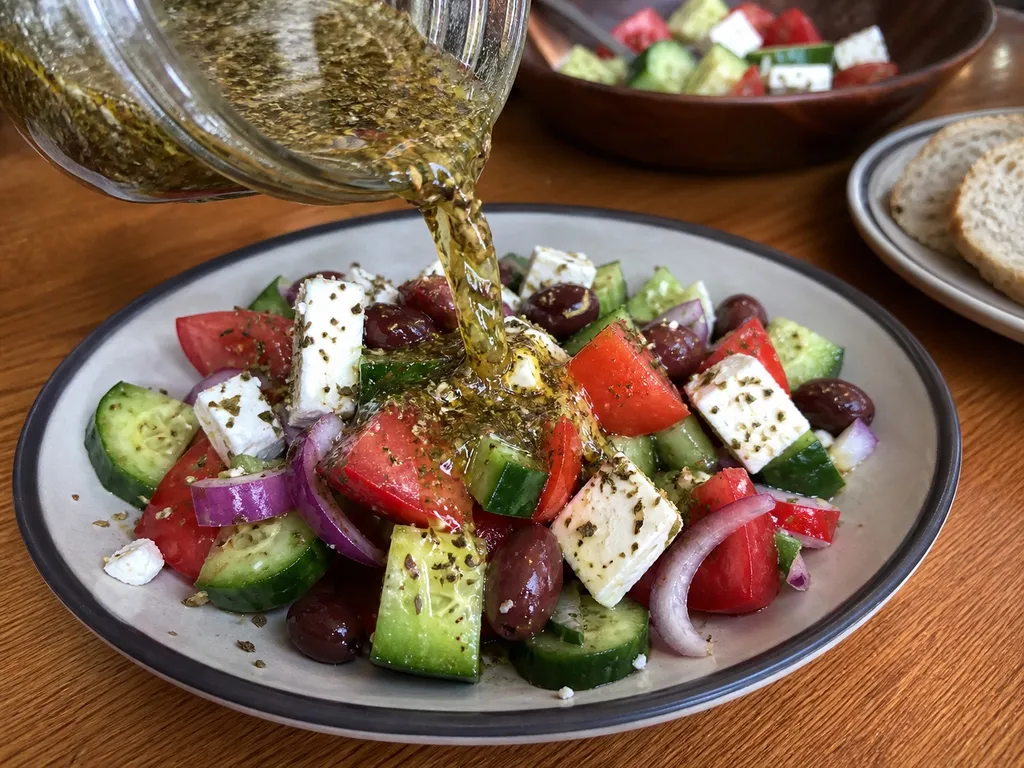 Images are for illustrative purposes only, may be inaccurate, and do not guarantee the presence or absence of specific ingredients.
 Listahan Family Score™
68/100
Works for many families
Score reflects how well this recipe fits a typical busy household. In the app, your Family Score is personalized to your household's allergens, kids, and pantry.
Nutrition
per serving185
Calories
0 g
Protein
0 g
Carbs
20 g
Fat
Estimated per serving. Actual values depend on the brands and portions you use.
Listahan cooking guide
Chef notes & practical guide
Technique notes, ingredient swaps, serve-alongside ideas, storage guidance, and equipment for this recipe.
Cultural context
Greek salad dressing draws on the Mediterranean ladolemono and oil-and-vinegar traditions, where good olive oil, an acid, and dried oregano are the entire point and nothing is meant to hide the ingredients. In Greece itself a horiatiki salad is barely dressed at all, just oil, vinegar, and oregano poured over the vegetables. The thicker, herb-and-garlic-forward bottled style most North Americans know is a diaspora invention built to coat lettuce.
Listahan note
This version splits the difference, keeping the oil-forward Mediterranean balance but adding enough garlic and oregano to make it cling to a hearty chopped salad.
Technique cues
- Use a generous three-to-one ratio of oil to acid, because Greek dressing is meant to taste of the olive oil rather than puckering with vinegar.
- Crush the dried oregano between your palms as you add it, which releases far more aroma than dropping it in whole.
- Let the dressing sit at least fifteen minutes before serving so the raw garlic and oregano steep into the oil and lose their harsh edge.
Kitchen flow
- Parallel prep
- Shake everything in a jar while the salad vegetables get chopped, so the dressing rests and the flavors meld.
- Make-ahead
- Make a big jar at the start of the week; it holds for many days and is ready whenever a salad is.
- Leftover move
- Use leftover dressing as a marinade for chicken or as a finishing drizzle over grilled vegetables.
- Cleanup rhythm
- Make and store it in the same jar so the only thing to wash is a whisk or, with the jar method, nothing at all.
Ingredient brief
Role, handling, and swap guidance for each key ingredient.
extra virgin olive oil
the foundation
Purpose: A good fruity olive oil is the dominant flavor of an authentic Greek dressing, not just a carrier.
Handling: Use the best oil you have, since there is nowhere for a flat one to hide.
Adaptation: A milder olive oil works if a peppery one fights the other flavors.
red wine vinegar
the acid
Purpose: Red wine vinegar gives the dressing its characteristic Mediterranean tang and color.
Handling: Whisk it with the garlic and oregano first so it carries those flavors.
Adaptation: Fresh lemon juice gives a softer, rounder acid in the ladolemono style.
dried oregano
signature herb
Purpose: Dried Greek oregano is the herb that makes the dressing taste unmistakably Greek.
Handling: Crumble it between your fingers as you add it to release the oils.
Adaptation: A mix of dried oregano and a little dried thyme deepens the herb layer.
garlic
savory bite
Purpose: Raw garlic gives the dressing its sharp, savory punch that stands up to feta and olives.
Handling: Grate or finely mince so it disperses without harsh chunks.
Adaptation: A smaller amount of garlic, or roasted garlic, makes it gentler for sensitive tables.
dijon mustard
emulsifier
Purpose: A small spoon of mustard helps the oil and vinegar hold together and adds a subtle savory depth.
Handling: Whisk it into the vinegar before adding oil so the emulsion forms cleanly.
Adaptation: A pinch of honey plus extra whisking keeps it together if you want no mustard.
Technique notes
- Shake the dressing hard in a sealed jar right before pouring, since the oil and vinegar always separate as it stands.
- Crumble a little feta directly into the dressing for a creamier, briny version that doubles as a dip.
- A pinch of sugar smooths out an aggressively sharp vinegar without making the dressing taste sweet.
Ingredient swaps
- Dairy-free option
- Keep the dressing as written and skip the optional feta to make it fully dairy-free.
- Lower-sodium direction
- Cut the salt and lean on extra oregano, garlic, and a squeeze of lemon for flavor.
- Weeknight shortcut
- Add all ingredients to a jar, seal, and shake instead of whisking for a one-container dressing.
Serve alongside
- Chopped horiatiki salad
- Grilled chicken souvlaki
- Warm pita with hummus
- Lemon roasted potatoes
- Assyrtiko white wine
- Sparkling water with lemon
- Iced mint tea
Serving suggestions only — check pairings for your household's allergens.
Storage & reheating
- Keep in a sealed jar in the fridge for up to two weeks; the olive oil may cloud or solidify when cold, which is normal. Let it sit at room temperature for a few minutes and shake well before each use. Do not freeze, as the emulsion breaks permanently.
Equipment
- Mason jar with a tight lid
- Whisk
- Microplane for garlic
- Measuring spoons
Make this household-aware
Listahan Pro checks this recipe against your household's allergens, finds pantry-aware swaps, builds the shopping list, and helps you plan the week around it.
Plan it in Listahan
Add Outstanding Greek Salad Dressing to your week, check it against your household's allergens, and build the shopping list automatically.
More Sauces & Dressings recipes
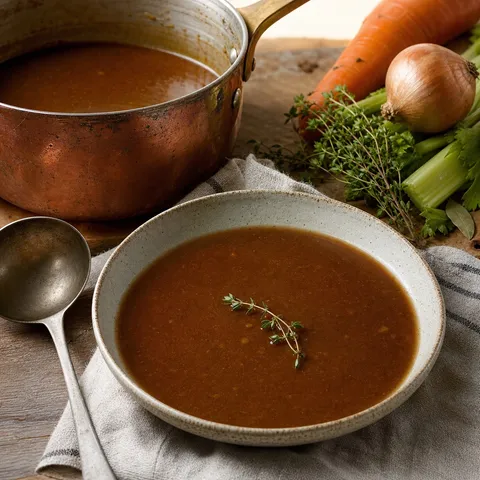 Sauces & Dressings Lens Verified Images are for illustrative purposes only, may be inaccurate, and do not guarantee the presence or absence of specific ingredients.
 Espagnole Sauce
A deep brown mother sauce of dark roux, mirepoix, and beef stock that forms the foundation for demi-glace and rich meat sauces.
 Sauces & Dressings Lens Verified Images are for illustrative purposes only, may be inaccurate, and do not guarantee the presence or absence of specific ingredients.
 Hollandaise Sauce
A silky, buttery emulsion brightened with lemon that crowns eggs Benedict, asparagus, and poached fish in golden luxury.
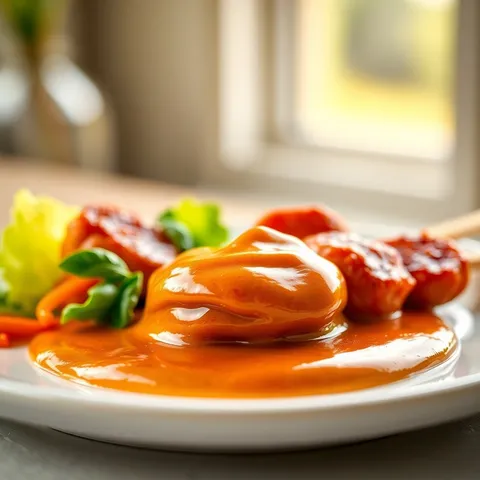 Sauces & Dressings Lens Verified Images are for illustrative purposes only, may be inaccurate, and do not guarantee the presence or absence of specific ingredients.
 Peanut Satay Sauce
A rich, creamy Southeast Asian dipping sauce of peanut butter, coconut milk, and soy with a sweet-spicy lime finish for grilled skewers.