 Bakery Images are for illustrative purposes only, may be inaccurate, and do not guarantee the presence or absence of specific ingredients.
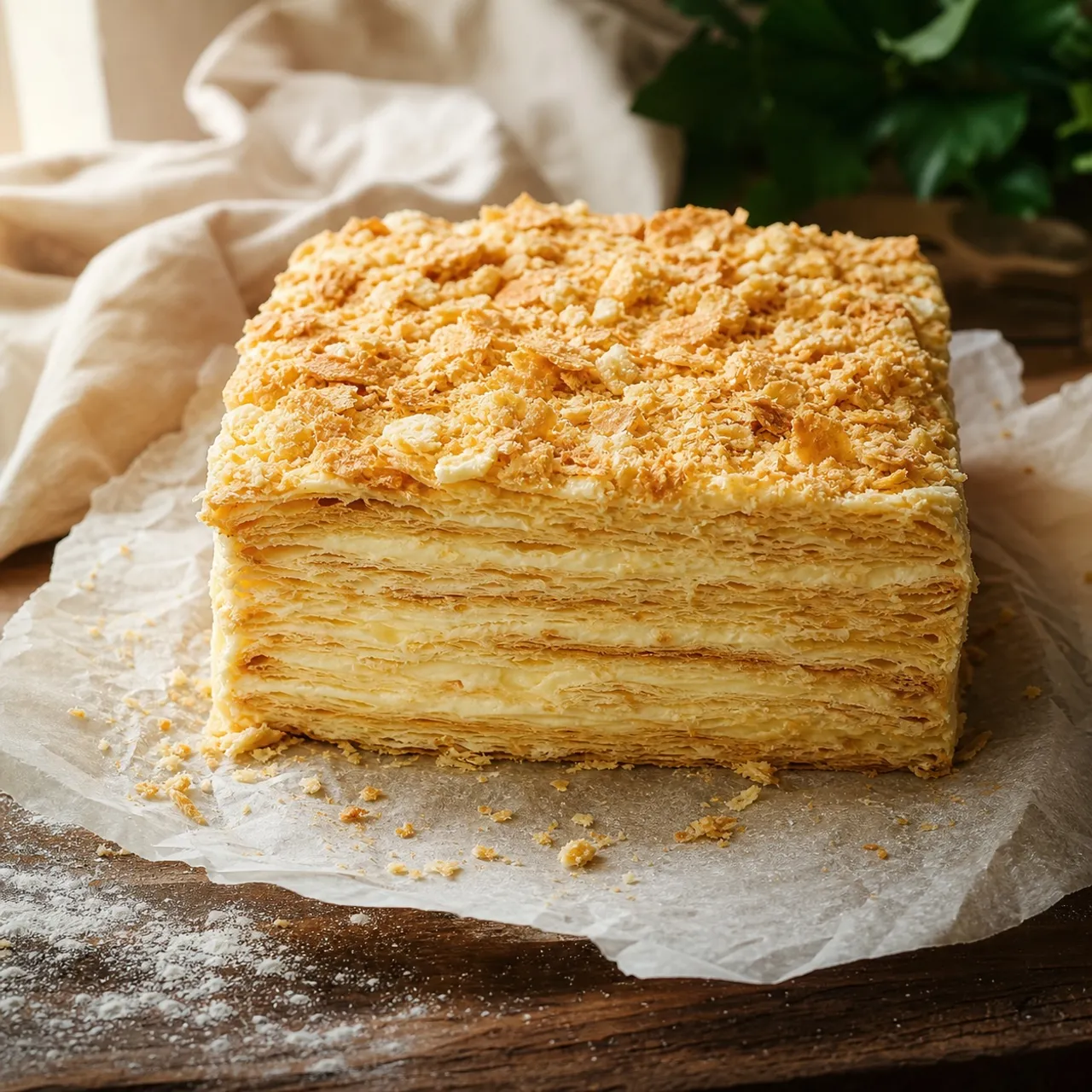
 Napoleon
Crisp layers of golden puff pastry sandwiched with silky vanilla pastry cream and finished with a feathered icing glaze.
Contains common allergens
In the app, Listahan checks these against your household automatically.
Good to know
- Crispy
Matched from this dish's own ingredients and timing. Browse more: crispy recipes
Instructions
6 steps- 1
Preheat the oven to 400°F, roll each puff pastry sheet into a 10x14-inch rectangle on a lightly floured surface, prick all over with a fork, and bake between two parchment-lined sheet pans (weighted with a second pan) for 18 to 20 minutes until deep golden and flat.
- 2
Make the pastry cream by heating the milk just to a simmer, then whisk the egg yolks, granulated sugar, and cornstarch together and slowly stream in the hot milk while whisking constantly to temper the eggs.
- 3
Return the mixture to the saucepan and cook over medium heat, whisking vigorously, for 2 to 3 minutes until thick and bubbling, then remove from heat and stir in the vanilla and butter until smooth.
- 4
Press plastic wrap directly onto the surface of the cream and chill for at least 2 hours, then trim the cooled pastry into three equal rectangles of matching size.
- 5
Spread half the pastry cream over the first layer, top with a second pastry sheet, spread the remaining cream, and finish with the third sheet pressed gently on top.
- 6
Whisk the powdered sugar with 2 to 3 teaspoons water into a smooth glaze, spread it over the top layer, then pipe thin lines of melted chocolate across and drag a toothpick through them to create the signature feathered pattern before slicing with a serrated knife.
Listahan Family Score™
65/100
Works for many families
Score reflects how well this recipe fits a typical busy household. In the app, your Family Score is personalized to your household's allergens, kids, and pantry.
Nutrition
per serving380
Calories
5 g
Protein
66 g
Carbs
11 g
Fat
Estimated per serving. Actual values depend on the brands and portions you use.
Listahan cooking guide
Chef notes & practical guide
Technique notes, ingredient swaps, serve-alongside ideas, storage guidance, and equipment for this recipe.
Cultural context
The Napoleon, known in France as mille-feuille, meaning a thousand leaves, is a classic French patisserie item built from crisp layers of puff pastry and silky pastry cream. Its name refers to the pastry's many thin layers rather than the French emperor, and the feathered chocolate-and-icing top is a signature technique taught in classical pastry training.
Listahan note
This version weights the puff pastry while it bakes, which keeps it flat and evenly crisp rather than puffing unevenly, so the layers stack cleanly at assembly.
Technique cues
- Baking the puff pastry between two parchment-lined sheet pans, weighted with a second pan, forces it to bake flat rather than puffing up unevenly, which is essential for clean, stackable layers.
- Tempering the egg yolks slowly with the hot milk prevents them from scrambling, which is what keeps the pastry cream silky rather than lumpy.
- Chilling the pastry cream with plastic wrap pressed directly onto its surface prevents a skin from forming, which would otherwise show up as lumps once folded into the assembled cake.
Kitchen flow
- Parallel prep
- Make the pastry cream while the puff pastry bakes and cools, so both components are ready around the same time.
- Make-ahead
- Bake the pastry layers and make the pastry cream up to a day ahead, assembling just before serving so the layers stay crisp.
- Leftover move
- Leftover slices are best enjoyed the same day; the pastry softens as it sits in the fridge, though the flavor stays good.
- Cleanup rhythm
- Make the pastry cream in the same saucepan you'll heat the milk in, minimizing dishes across that step.
Ingredient brief
Role, handling, and swap guidance for each key ingredient.
Frozen puff pastry
Layered base
Purpose: Baked flat and crisp, it forms the crunchy layers that alternate with the pastry cream.
Handling: Roll it out to an even thickness and prick all over with a fork so it doesn't puff unevenly.
Adaptation: Store-bought puff pastry works well here; homemade puff pastry is possible but significantly more time-intensive.
Egg yolks
Pastry cream base
Purpose: Whisked with sugar and cornstarch, then tempered with hot milk, they thicken into the rich, custardy pastry cream.
Handling: Whisk thoroughly with the sugar and cornstarch before slowly streaming in the hot milk while whisking constantly.
Adaptation: There isn't a good substitute for egg yolks here; they're central to the pastry cream's richness and set.
Whole milk
Pastry cream liquid
Purpose: Heated and slowly combined with the egg yolk mixture, it becomes the base of the finished custard.
Handling: Heat just to a simmer before tempering into the egg mixture, to avoid scrambling the yolks.
Adaptation: A mix of milk and a small amount of cream makes an even richer pastry cream.
Powdered sugar and melted chocolate
Feathered glaze
Purpose: Piped in thin lines and dragged with a toothpick, the chocolate creates the classic feathered design that identifies a Napoleon at a glance.
Handling: Make the icing glaze smooth first, then pipe chocolate lines across it while both are still workable, dragging a toothpick through immediately.
Adaptation: A simple dusting of powdered sugar without the chocolate feathering is a simpler, still traditional finish.
Technique notes
- Weight the pastry while it bakes; unweighted puff pastry can rise unevenly and won't stack into clean layers.
- Chill the pastry cream fully before assembling; warm cream will soak into the pastry layers and turn them soggy.
- Assemble close to serving time, since the crisp pastry layers soften the longer they sit against the cream.
Ingredient swaps
- Simpler finishing direction
- Skip the feathered chocolate pattern and simply dust the top with powdered sugar for an easier, still elegant finish.
- Fruit addition
- Add a thin layer of fresh berries between the cream layers for a brighter, fruitier variation.
- Individual portions direction
- Cut the pastry into smaller rectangles before assembling for individual Napoleons instead of one large cake.
Serve alongside
- Fresh berries
- Espresso
- A dusting of extra powdered sugar
- Espresso
- Black tea
- Sparkling water
Serving suggestions only — check pairings for your household's allergens.
Storage & reheating
- Refrigerate assembled Napoleon loosely covered for up to 2 days.
- Serve chilled; this pastry is not meant to be reheated.
- The unfilled pastry layers can be frozen for up to a month; the assembled pastry with cream does not freeze well.
Equipment
- Two sheet pans
- Parchment paper
- Saucepan for the pastry cream
- Serrated knife
Make this household-aware
Listahan Pro checks this recipe against your household's allergens, finds pantry-aware swaps, builds the shopping list, and helps you plan the week around it.
Plan it in Listahan
Add Napoleon to your week, check it against your household's allergens, and build the shopping list automatically.
More Bakery recipes
 Bakery Lens Verified Images are for illustrative purposes only, may be inaccurate, and do not guarantee the presence or absence of specific ingredients.
 Scones
Flaky and buttery British baked goods, often with currants or berries.
 Bakery Lens Verified Images are for illustrative purposes only, may be inaccurate, and do not guarantee the presence or absence of specific ingredients.
 French Baguette
Savor the authentic crunch of this rustic French baguette, featuring a beautifully crackling golden crust and a soft, airy, and utterly irresistible crumb.
 Bakery Lens Verified Images are for illustrative purposes only, may be inaccurate, and do not guarantee the presence or absence of specific ingredients.
 Lemon Tart
Brighten your dessert spread with this elegant lemon tart, perfectly balancing a brilliantly zesty, silky-smooth lemon curd inside a crisp and buttery sweet pastry shell.