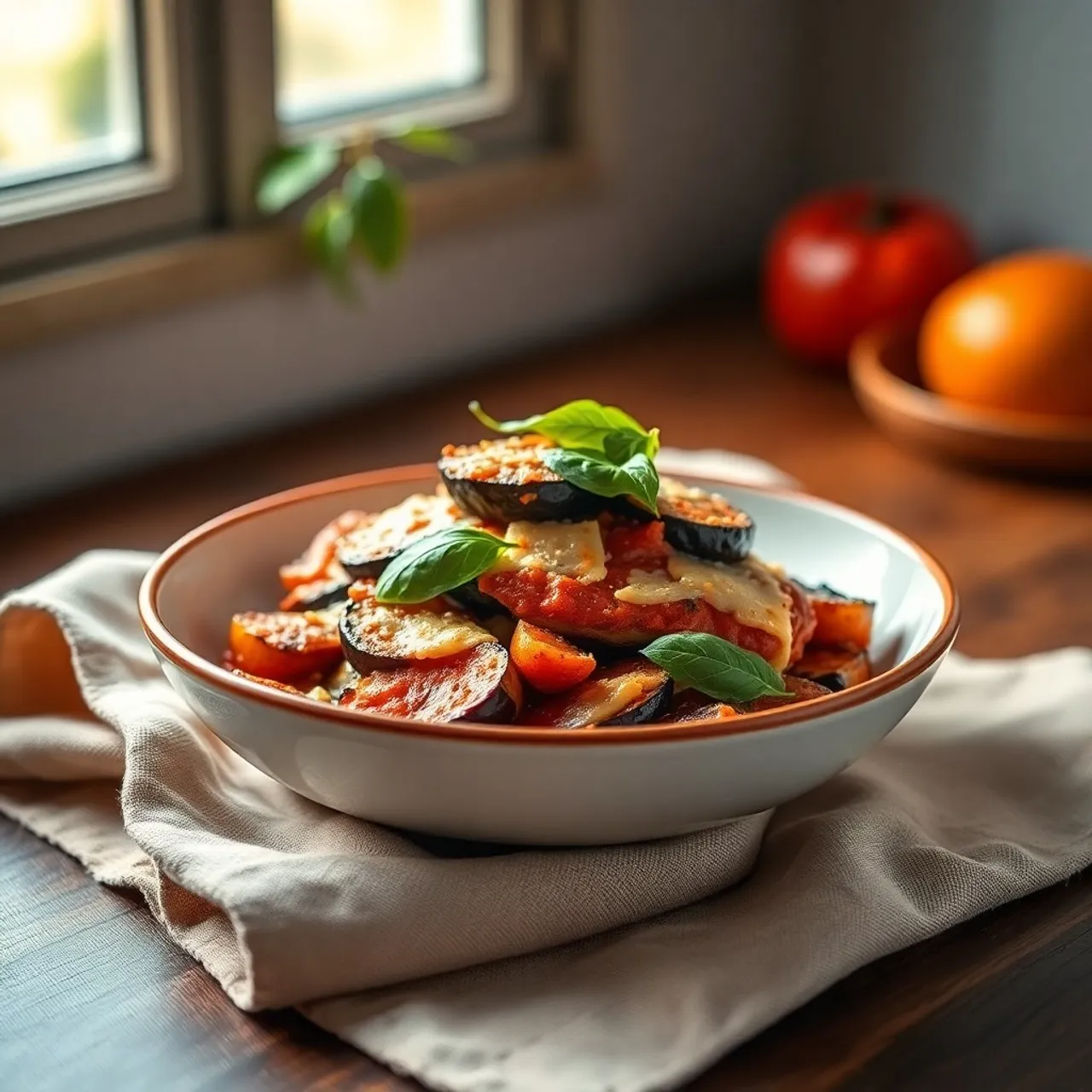
 Italian Images are for illustrative purposes only, may be inaccurate, and do not guarantee the presence or absence of specific ingredients.
 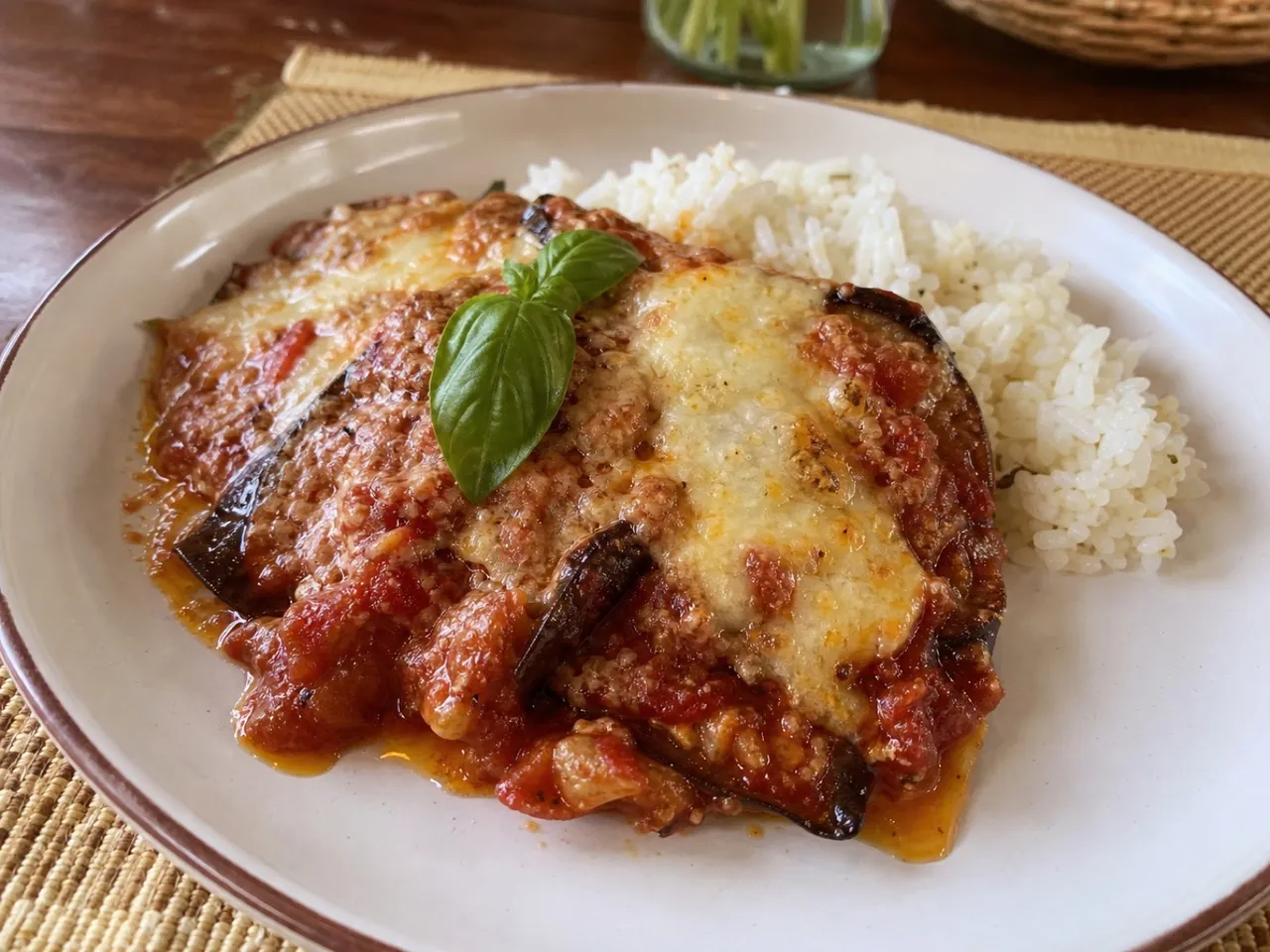 Serving Images are for illustrative purposes only, may be inaccurate, and do not guarantee the presence or absence of specific ingredients.
 Eggplant Parmigiana (Melanzane alla Parmigiana)
Baked layers of sliced, fried eggplant with tomato sauce and cheese.
Contains common allergens
In the app, Listahan checks these against your household automatically.
Instructions
6 steps- 1
Purge the Eggplant: Layer the eggplant slices in a colander, heavily salting each layer. Place a heavy weight on top and let them sit for 45-60 minutes to draw out the bitter liquid. Rinse thoroughly under cold water and pat completely dry with paper towels.
- 2
Fry the Eggplant: In a large skillet, heat 1/2 inch of frying oil to 350°F (175°C). Fry the eggplant slices in batches until deeply golden brown and tender, about 3-4 minutes per side. Drain on paper towels.
- 3
Prepare for Assembly: Preheat your oven to 375°F (190°C). Lightly grease a 9x13 inch baking dish.
- 4
Layering (Base and Middle): Spread a thin layer of marinara sauce in the bottom of the dish. Add a slightly overlapping layer of fried eggplant. Top with a few dollops of marinara sauce, scattered mozzarella slices, a dusting of Parmigiano-Reggiano, and torn basil leaves. Repeat this layering process until all eggplant is used (usually 3 layers).
- 5
Top Layer: Finish the top layer with extra marinara sauce, a generous amount of mozzarella, and a thick coating of Parmigiano-Reggiano to create a crust.
- 6
Bake and Rest: Bake uncovered for 30-35 minutes until the sauce is vigorously bubbling and the cheese on top is beautifully browned and slightly crispy. Let the dish rest at room temperature for at least 20 minutes before slicing so it holds its shape.
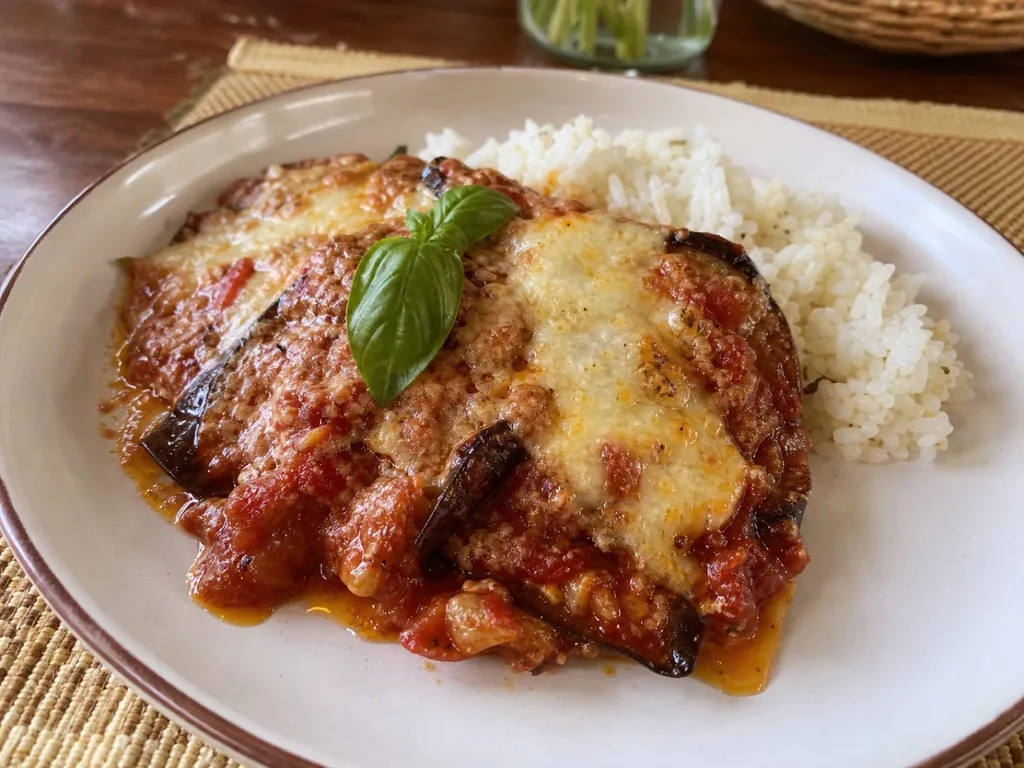 Images are for illustrative purposes only, may be inaccurate, and do not guarantee the presence or absence of specific ingredients.
 Listahan Family Score™
76/100
Good fit for most families
Score reflects how well this recipe fits a typical busy household. In the app, your Family Score is personalized to your household's allergens, kids, and pantry.
Nutrition
per serving395
Calories
25 g
Protein
32 g
Carbs
20 g
Fat
Estimated per serving. Actual values depend on the brands and portions you use.
Listahan cooking guide
Chef notes & practical guide
Technique notes, ingredient swaps, serve-alongside ideas, storage guidance, and equipment for this recipe.
Cultural context
Despite its name, Eggplant Parmigiana is claimed by both Campania (Naples) and Sicily, with credible evidence for southern Italian origins rather than Parma — the name likely derives from the Sicilian word 'parmiciana,' referring to the overlapping slats of a window shutter that the layered eggplant slices resemble. The dish arrived in North America with southern Italian immigrants and became one of the most beloved dishes in Italian-American cooking, where it often features more cheese and a heavier breading than the original. Authentic versions vary considerably: Neapolitan preparations may use fried, unbreaded eggplant, while Sicilian versions sometimes include hard-boiled eggs and salami.
Listahan note
This version fries the eggplant slices rather than baking them before layering, which gives the finished dish a much more satisfying texture — the fried slices hold their shape rather than becoming uniformly soft during the bake.
Technique cues
- Salt the eggplant slices generously and let them sit in a colander for at least 30 minutes to draw out moisture and bitter compounds — this also means the eggplant absorbs significantly less oil when fried.
- Fry the eggplant in small batches in hot oil rather than crowding the pan; overcrowding drops the oil temperature and results in greasy, steamed slices instead of crispy, golden ones.
- Use a sauce that is drier than you would for pasta — the eggplant releases moisture during baking, so an overly wet sauce will leave the dish soupy; a briefly cooked, chunky tomato sauce works better than a long-simmered one here.
Kitchen flow
- Parallel prep
- Salt and drain the eggplant up to an hour ahead while you prepare the tomato sauce; by the time the sauce is done, the eggplant is ready to fry.
- Make-ahead
- Assemble the entire dish up to a day ahead, cover, and refrigerate; bake from cold adding 10 to 15 extra minutes, or allow to come to room temperature first.
- Leftover move
- Leftover Eggplant Parmigiana reheats beautifully in a 350F oven covered with foil for 20 minutes; slice individual portions and reheat in a skillet for a crispier result.
- Cleanup rhythm
- The frying setup is the main cleanup task — use a deep pot to minimize oil splatter and let the oil cool before straining and storing or discarding; the baking dish soaks while you eat.
Ingredient brief
Role, handling, and swap guidance for each key ingredient.
eggplant
main structural ingredient
Purpose: Eggplant provides the dense, meaty layers that give the dish its substantial, satisfying character; it absorbs the surrounding flavors of tomato, cheese, and basil during baking.
Handling: Slice 1/4 to 1/3 inch thick crosswise, salt generously, and let drain for 30 to 60 minutes; rinse and pat very dry before frying.
Adaptation: Zucchini can replace some or all of the eggplant for a lighter, more delicate version.
mozzarella
melting cheese layer
Purpose: Mozzarella provides the stretchy, molten cheese layer that binds the dish together and creates the characteristic pull when cut and served.
Handling: Slice or tear low-moisture mozzarella (preferred over fresh for baked dishes to avoid waterlogging); shred if you want an even melt.
Adaptation: Provolone adds a sharper flavor; fontina gives a more buttery, nutty melt.
Parmigiano-Reggiano
savory crust and seasoning
Purpose: Parmesan adds umami depth throughout the layers and forms a slightly crispy, savory top crust during baking.
Handling: Grate finely and distribute between layers as well as on top for consistent seasoning throughout.
Adaptation: Grana Padano or Pecorino Romano can substitute.
tomato sauce
moisture and acid
Purpose: The sauce provides the liquid medium and acidity that balances the richness of the cheese and fried eggplant.
Handling: Use a fairly dry sauce (passata or briefly cooked crushed tomatoes with garlic and basil); reduce if the sauce is too loose.
Adaptation: A simple crushed-tomato-and-garlic sauce is preferable to a heavily seasoned commercial marinara.
fresh basil
aromatic seasoning between layers
Purpose: Basil layered throughout the dish infuses the tomato and cheese with its fragrance during baking.
Handling: Whole leaves work; the heat of the oven blooms the basil aroma into the surrounding layers.
Adaptation: Dried basil can substitute in the layers if fresh is unavailable, though the aroma is less vibrant.
Technique notes
- Resist the urge to layer the eggplant too thick — no more than 3 to 4 layers in the dish ensures the heat penetrates through to the center and the layers merge properly rather than remaining distinct and separate.
- Let the finished dish rest for at least 10 minutes before cutting — this allows the layers to compress and set so you can serve clean, intact portions rather than a molten collapse.
- The dish is excellent at room temperature, which is actually how it is often served in southern Italy — the flavors deepen and the layers compact into something almost terrine-like.
Ingredient swaps
- Baked direction (lighter)
- Brush eggplant slices with olive oil and roast at 425F on a rack for 20 to 25 minutes instead of frying; the result is less rich but significantly lighter and easier.
- Dairy-free option
- Use a good-quality dairy-free mozzarella and skip the Parmesan or use nutritional yeast; the dish holds together well since the eggplant provides its own structure.
- Gluten-free direction
- Omit the breadcrumb coating entirely (many traditional Italian versions do not use breadcrumbs) — the unbreaded eggplant layers actually hold up extremely well.
Serve alongside
- Crusty Italian bread for scooping up sauce
- Simple green salad with lemon dressing
- Spaghetti al pomodoro as a primo before serving parmigiana as a secondo
- Nero d'Avola (Sicilian red that mirrors the dish's southern heritage)
- Chianti (the classic Italian red for tomato-based dishes)
Serving suggestions only — check pairings for your household's allergens.
Storage & reheating
- Store covered in the refrigerator for up to 4 days; this dish actually improves after a day as the layers meld.
- Freeze individual slices wrapped in plastic wrap and foil for up to 2 months; thaw overnight and reheat covered in a 350F oven.
Equipment
- Deep heavy-bottomed pot or cast-iron skillet for frying eggplant with minimal splatter
- 9x13 inch baking dish for a standard 4-serving assembly
- Wire rack and sheet pan for draining fried eggplant slices without becoming soggy
Make this household-aware
Listahan Pro checks this recipe against your household's allergens, finds pantry-aware swaps, builds the shopping list, and helps you plan the week around it.
Plan it in Listahan
Add Eggplant Parmigiana (Melanzane alla Parmigiana) to your week, check it against your household's allergens, and build the shopping list automatically.
More Italian recipes
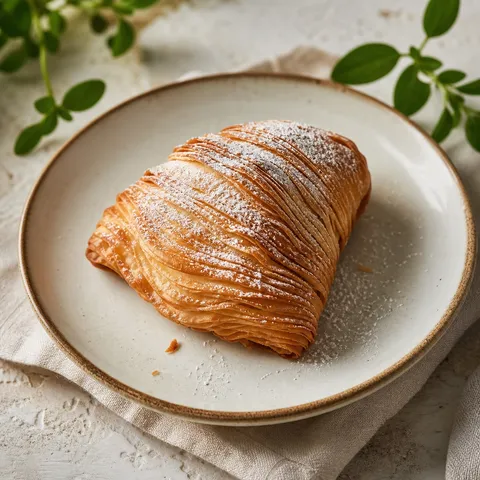 Italian Lens Verified Images are for illustrative purposes only, may be inaccurate, and do not guarantee the presence or absence of specific ingredients.
 Sfogliatella
Naples' iconic shell-shaped pastry with crisp, flaky layers wrapped around a sweet ricotta-semolina filling.
 Italian Lens Verified Images are for illustrative purposes only, may be inaccurate, and do not guarantee the presence or absence of specific ingredients.
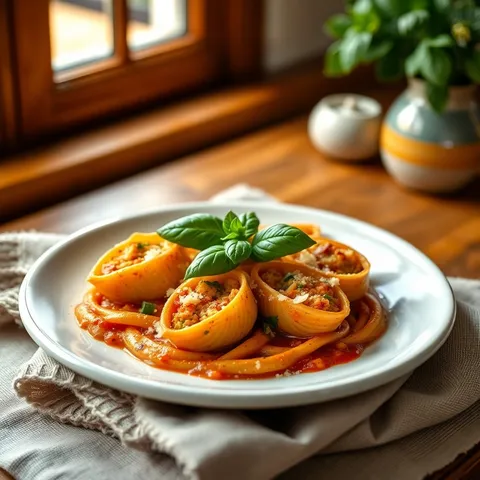
 Stuffed Shells (Conchiglioni Ripieni)
Jumbo pasta shells filled with a creamy ricotta-spinach mixture and baked in tomato sauce.
 Italian Lens Verified Images are for illustrative purposes only, may be inaccurate, and do not guarantee the presence or absence of specific ingredients.
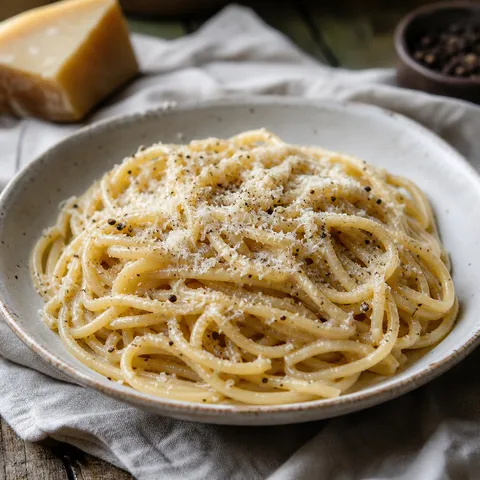
 Cacio e Pepe
A minimalist Roman pasta dish literally meaning "cheese and pepper."