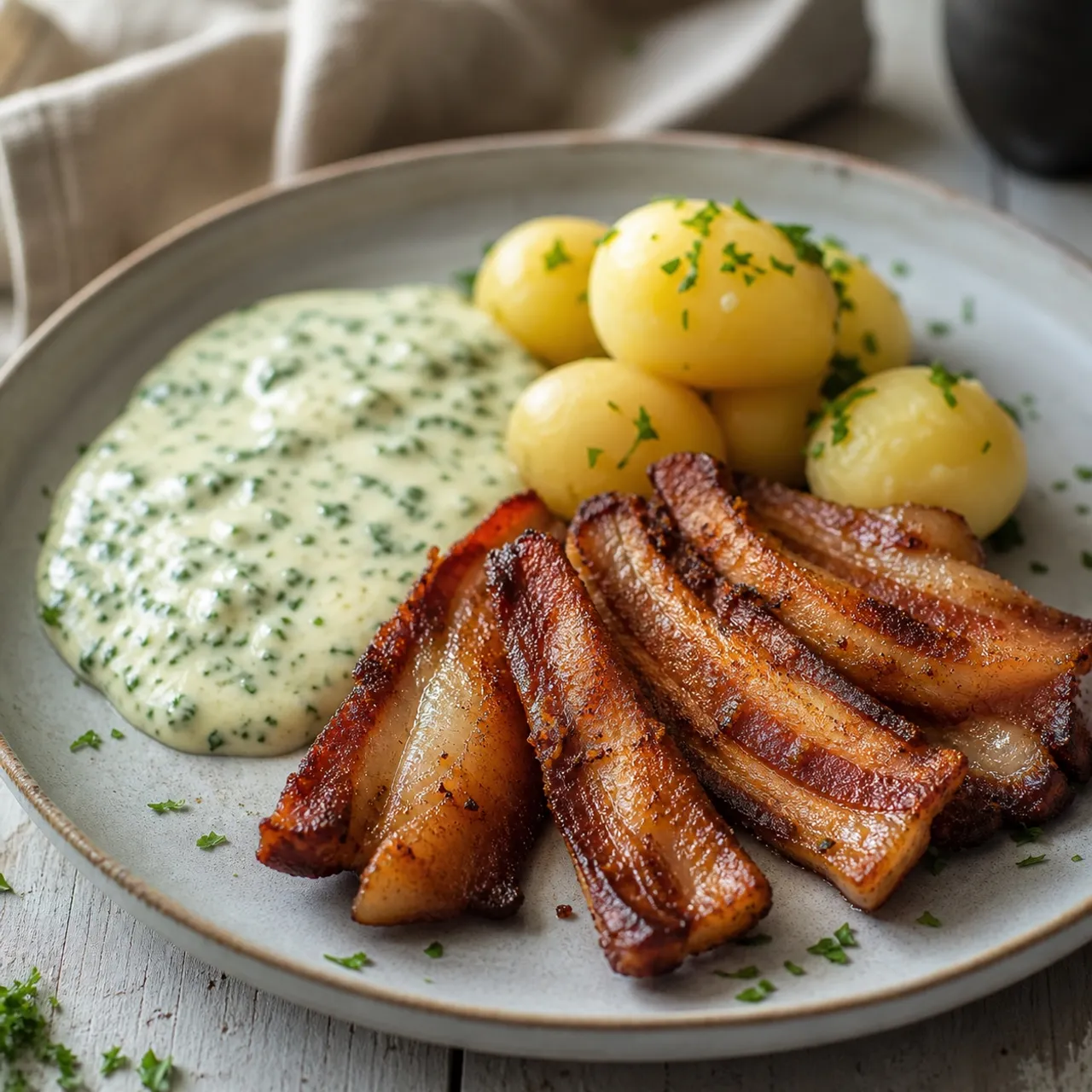
 Nordic Images are for illustrative purposes only, may be inaccurate, and do not guarantee the presence or absence of specific ingredients.
 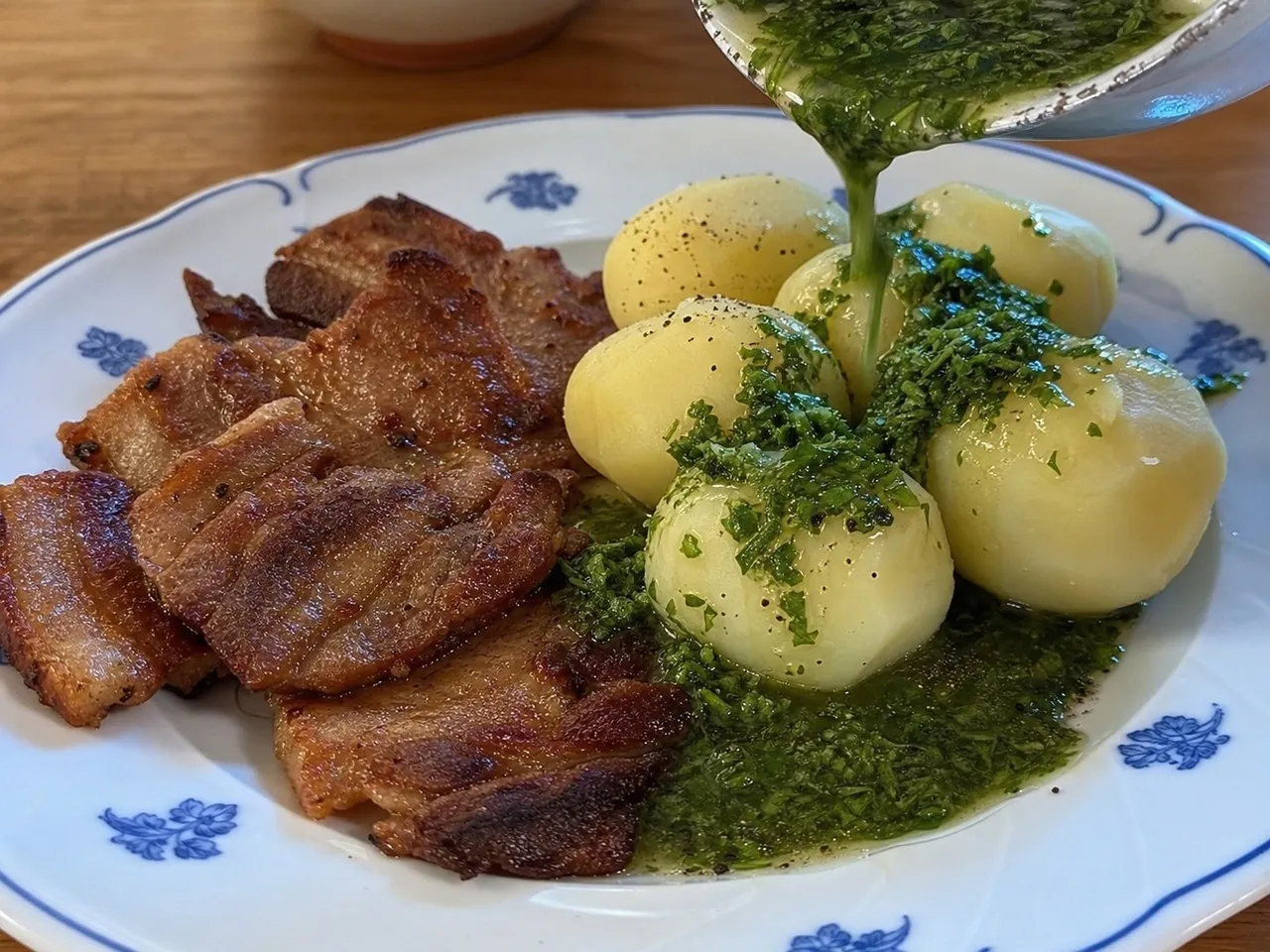 Serving Images are for illustrative purposes only, may be inaccurate, and do not guarantee the presence or absence of specific ingredients.
 Stegt Flæsk
Denmark's national dish — thick strips of pork belly fried until irresistibly crispy and golden, served alongside creamy parsley sauce and boiled potatoes.
Contains common allergens
In the app, Listahan checks these against your household automatically.
Good to know
- Crispy
Matched from this dish's own ingredients and timing. Browse more: crispy recipes
Instructions
6 steps- 1
Preheat the oven to 400°F (200°C). Lay the pork belly slices on a wire rack set over a rimmed baking sheet. Season generously with sea salt.
- 2
Roast the pork in the oven for 25-30 minutes, turning once, until deeply golden brown and extremely crispy. Alternatively, pan-fry them in batches in a dry cast-iron skillet.
- 3
While the pork cooks, boil the peeled potatoes in heavily salted water until tender (about 15-20 minutes). Drain and keep warm.
- 4
To make the sauce, melt the butter in a medium saucepan over medium heat. Whisk in the flour and cook for 1 minute to form a roux.
- 5
Gradually whisk in the whole milk. Bring to a gentle simmer, whisking constantly, until the sauce becomes thick and velvety (about 5-7 minutes). Season with salt and white pepper.
- 6
Remove the sauce from the heat and stir in the massive handful of chopped parsley just before serving to keep it bright green. Serve the crispy pork and potatoes smothered in the sauce.
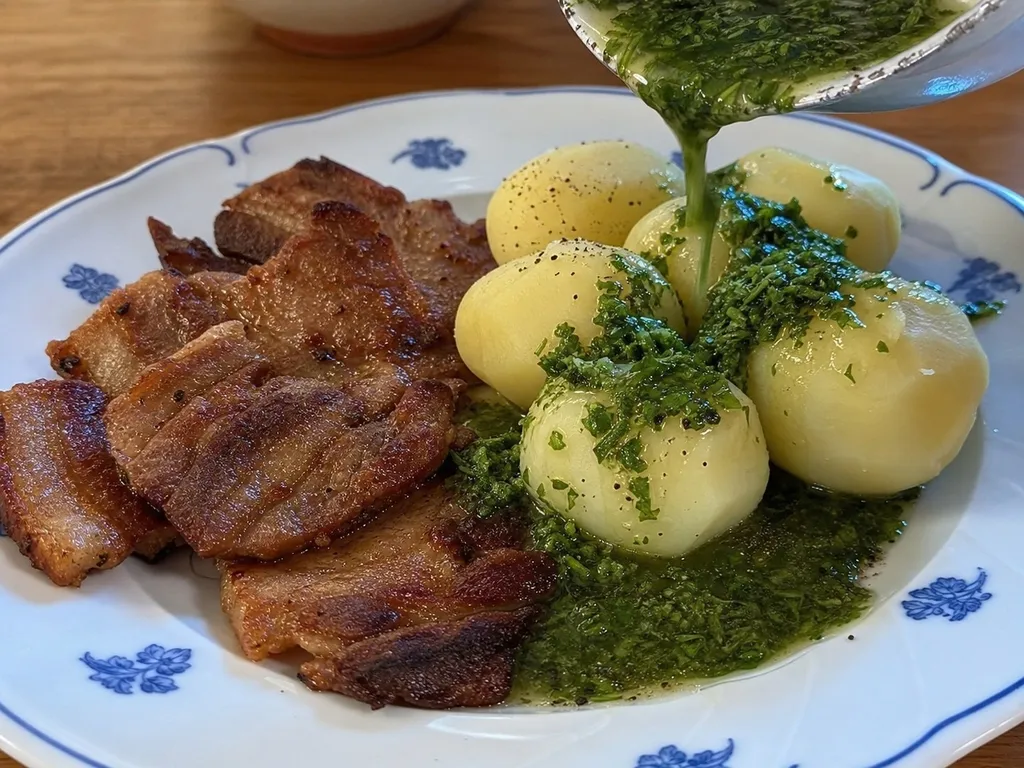 Images are for illustrative purposes only, may be inaccurate, and do not guarantee the presence or absence of specific ingredients.
 Listahan Family Score™
70/100
Good fit for most families
Score reflects how well this recipe fits a typical busy household. In the app, your Family Score is personalized to your household's allergens, kids, and pantry.
Nutrition
per serving370
Calories
28 g
Protein
23 g
Carbs
18 g
Fat
Estimated per serving. Actual values depend on the brands and portions you use.
Listahan cooking guide
Chef notes & practical guide
Technique notes, ingredient swaps, serve-alongside ideas, storage guidance, and equipment for this recipe.
Cultural context
Stegt flæsk med persillesauce — fried pork belly with parsley sauce — was voted Denmark's national dish by the Danish public in 2014, beating out rye bread and the open-faced sandwich. The dish is ancient in concept: fried salted pork has been a staple of Danish farm kitchens for centuries, eaten with boiled potatoes and whatever sauce the season offered. The parsley sauce, a simple flour-thickened milk sauce loaded with fresh parsley, is the element that elevates the dish from simple fried pork to a complete Danish home meal. It remains a staple of Danish school cafeterias and home kitchens.
Listahan note
This version cooks the pork slices in a dry oven rather than a pan to render the fat gradually and produce a uniformly crispy rind without charring — the oven method requires less attention than stovetop frying and produces more consistent results across a large batch.
Technique cues
- The pork slices must be thin (about 6-7mm) and cut across the grain of the belly; too thick and the fat does not render fully before the meat overcooks, leaving rubbery rather than crispy edges.
- The parsley sauce begins as a classic Danish white sauce (smorsauce) — a butter-and-flour roux cooked until sandy-smelling before the milk is added — and the parsley must be stirred in at the very end, off the heat, to preserve its bright green color and fresh flavor.
- Boil the potatoes in well-salted water and do not rinse after draining; the surface starch absorbs the parsley sauce more readily and the potatoes stay hotter longer when not rinsed.
Kitchen flow
- Parallel prep
- Start the potatoes boiling and make the parsley sauce base while the pork is in the oven; all three components finish within 5 minutes of each other.
- Make-ahead
- The parsley sauce can be made up to 1 hour ahead and kept warm in a bain-marie (bowl over a pot of hot water) covered with a lid; stir before serving and add a splash of milk if it has thickened too much.
- Leftover move
- Leftover fried pork slices reheat excellently in an air fryer at 180°C for 5 minutes, restoring the crispness lost in the refrigerator; the parsley sauce reheats gently on the stovetop with a splash of milk.
- Cleanup rhythm
- Deglaze the parsley sauce pan immediately with water while still warm — the flour-based sauce dissolves in seconds; the pork tray soaks in hot water for 10 minutes to release the rendered fat.
Ingredient brief
Role, handling, and swap guidance for each key ingredient.
800g (1.7 lbs) pork belly, cut into 1/4-inch thick slices
primary protein, fat source, and textural focus
Purpose: Pork belly contains the layered fat-to-meat ratio that renders into crispy, golden slices when cooked at the right temperature — this layering is the defining visual and textural element of stegt flæsk.
Handling: Pat slices dry before cooking and score through the rind at 1cm intervals to prevent curling and allow fat to render from the edges.
Adaptation: Thick-cut unsalted bacon (not smoked) is the most accessible North American substitute; adjust salt in the parsley sauce accordingly.
3 tbsp all-purpose flour
roux base for the parsley sauce
Purpose: Flour cooked in butter forms the thickening base that gives the parsley sauce its characteristic body — without it, the sauce would be a thin, broken milk.
Handling: Cook the butter and flour together for at least 2 minutes, stirring constantly, until the mixture smells biscuit-like rather than raw — undercooked roux gives the sauce a starchy, floury taste.
Adaptation: Cornstarch (1.5 tablespoons) whisked into cold milk can replace the flour roux for a gluten-free version, though the texture will be slightly less silky.
400ml (1.75 cups) whole milk
sauce liquid and body
Purpose: Whole milk provides the fat content needed for the sauce to coat the back of a spoon — low-fat milk produces a watery, less coating sauce.
Handling: Add the milk warm (not cold) to the roux in a thin, steady stream while whisking constantly; cold milk causes lumps that require vigorous beating to smooth out.
Adaptation: A 50/50 blend of whole milk and light cream produces a richer sauce that is closer to the restaurant version.
1 large bunch of fresh curly parsley, very finely chopped
primary flavoring of the sauce
Purpose: Curly parsley is the traditional choice over flat-leaf — its slightly more robust, less peppery flavor holds up in the cooked sauce without becoming bitter.
Handling: Chop as fine as possible so the parsley distributes through the sauce evenly without large wet clumps; add off the heat to preserve its color.
Adaptation: Flat-leaf parsley can substitute but the sauce will have a more assertive, slightly more bitter flavor.
Technique notes
- Cook the pork on a wire rack over a baking tray rather than directly on the tray — the rack allows hot air to circulate under the slices, rendering the bottom fat as efficiently as the top.
- The parsley sauce must be seasoned aggressively with white pepper — it should taste slightly over-seasoned on its own because the unseasoned pork and plain potatoes will balance it on the plate.
- Serve the three components separately at the table so guests can assemble each bite; pouring the sauce over the pork in the kitchen softens the crispy crust before it reaches the table.
Ingredient swaps
- Gluten-free direction
- Thicken the parsley sauce with 1.5 tablespoons of cornstarch whisked into cold milk instead of a flour roux; the sauce will be slightly glossier but equally thick.
- Dairy-free option
- Use unsweetened oat milk for the parsley sauce and cook it slightly longer to allow the natural oat starch to thicken — the result is slightly thinner but still herb-forward and coating.
Serve alongside
- small waxy boiled potatoes with butter and sea salt
- quick-pickled red cabbage with vinegar and caraway seeds
- rye bread for mopping up the parsley sauce
- cold Danish pilsner, the canonical pairing
- cold buttermilk (kærnemælk) — the traditional Danish working-lunch drink
- aquavit for a festive serving
Serving suggestions only — check pairings for your household's allergens.
Storage & reheating
- Refrigerate pork slices and parsley sauce separately for up to 3 days; the pork loses its crispness when stored but refries well.
- Reheat pork slices in an air fryer or under a broiler to restore crispness; reheat sauce gently on the stovetop, stirring in a splash of milk.
- The parsley sauce does not freeze well — it separates on thawing; make it fresh in under 10 minutes when needed.
Equipment
- wire rack and rimmed baking tray for oven-roasting the pork
- medium saucepan for the parsley sauce
- separate pot for boiling potatoes
- whisk for the sauce
Make this household-aware
Listahan Pro checks this recipe against your household's allergens, finds pantry-aware swaps, builds the shopping list, and helps you plan the week around it.
Plan it in Listahan
Add Stegt Flæsk to your week, check it against your household's allergens, and build the shopping list automatically.
More Nordic recipes
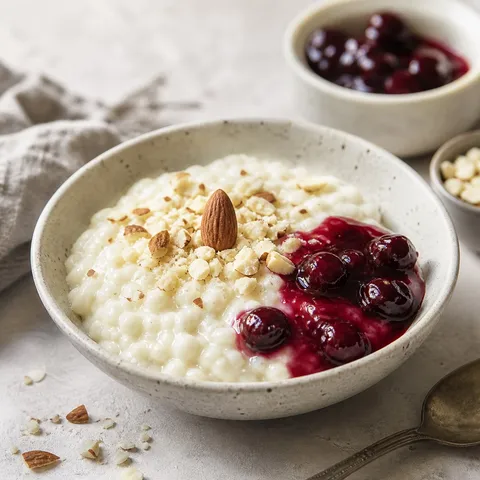 Nordic Lens Verified Images are for illustrative purposes only, may be inaccurate, and do not guarantee the presence or absence of specific ingredients.
 Risalamande
A creamy Danish cold rice pudding folded with whipped cream and chopped almonds, served with a glossy warm cherry sauce on Christmas Eve.
 Nordic Lens Verified Images are for illustrative purposes only, may be inaccurate, and do not guarantee the presence or absence of specific ingredients.
 Risgrynsgröt
Creamy Nordic rice porridge, slow-cooked until thick and comforting, scented with cinnamon and served with a pat of melting butter — Christmas morning in a bowl.
 Nordic Lens Verified Images are for illustrative purposes only, may be inaccurate, and do not guarantee the presence or absence of specific ingredients.
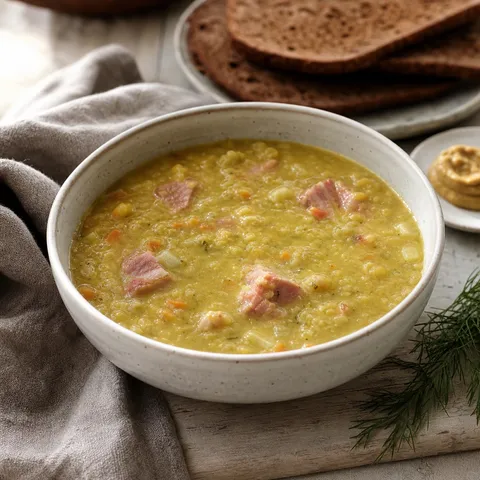
 Hernekeitto
Finland's beloved Thursday pea soup — yellow split peas simmered with smoky ham until thick and hearty, traditionally served with a shot of Finnish mustard and pancakes.