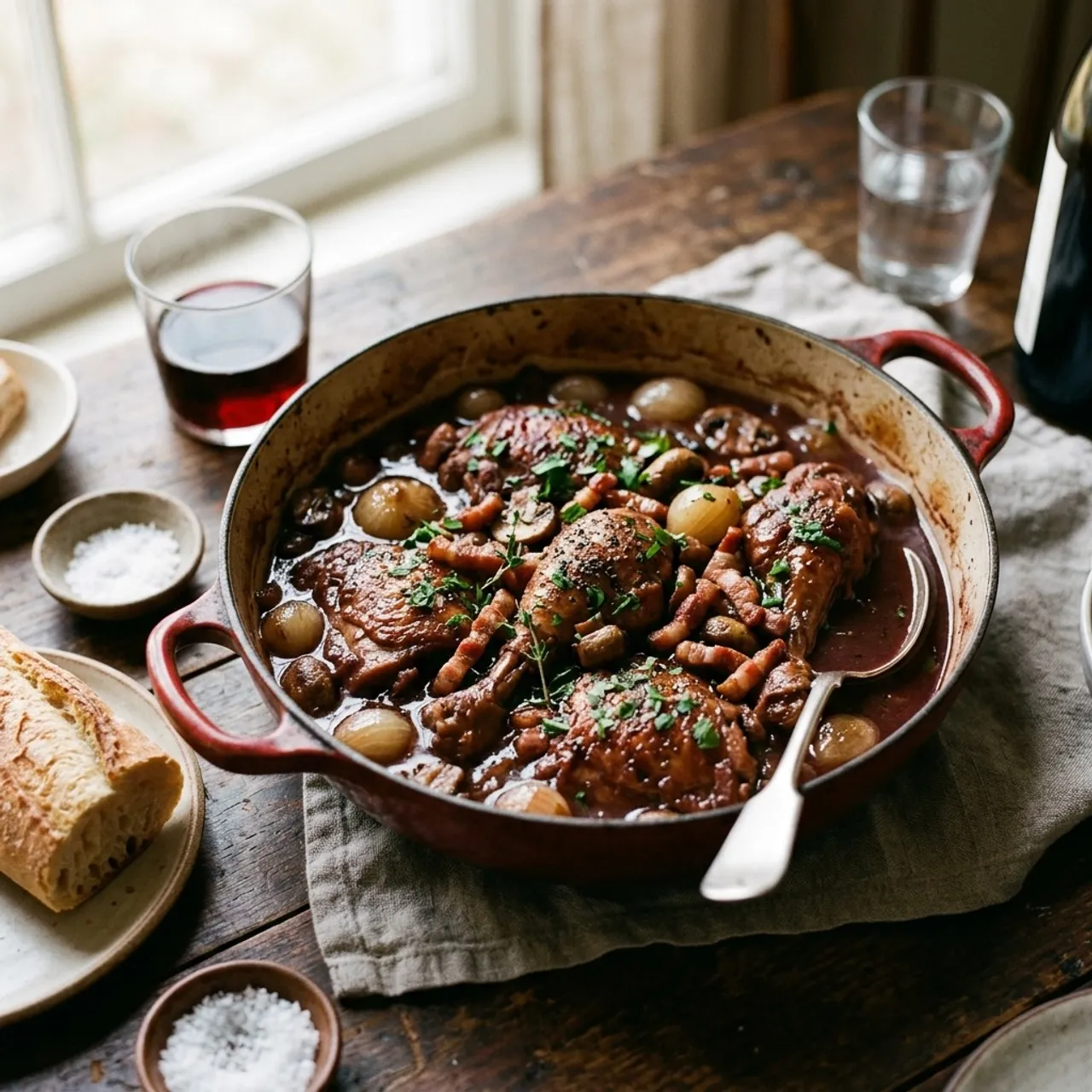
 French Images are for illustrative purposes only, may be inaccurate, and do not guarantee the presence or absence of specific ingredients.
 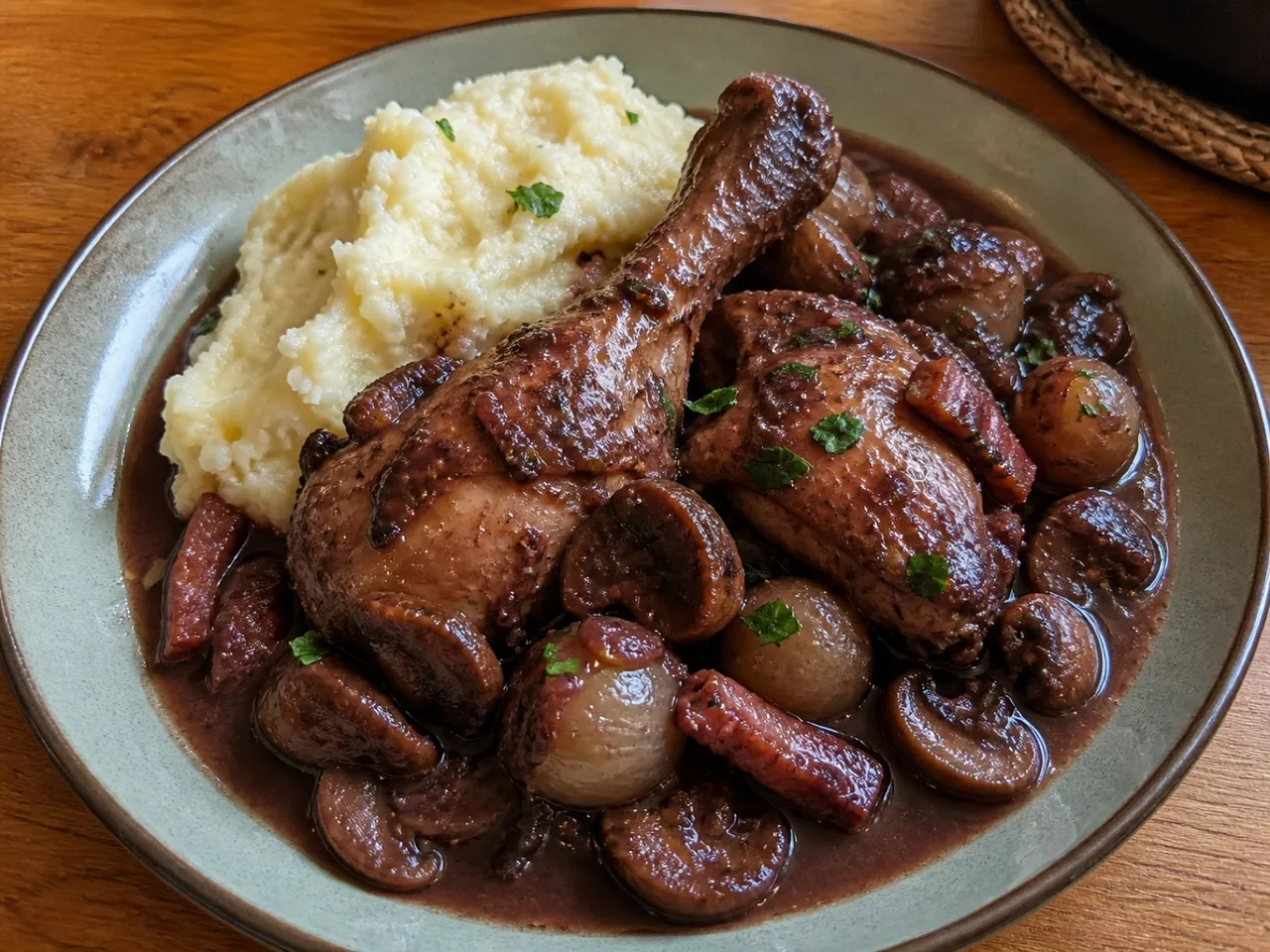 Serving Images are for illustrative purposes only, may be inaccurate, and do not guarantee the presence or absence of specific ingredients.
 Coq au Vin
Chicken braised low and slow in red wine with smoky lardons, mushrooms, and pearl onions until impossibly tender and deeply fragrant.
No common allergens detected
Based on this recipe's ingredient list. Always verify with your own brands and labels.
Good to know
- One-pot
Matched from this dish's own ingredients and timing. Browse more: one-pot dinners
Instructions
5 steps- 1
In a large heavy pot, fry the bacon lardons over medium heat until crispy. Remove them with a slotted spoon and set aside, leaving the fat in the pot.
- 2
Season the chicken pieces generously with salt and pepper. Sear them in the bacon fat until golden brown on all sides (about 8 minutes per batch). Remove and set aside.
- 3
Sauté the pearl onions, carrots, and mushrooms in the same pot until softened and slightly browned. Add minced garlic and cook for 1 minute until fragrant.
- 4
Return the chicken and bacon to the pot. Pour in the red wine and bring to a simmer. Add the bouquet garni, cover, and reduce the heat to low.
- 5
Braise gently for 1.5 to 2 hours, until the chicken is tender and falling off the bone. Skim any excess fat from the surface and serve hot.
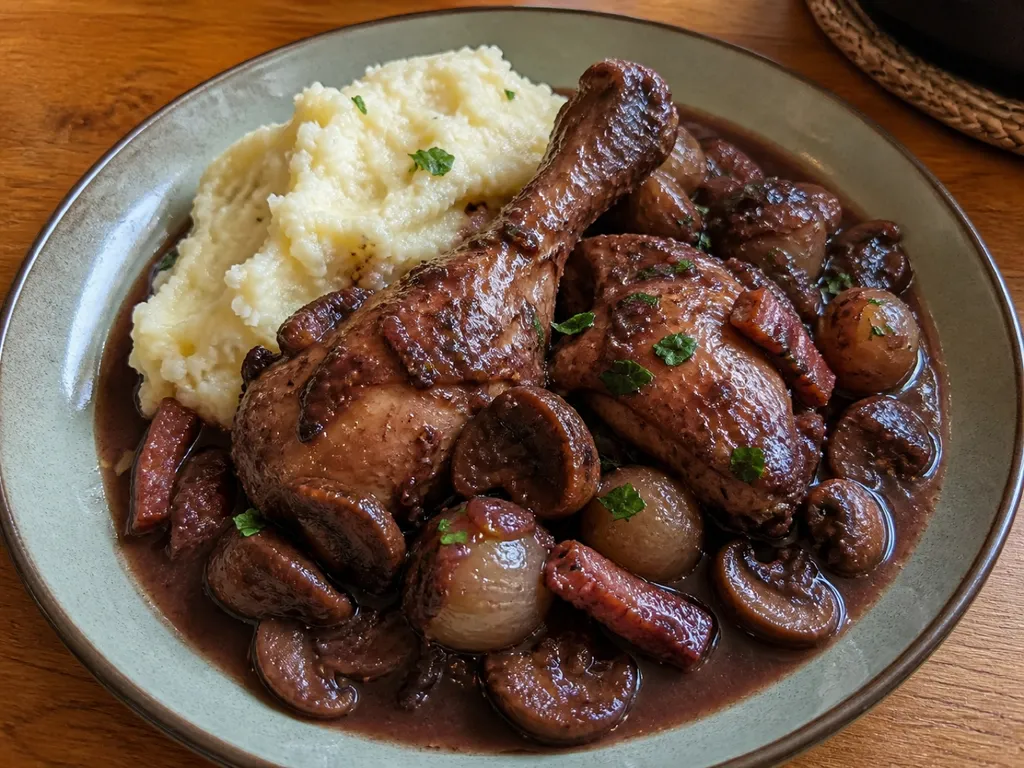 Images are for illustrative purposes only, may be inaccurate, and do not guarantee the presence or absence of specific ingredients.
 Listahan Family Score™
72/100
Good fit for most families
Score reflects how well this recipe fits a typical busy household. In the app, your Family Score is personalized to your household's allergens, kids, and pantry.
Nutrition
per serving1485
Calories
98 g
Protein
58 g
Carbs
97 g
Fat
Estimated per serving. Actual values depend on the brands and portions you use.
Listahan cooking guide
Chef notes & practical guide
Technique notes, ingredient swaps, serve-alongside ideas, storage guidance, and equipment for this recipe.
Cultural context
Coq au Vin translates literally to 'rooster in wine,' and for most of French culinary history that is exactly what it was: a tough old bird made tender through a long braise in the farmhouse wine that was always on hand. The dish rose to prominence in the Burgundy region, where local Pinot Noir was the obvious braising liquid, though versions exist across nearly every wine-producing region of France. Julia Child introduced it to North American home cooks in the 1960s, and it became the dish that proved French cooking was approachable without being simple.
Listahan note
This version focuses on a deep, glossy sauce built from patient browning and a good-quality dry red wine rather than expensive Burgundy — the goal is honest weeknight luxury without theater.
Technique cues
- Brown the chicken pieces in batches on medium-high heat and resist moving them; you need real color on the skin or the finished sauce will taste thin and pale.
- Add the wine to the pan before the stock, let it bubble hard for two minutes to drive off sharpness, then lower the heat so the braise stays at a lazy simmer rather than a full boil.
- Stir in a tablespoon of tomato paste with the aromatics early on — it deepens the color and adds a quiet savory backbone without tasting like tomatoes.
Kitchen flow
- Parallel prep
- While the chicken browns in batches, prep the pearl onions, slice the mushrooms, and measure the wine and stock so the braise comes together without gaps.
- Make-ahead
- Coq au Vin tastes better the next day; make it up to 2 days ahead, refrigerate, and reheat gently on the stovetop over medium-low heat.
- Leftover move
- Shred any remaining chicken off the bone and toss with the sauce over egg noodles or polenta for a quick second-night dinner.
- Cleanup rhythm
- Use a single wide Dutch oven for everything — browning, braising, and serving — to keep pots to a minimum.
Ingredient brief
Role, handling, and swap guidance for each key ingredient.
bone-in chicken pieces
braise anchor
Purpose: Bone-in cuts release collagen as they cook, giving the sauce body and the meat staying power that boneless pieces cannot match.
Handling: Pat completely dry before seasoning so the skin browns rather than steams in the pan.
Adaptation: Bone-in thighs alone work beautifully and are more forgiving than breast pieces, which can dry out during a long braise.
dry red wine
braising liquid and flavor base
Purpose: The wine's acidity tenderizes the meat while its tannins provide structure and depth that stock alone cannot deliver.
Handling: Use a wine you would actually drink — something drinkable but not precious; a Cotes du Rhone or a California Pinot Noir both work.
Adaptation: For an alcohol-free version, substitute unsweetened grape juice plus an extra tablespoon of red wine vinegar to replicate the acidity.
lardons or thick-cut bacon
fat and smoky depth
Purpose: Rendered bacon fat is the first flavor layer in the pot and the lardons themselves become little pockets of savory richness in the finished dish.
Handling: Cut into 1-inch batons and render slowly over medium heat until golden but not hard.
Adaptation: Pancetta brings a milder, less smoky flavor and is a good substitute if you want something closer to the French original.
pearl onions
sweet aromatic
Purpose: Pearl onions braise into tender, slightly sweet globes that balance the wine's acidity and add visual interest to the finished dish.
Handling: Blanch in boiling water for 60 seconds, then slip the skins off; frozen pearl onions eliminate this step entirely.
Adaptation: Quartered shallots caramelize faster and provide a similar sweetness with less prep time.
cremini or button mushrooms
earthy body
Purpose: Mushrooms absorb the braising liquid as they cook, concentrating flavor and adding a meaty texture that balances the sauce.
Handling: Saute in butter separately until golden and add them in the last 20 minutes so they stay firm rather than going soft.
Adaptation: Shiitake mushrooms add a deeper, more pronounced earthiness and work well if creminis are unavailable.
fresh thyme and bay leaf
herbal backbone
Purpose: Thyme and bay are the aromatic spine of most French braises, providing a woody, slightly floral note that holds up through long cooking.
Handling: Tie thyme sprigs and bay leaves into a bouquet garni with kitchen twine for easy removal before serving.
Adaptation: Dried thyme works at one-third the volume; discard both thyme and bay before serving regardless.
Technique notes
- Finish the sauce without the chicken: remove the cooked pieces, crank the heat, and reduce the braising liquid by a third until it coats a spoon, then return the chicken to reheat gently — this is the step that separates a restaurant-quality sauce from a murky stew.
- A tablespoon of cold butter whisked in off-heat right before serving gives the sauce a glossy sheen and rounds the edges without adding visible fat.
- If the sauce tastes too acidic at the end, a pinch of sugar or a small knob of butter will balance it faster than more cooking time.
Ingredient swaps
- Gluten-free direction
- Replace any flour-based thickening with a beurre manie made from equal parts softened butter and cornstarch stirred in at the end; check your stock labels for hidden wheat.
- Lower-sodium direction
- Use homemade or unsalted stock and taste before adding any salt at the end — the reduction concentrates whatever sodium is already in the pot.
- Weeknight shortcut
- Skip the pearl onions and use a quartered yellow onion instead; the flavor is nearly identical and saves 10 minutes of blanching and peeling.
- Alcohol-free direction
- Substitute 1.5 cups unsweetened purple grape juice plus 2 tablespoons red wine vinegar and proceed exactly as written.
Serve alongside
- Buttered egg noodles
- Crusty French baguette
- Steamed green beans with lemon
- Burgundy Pinot Noir
- Sparkling water with a twist of orange
Serving suggestions only — check pairings for your household's allergens.
Storage & reheating
- Store cooled leftovers in an airtight container in the refrigerator for up to 3 days; the flavors deepen overnight.
- Reheat gently in a covered pot over medium-low heat, adding a splash of stock if the sauce has thickened too much; freeze for up to 2 months in sealed freezer bags.
Equipment
- 5- to 6-quart Dutch oven or heavy braising pot
- Tongs for turning chicken without piercing the skin
- Fine-mesh strainer if you want a cleaner sauce
Make this household-aware
Listahan Pro checks this recipe against your household's allergens, finds pantry-aware swaps, builds the shopping list, and helps you plan the week around it.
Plan it in Listahan
Add Coq au Vin to your week, check it against your household's allergens, and build the shopping list automatically.
More French recipes
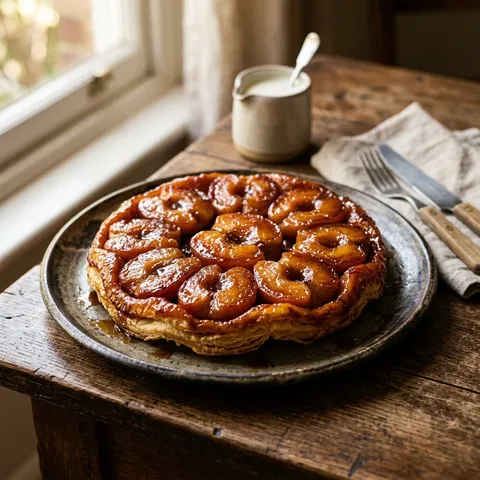 French Lens Verified Images are for illustrative purposes only, may be inaccurate, and do not guarantee the presence or absence of specific ingredients.
 Tarte Tatin
Apples cooked in caramel until jammy and burnished, then flipped onto buttery pastry — a rustic upside-down tart from the Loire Valley.
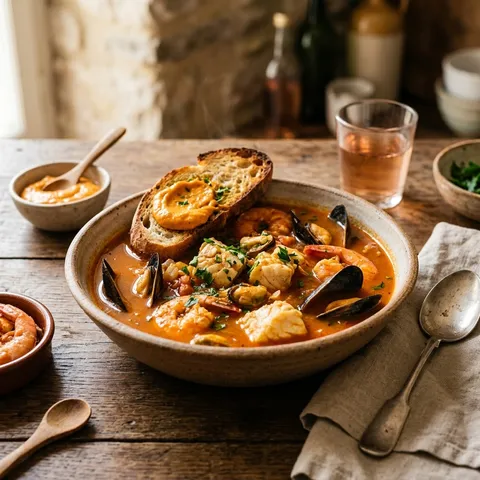 French Lens Verified Images are for illustrative purposes only, may be inaccurate, and do not guarantee the presence or absence of specific ingredients.
 Bouillabaisse
Marseille's legendary saffron-scented fisherman's stew, brimming with fresh seafood and served with garlicky rouille on toasted baguette.
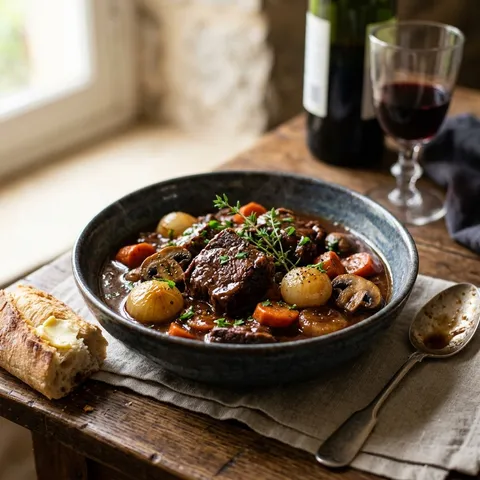 French Lens Verified Images are for illustrative purposes only, may be inaccurate, and do not guarantee the presence or absence of specific ingredients.
 Bœuf Bourguignon
Burgundy's legendary beef stew — rich, wine-dark, and fall-apart tender after hours of slow braising with carrots, mushrooms, and thyme.