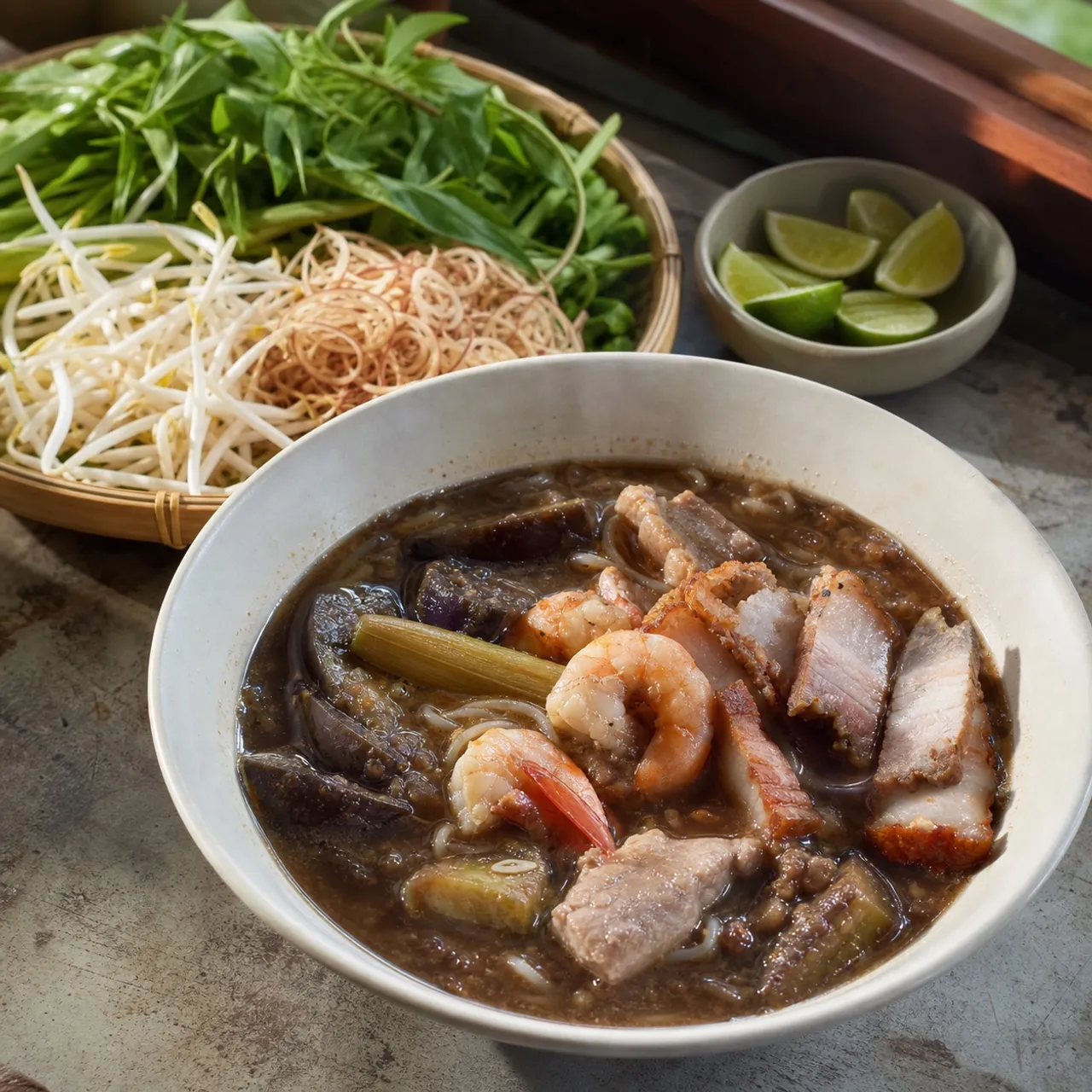
 Vietnamese Images are for illustrative purposes only, may be inaccurate, and do not guarantee the presence or absence of specific ingredients.
 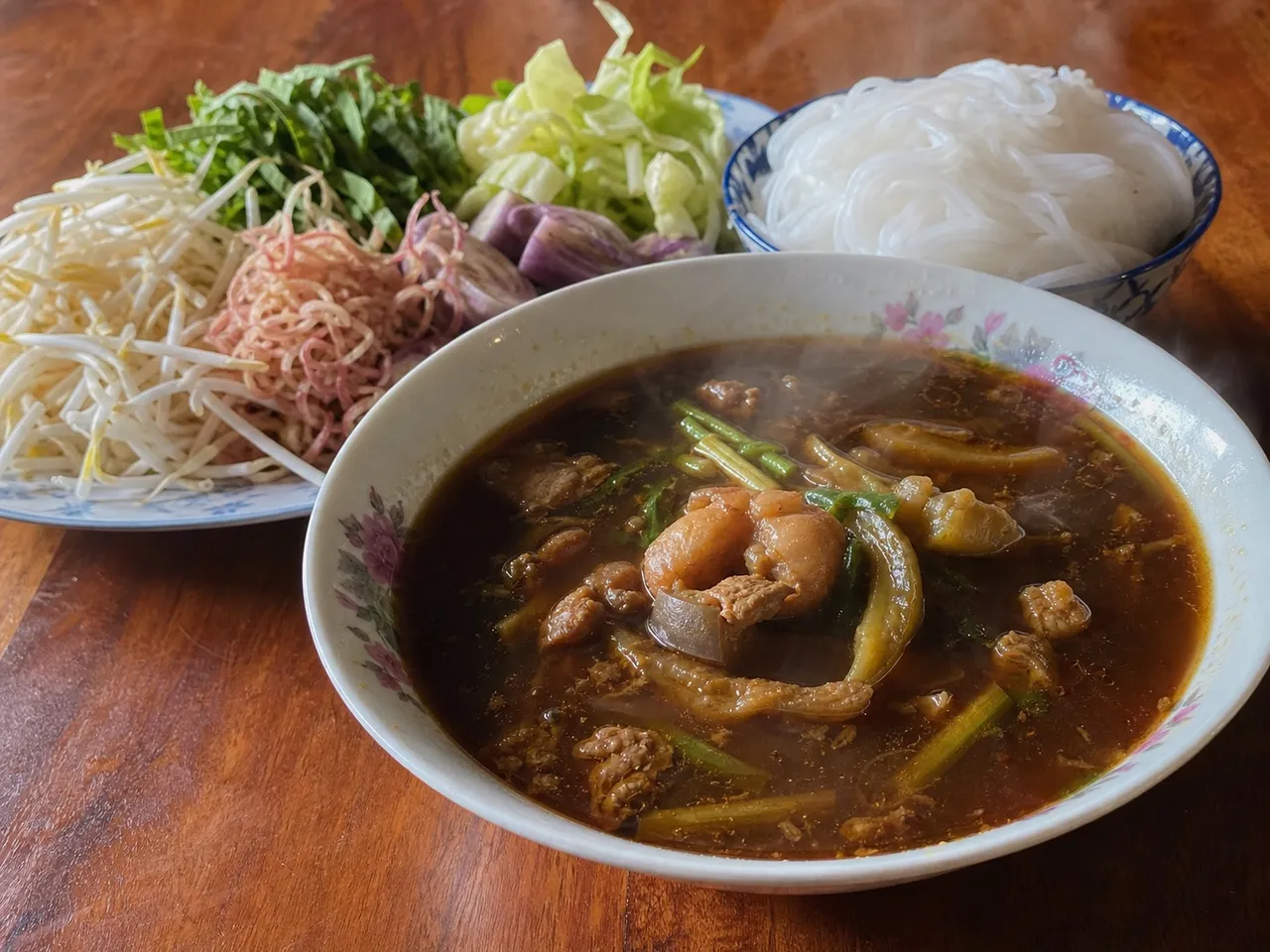 Serving Images are for illustrative purposes only, may be inaccurate, and do not guarantee the presence or absence of specific ingredients.
 Bún Mắm (Fermented Fish Noodle Soup)
A bold, deeply savory Mekong Delta noodle soup built on fermented fish broth and loaded with shrimp, pork, and roasted pork belly.
Contains common allergens
In the app, Listahan checks these against your household automatically.
Instructions
6 steps- 1
Simmer the fermented fish with 1 cup of the stock in a small pot for 10 minutes, then strain through a fine sieve, discarding solids, to make a clean, intensely savory base.
- 2
In a large pot, combine the remaining stock, the strained fish liquid, and the bruised lemongrass, then bring to a gentle simmer over medium heat.
- 3
Add the pork shoulder and cook for 25 minutes until tender, then add the eggplant and simmer 8 more minutes until soft.
- 4
Stir in the shrimp and cook just until pink and curled, about 3 minutes, then taste and adjust with a little sugar and fish sauce to balance the saltiness.
- 5
Blanch the fresh bún briefly in boiling water and divide among deep bowls, then top with the sliced roasted pork belly.
- 6
Ladle the hot broth with pork, shrimp, and eggplant over the noodles and serve with a heaping plate of water spinach, bean sprouts, and banana blossom for adding at the table.
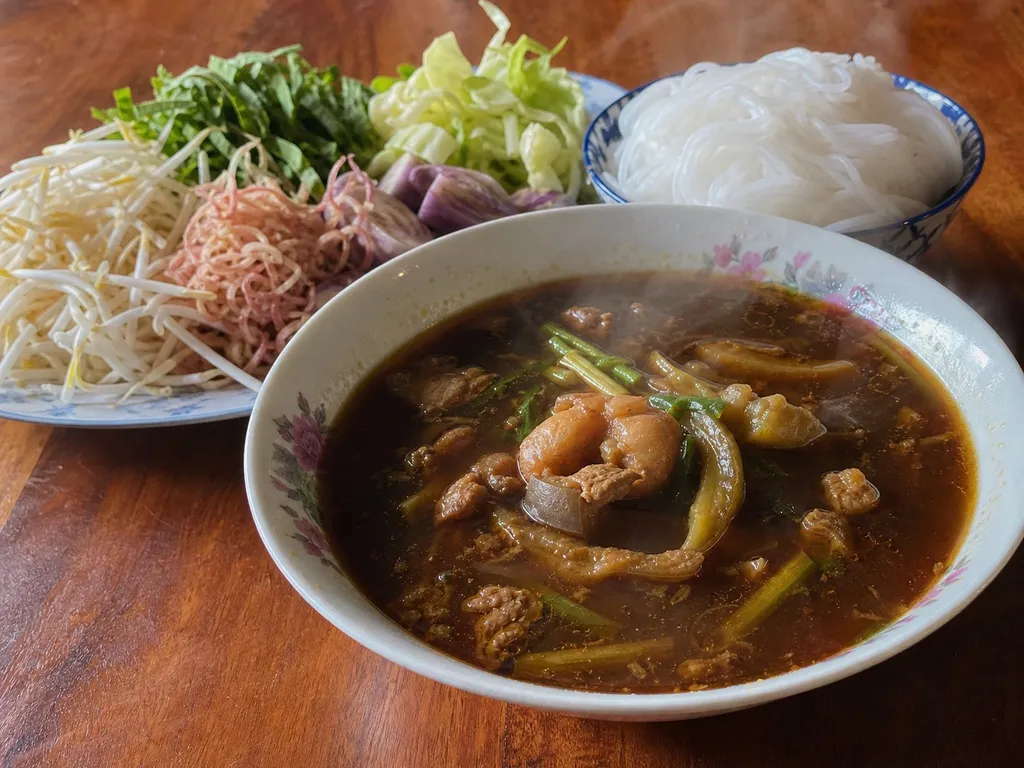 Images are for illustrative purposes only, may be inaccurate, and do not guarantee the presence or absence of specific ingredients.
 Listahan Family Score™
58/100
Works for many families
Score reflects how well this recipe fits a typical busy household. In the app, your Family Score is personalized to your household's allergens, kids, and pantry.
Nutrition
per serving1215
Calories
119 g
Protein
62 g
Carbs
54 g
Fat
Estimated per serving. Actual values depend on the brands and portions you use.
Listahan cooking guide
Chef notes & practical guide
Technique notes, ingredient swaps, serve-alongside ideas, storage guidance, and equipment for this recipe.
Cultural context
Bún mắm is a southern Vietnamese specialty with roots in the Mekong Delta, where the abundance of freshwater fish and centuries-old fermentation traditions produced mắm — intensely pungent preserved fish paste — as a cornerstone ingredient rather than a condiment. The dish traveled to and became strongly associated with Sóc Trăng province, home to a large Khmer community, reflecting the culinary overlap between southern Vietnamese and Cambodian fermented-fish traditions. In the Mekong Delta, mắm was an economic staple that could preserve the delta's fish harvest for months, and bún mắm turns that pungent ingredient into a nuanced, deeply savory broth by long simmering with lemongrass, pork, and aromatics.
Listahan note
This version uses fermented anchovy paste or mắm nêm as an accessible substitute for the harder-to-find mắm cá linh, balanced with good pork stock and lemongrass so the fermented quality enriches rather than overwhelms the broth.
Technique cues
- The fermented fish paste is not dissolved into the broth at the end — it is sauteed in oil with aromatics first, which mutes its raw edge and converts its intensely pungent compounds into a deep, savory backbone that smells and tastes dramatically different from the paste straight from the jar.
- Eggplant is not optional in bún mắm; it absorbs the fermented broth as it cooks and becomes a soft, intensely flavored element that no other vegetable replicates — add it to the simmering broth in the last 15 minutes so it is tender but not disintegrated.
- Bún mắm is a build-at-the-table soup: the broth is served very hot over noodles in individual bowls, and each diner adds their own raw bean sprouts, water spinach, and banana blossom so the vegetables retain their crunch and freshness against the intensely flavored broth.
Kitchen flow
- Parallel prep
- While the broth simmers, prepare the garnish plate (bean sprouts, water spinach, banana blossom, lime wedges, fresh chili) and slice the pork belly so everything is ready when the broth is done.
- Make-ahead
- The broth improves significantly made a day ahead; cool completely and refrigerate, then skim any solidified fat before reheating and adding eggplant fresh in the last 15 minutes.
- Leftover move
- Leftover broth can be reduced by half and used as a deeply flavored base for a stir-fry sauce or braising liquid for tofu or mushrooms.
- Cleanup rhythm
- The fermented fish paste smell clings to pans and utensils; wash immediately with hot soapy water after the paste-frying step and ventilate the kitchen well during that stage.
Ingredient brief
Role, handling, and swap guidance for each key ingredient.
mắm cá linh or fermented anchovy (mắm nêm)
broth foundation and primary flavor
Purpose: Fermented fish paste is the dish's name ingredient and its defining flavor — without it, the broth is just pork noodle soup; even a small amount transforms the entire character of the liquid.
Handling: Fry the paste in a neutral oil with minced shallots and lemongrass over medium heat, stirring constantly for 2-3 minutes until fragrant and slightly darkened, before adding stock.
Adaptation: Mắm nêm (fermented anchovy sauce) is widely available in Asian grocery stores and is the most accurate substitute; Thai shrimp paste (kapi) is a more distant but workable second option.
lemongrass, bruised
aromatic lift and bitterness buffer
Purpose: Lemongrass's citrusy, slightly medicinal perfume cuts through the fermented fish paste's intensity and gives the broth a clean, high note that prevents it from tasting muddy.
Handling: Smash the bottom two-thirds of each stalk with a heavy knife handle to split the fibers and release the essential oils; leave in the broth to steep and remove before serving.
Adaptation: Lemongrass paste (from a tube) can substitute in a pinch; use 1 tablespoon per stalk, but the flavor is less bright and aromatic.
pork shoulder, cut into bite-size pieces
protein and body builder
Purpose: Pork shoulder adds richness and gelatin to the broth as it cooks, rounding out the fermented fish paste's sharp edges and giving the broth body that lighter proteins would not provide.
Handling: Blanch in boiling water for 2 minutes and discard the water before adding to the main stock to produce a cleaner, less scummy broth.
Adaptation: Pork belly provides even more richness; chicken thighs are a lighter substitute but change the broth character substantially.
roasted pork belly, sliced
rich topping
Purpose: Sliced roasted pork belly adds a caramelized, fatty contrast to the fermented broth and is a signature element that differentiates bún mắm from simpler southern noodle soups.
Handling: Slice thin across the grain just before serving so it is room temperature when it hits the hot broth, which warms it through without overcooking.
Adaptation: Char siu (Chinese BBQ pork) from an Asian deli is a convenient substitute with a compatible flavor profile.
eggplant, cut into chunks
absorptive vegetable element
Purpose: Eggplant soaks up the intensely flavored broth as it cooks, becoming a soft, deeply savory bite that anchors the bowl against the lighter noodles and herbs.
Handling: Add in the last 15 minutes of simmering; cutting into 1.5-inch chunks (not too small) ensures they soften without dissolving.
Adaptation: Taro root or kabocha squash can substitute and will likewise absorb the broth, though they contribute different starch levels and textures.
fresh thick rice vermicelli (bún)
starchy base
Purpose: Fresh bún noodles are softer and more gelatinous than dried rice vermicelli and better complement the rich, intensely flavored broth without competing with it.
Handling: Blanch briefly in boiling water just to heat through (they are already cooked), drain, and portion into bowls before ladling hot broth over.
Adaptation: Dried rice vermicelli soaked and cooked according to package directions works; the texture will be slightly firmer.
Technique notes
- Taste the broth for balance after adding the fried paste and before serving — it should be intensely savory and slightly funky but not aggressively fishy; add a small amount of sugar (1-2 teaspoons) and fish sauce to balance if the fermented quality is too prominent.
- Serve the accompaniment vegetables on a separate plate rather than pre-adding them to bowls so each diner can control their ratio of crunchy-fresh to hot-broth-softened — this is how bún mắm is always served in the south.
- The shrimp should be added to the hot broth in the last 3 minutes of cooking, not simmered throughout — overcooked shrimp turn rubbery and their delicate sweetness disappears into the assertive broth.
Ingredient swaps
- Gluten-free direction
- The dish is naturally gluten-free when using rice noodles; verify the fermented fish paste does not contain added wheat — most Southeast Asian brands do not, but check the label.
- Lower-intensity fermented flavor
- For those new to fermented fish, replace half the mắm paste with good-quality fish sauce and a tablespoon of anchovy paste to get a more approachable funk level while keeping the savory depth.
- Seafood-forward version
- Double the shrimp and add squid rings in the last 5 minutes, reducing the pork shoulder to a garnish only — common in coastal Mekong Delta versions of the dish.
Serve alongside
- simple cucumber slices with a drizzle of rice vinegar and toasted sesame
- steamed jasmine rice for soaking up extra broth
- Vietnamese pickled mustard greens (dua cai) as a sharp, acidic contrast
- cold Vietnamese lager (333 or Saigon) to cut through the fermented richness
- unsweetened iced green tea
- young coconut water for a cooling, sweet counterpoint
Serving suggestions only — check pairings for your household's allergens.
Storage & reheating
- Broth keeps refrigerated for up to 4 days; store separately from noodles and toppings to prevent the noodles from absorbing all the liquid.
- Reheat broth to a rolling boil before serving, as the high temperature is important for food safety with fermented ingredients.
- Broth freezes well for up to 3 months; freeze in portioned containers (2-cup servings are practical) and thaw overnight in the fridge.
Equipment
- large heavy-bottomed stockpot for the broth
- small skillet for frying the fermented paste with aromatics separately
- spider or strainer for blanching pork and noodles
- large serving bowls — the dish needs volume for the noodles, broth, and toppings
Make this household-aware
Listahan Pro checks this recipe against your household's allergens, finds pantry-aware swaps, builds the shopping list, and helps you plan the week around it.
Plan it in Listahan
Add Bún Mắm (Fermented Fish Noodle Soup) to your week, check it against your household's allergens, and build the shopping list automatically.
More Vietnamese recipes
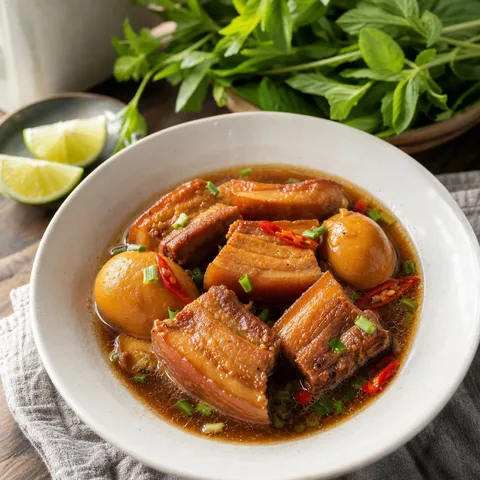 Vietnamese Lens Verified Images are for illustrative purposes only, may be inaccurate, and do not guarantee the presence or absence of specific ingredients.
 Thịt Kho Tàu (Caramelized Pork and Eggs)
Meltingly tender pork belly and hard-boiled eggs braised in a rich, sweet, and savory coconut juice caramel, perfect over steamed rice.
 Vietnamese Lens Verified Images are for illustrative purposes only, may be inaccurate, and do not guarantee the presence or absence of specific ingredients.
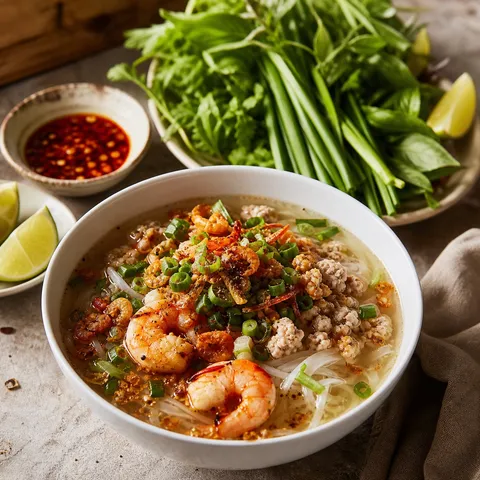
 Hủ Tiếu (Pork and Seafood Noodle Soup)
A Vietnamese pork-bone broth noodle soup loaded with ground pork, shrimp, and dried shrimp over chewy tapioca noodles, finished with garlic chives and fried garlic.
 Vietnamese Lens Verified Images are for illustrative purposes only, may be inaccurate, and do not guarantee the presence or absence of specific ingredients.
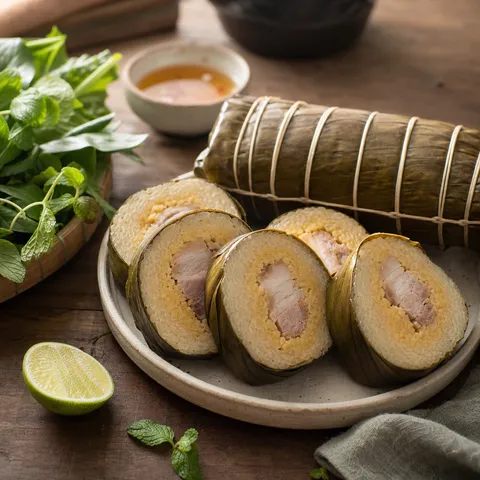
 Bánh Tét (Cylindrical Sticky Rice Cake)
The Southern equivalent of Bánh Chưng, rolled into a cylinder.