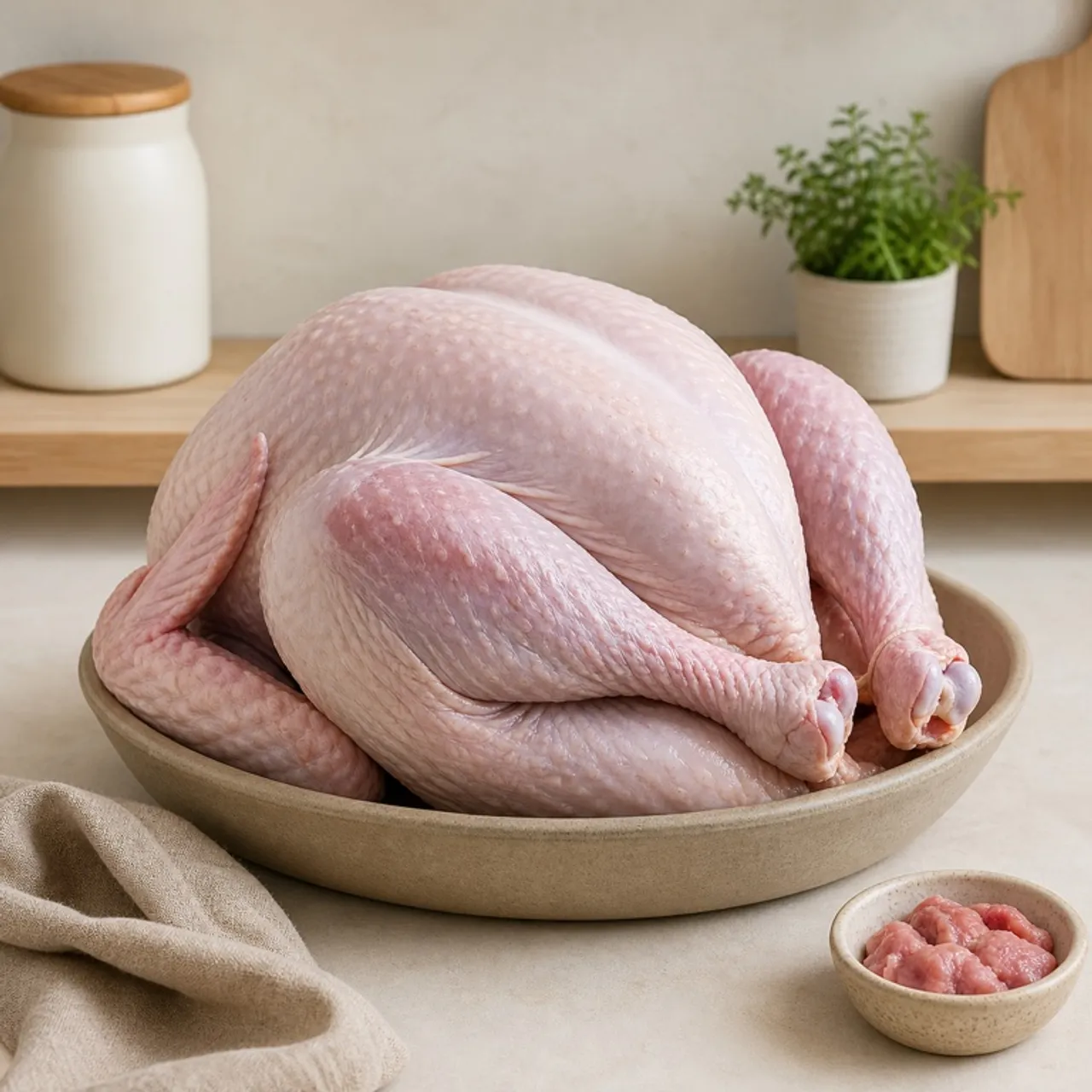
 Food Lens Images are for illustrative purposes only, may be inaccurate, and do not guarantee the presence or absence of specific ingredients.
 Food Lens · Recipe ingredients
Turkey
Turkey breast meat is mild, lean, and subtly savory — it absorbs flavors from brining, seasoning, and cooking fat readily, as it has relatively little fat of its own. Dark meat (legs and thighs) is deeper in flavor, richer, more forgiving in cooking, and more succulent due to higher fat and collagen content. The skin, when properly crisped, contributes a savory, golden, roasted flavor. Heritage breeds have a more complex, gamier quality comparable to properly raised chicken.
Lens VerifiedTurkey is a large domestic bird native to North America, offering a lean, mild white meat from the breast and more flavorful dark meat from the legs and thighs. It is one of the most significant proteins in North American culinary culture, carrying enormous emotional and ceremonial weight as the centerpiece of Thanksgiving and other celebrations. Beyond the holiday context, turkey is a widely used everyday protein available in whole birds, parts, ground, and cured forms.
Where it comes from
Turkeys were first domesticated by indigenous peoples in Mexico and the American Southwest thousands of years ago, reaching Europe via Spanish explorers in the 16th century and becoming central to North American culinary culture through the traditions surrounding Thanksgiving.
Varieties — Broad-breasted white turkeys dominate commercial production — they grow quickly and produce large breast portions. Heritage breeds (Narragansett, Bronze, Bourbon Red, Royal Palm) have a more complex flavor, more balanced dark-to-white-meat ratio, and firmer texture — they grow more slowly on traditional forage. Fresh turkeys have more flavor than frozen; organic and pastured birds typically have better taste and texture. Turkey parts (breast, thighs, legs, wings, ground) are widely available year-round.
Thanksgiving turkey is the most symbolically loaded food in American culture — its preparation, carving, and serving is freighted with family tradition, regional recipe loyalty, and generational memory. In Mexico, turkey (guajolote) has deep pre-Columbian roots and appears in mole negro, one of Mexico's most complex and celebrated sauces. In many Middle Eastern and Mediterranean countries, turkey is roasted or braised with warming spices and rice stuffings for celebratory meals.
In a modern kitchen — Dry-brining (salting the turkey uncovered in the refrigerator for 2–3 days before roasting) has become the preferred technique for home cooks seeking crispy skin and well-seasoned, juicy meat without the mess of wet brining. Spatchcocking (removing the backbone and flattening the bird) reduces roasting time significantly and produces more evenly cooked breast and thigh meat. Turkey thighs braised separately are a year-round weeknight option that many cooks find more manageable than a whole bird.
Buying it
For whole birds, choose fresh over frozen when possible — thawed turkeys can have compromised texture. Heritage or pastured birds offer noticeably more flavor. Check that skin is intact and unbruised, and that the bird smells clean. For parts, turkey thighs and drumsticks have far more flavor than breast alone. Ground turkey should have a pink color with no grey areas and be purchased from a refrigerated case, not the freezer section if you intend to cook it soon.
Storing it
Raw turkey needs to stay cold: keep it refrigerated until you're ready to cook, or store it in the freezer for longer keeping and thaw in the fridge before use. Fresh turkey should smell mild — a sour or ammonia-like odor means it's spoiled.
Keeps about 3 days in the fridge.
Out of turkey? Good swaps
General cooking guidance — always check the labels on the products you use. Listahan’s allergen checks run automatically when you plan a recipe in the app. Not medical advice.
Recipes that use turkey
Common questions about turkey
What can I use instead of turkey?
Good swaps include , , , . Each behaves a little differently — see the swaps above for notes, and always check labels for allergens.
How do I store turkey?
Raw turkey needs to stay cold: keep it refrigerated until you're ready to cook, or store it in the freezer for longer keeping and thaw in the fridge before use. Fresh turkey should smell mild — a sour or ammonia-like odor means it's spoiled. It keeps about 3 days in the fridge.
More recipe ingredients
See all


Make turkey about your kitchen — with Listahan Pro
Everything above is free, forever. Pro adds the Household Lens — the same food, seen for your family:
-
Checked for each member
Flags turkey per person against your household's allergies and school rules — not just a generic "contains" tag.
-
Pantry-aware
Knows whether you already have it, what is running low, and the best swap from what is in your kitchen tonight.
-
What it costs near you
A real price from the Presyo community index, so you can plan the budget — not guess.
-
Your household memory
Who likes it, plus your own private notes — brand, where you keep it, who skips it.
Allergen safety is always free — Pro adds the automation, never the safety.
Cook with turkey — safely
Plan a recipe in Listahan and the household allergen check runs automatically — every plan, every swap, every lunchbox. Safety is never paywalled.