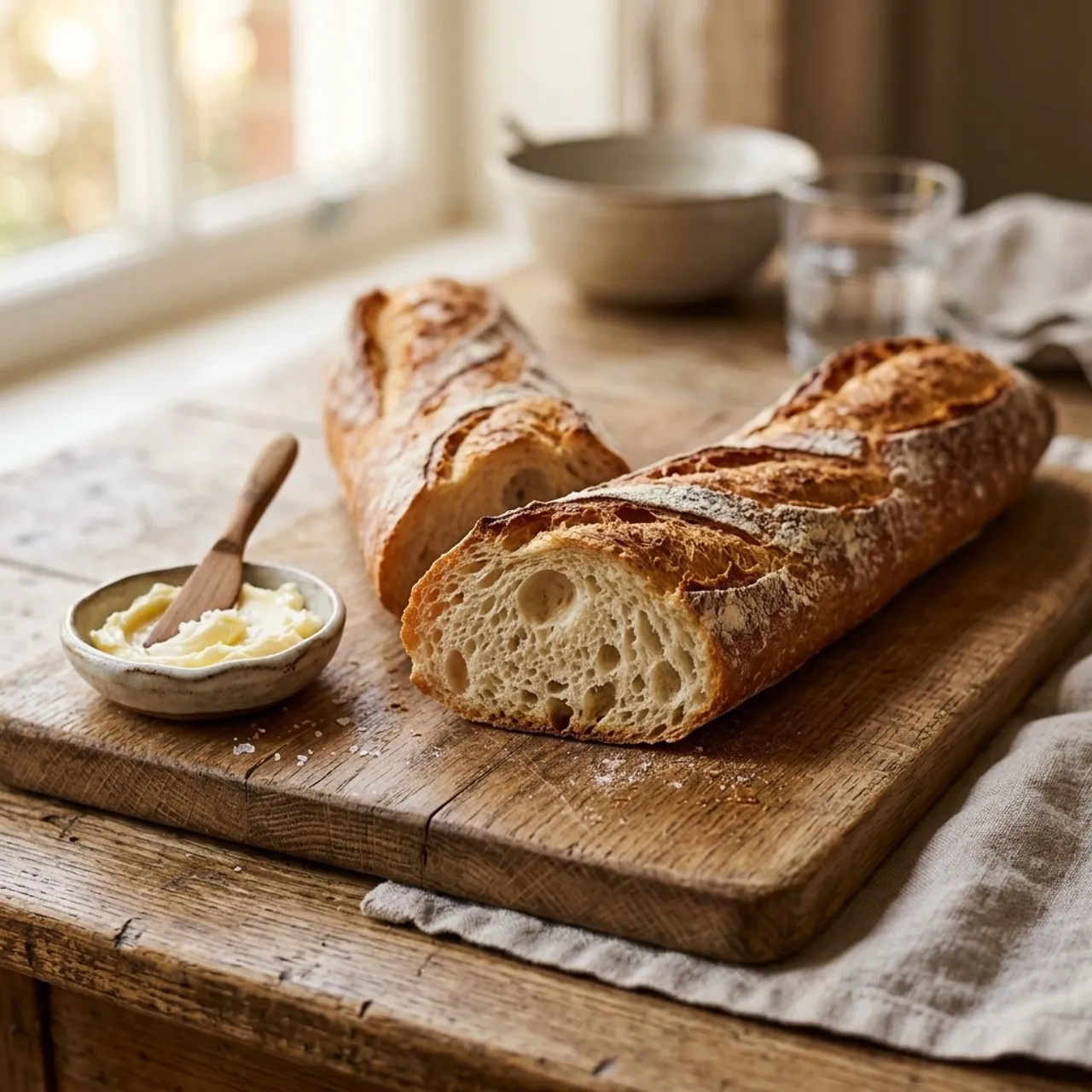
 Bakery Images are for illustrative purposes only, may be inaccurate, and do not guarantee the presence or absence of specific ingredients.
 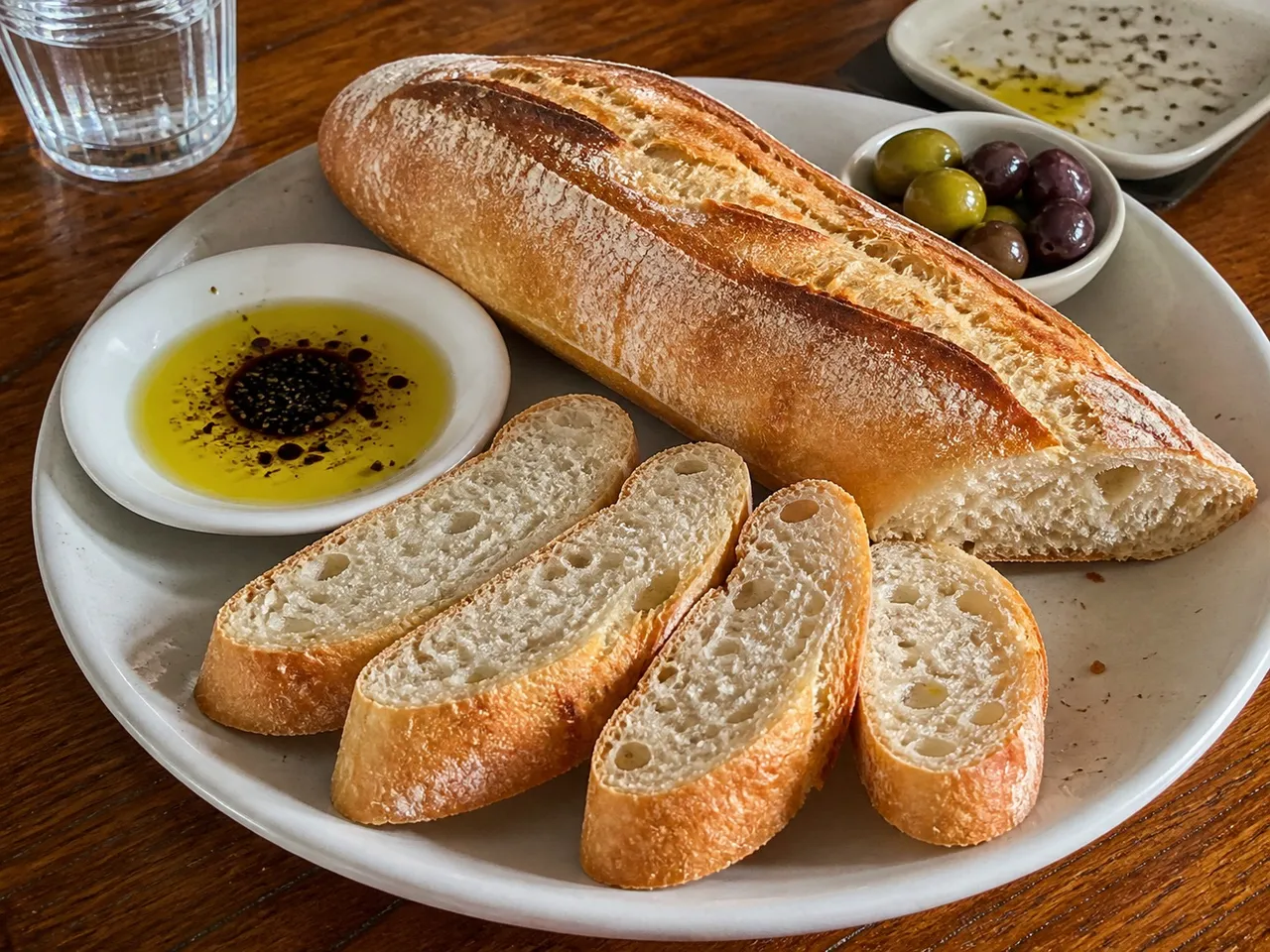 Serving Images are for illustrative purposes only, may be inaccurate, and do not guarantee the presence or absence of specific ingredients.
 French Baguette
Savor the authentic crunch of this rustic French baguette, featuring a beautifully crackling golden crust and a soft, airy, and utterly irresistible crumb.
Contains common allergens
In the app, Listahan checks these against your household automatically.
Good to know
- Crispy
Matched from this dish's own ingredients and timing. Browse more: crispy recipes
Instructions
6 steps- 1
In a large mixing bowl, combine the bread flour, warm water, yeast, and salt. Mix until a shaggy dough forms.
- 2
Turn the dough out onto a lightly floured surface and knead vigorously for 10-15 minutes until smooth, elastic, and passes the windowpane test.
- 3
Place the dough in a lightly oiled bowl, cover with a damp cloth, and let rise in a warm, draft-free area for 1 hour, or until doubled in volume.
- 4
Punch down the dough and divide it into two equal portions. Gently stretch and roll each portion into a long, thin cylinder (about 12-14 inches long).
- 5
Place the shaped loaves on a lightly floured baker's couche or parchment-lined baking sheet. Cover and let proof for 45 minutes until noticeably swollen.
- 6
Preheat the oven to 450°F (230°C) with a shallow pan of water on the bottom rack to create steam. Using a sharp razor or lame, make 3-4 diagonal, shallow slashes across the top of each loaf. Bake for 20-25 minutes until the crust is deep golden brown and the loaves sound hollow when tapped on the bottom.
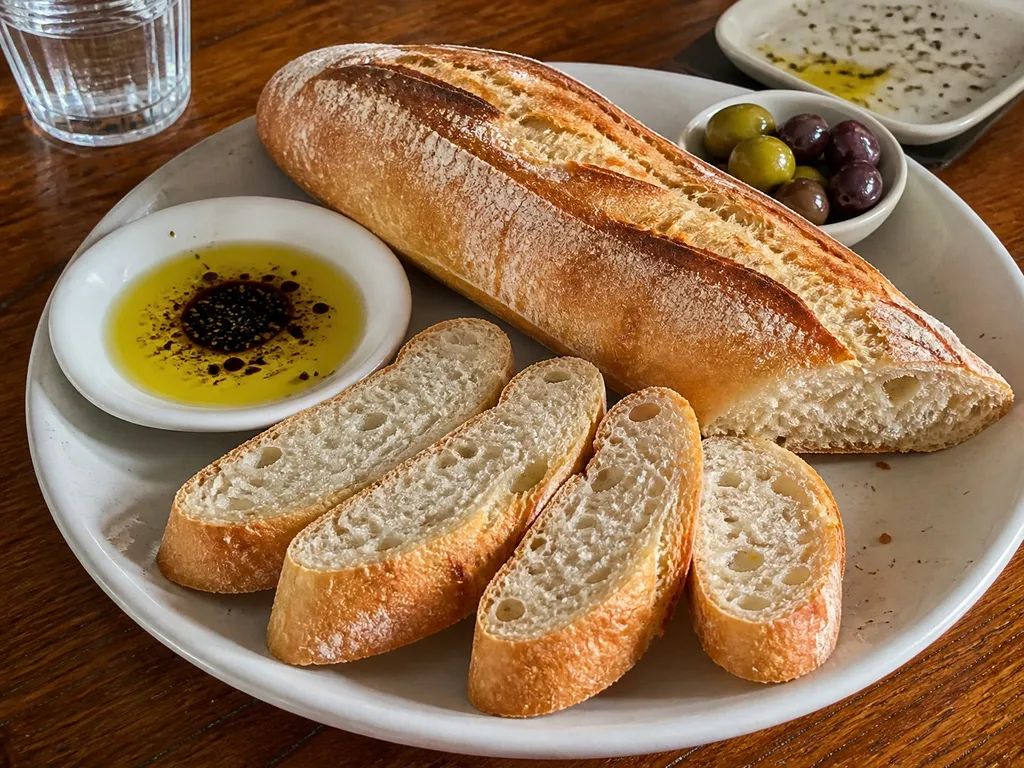 Images are for illustrative purposes only, may be inaccurate, and do not guarantee the presence or absence of specific ingredients.
 Listahan Family Score™
71/100
Good fit for most families
Score reflects how well this recipe fits a typical busy household. In the app, your Family Score is personalized to your household's allergens, kids, and pantry.
Nutrition
per serving200
Calories
6 g
Protein
42 g
Carbs
1 g
Fat
Estimated per serving. Actual values depend on the brands and portions you use.
Listahan cooking guide
Chef notes & practical guide
Technique notes, ingredient swaps, serve-alongside ideas, storage guidance, and equipment for this recipe.
Cultural context
The long, thin baguette as we know it was shaped partly by an 1888 Parisian labor law prohibiting bakers from working before 4 AM, which meant bread had to proof and bake faster than the traditional round country loaves allowed. The narrow form solved the problem: a baguette can be made, proofed, and baked within a few hours. By the 1920s it was codified as a cultural artifact, and in 2022 UNESCO added the craft of the French baguette to its intangible cultural heritage list. A genuine baguette de tradition uses no additives -- only flour, water, salt, and yeast.
Listahan note
This version uses an extended cold overnight ferment rather than a same-day rise to build the complex flavor that most home recipes skip, and scores deeply so the bread has room to bloom without tearing at the sides.
Technique cues
- Shape the dough with confident, even tension so the outer skin is taut and smooth -- a loose, slack surface will not hold its form in the oven and will spread sideways instead of rising upward.
- Introduce steam in the first 10 minutes of baking by placing a metal pan on the lower rack and pouring boiling water into it just before closing the oven door; steam keeps the surface extensible long enough for the bread to fully expand before the crust sets.
- Score at a shallow 30-degree angle to the length of the loaf, not straight down -- a shallow angled score opens outward into an ear, which is the hallmark of proper bloom and reveals the honeycomb crumb.
Kitchen flow
- Parallel prep
- Mix the dough the evening before and refrigerate overnight; the next day the bread is ready to shape and bake with no waiting for flavor to develop.
- Make-ahead
- Shaped, unscored loaves can be refrigerated overnight on a floured couche or parchment; score and bake directly from cold, which often improves the ear.
- Leftover move
- Day-old baguette makes superior crostini (slice thin, brush with olive oil, bake at 375 F until golden) or a classic French onion soup topping that holds up under broth and melted cheese.
- Cleanup rhythm
- Dust the work surface with flour rather than oiling it during shaping so cleanup is a quick scrape; soak the mixing bowl immediately after emptying it.
Ingredient brief
Role, handling, and swap guidance for each key ingredient.
bread flour
structural gluten network
Purpose: The higher protein content of bread flour builds the strong, elastic gluten needed to trap the gas bubbles that create an open, chewy crumb.
Handling: Weigh the flour for accuracy; a difference of 20 grams can noticeably affect the hydration and texture of the finished loaf.
Adaptation: All-purpose flour produces an acceptable loaf with a slightly less chewy crumb; add 1 teaspoon of vital wheat gluten per cup to partially compensate.
instant yeast
fermentation and gas production
Purpose: Even a small amount of yeast generates the carbon dioxide that inflates the gluten network, while a long cold ferment allows flavor compounds to develop fully.
Handling: For the overnight method, use as little as 1/4 teaspoon per 500 grams of flour; too much yeast rushes the ferment and suppresses flavor.
Adaptation: Sourdough starter can replace commercial yeast at 20 percent of flour weight for a more complex, tangy loaf with a longer total ferment time.
fine sea salt
flavor enhancer and gluten strengthener
Purpose: Salt strengthens gluten bonds by tightening the protein network and controls yeast activity so fermentation does not outpace flavor development.
Handling: Add salt after the initial flour-water mix to avoid direct contact with the yeast, which can inhibit it before hydration is complete.
Adaptation: Kosher salt works at the same weight; do not substitute iodized table salt, which can inhibit yeast and leave a slightly metallic flavor.
water
hydration and steam source
Purpose: Water hydrates the flour proteins to form gluten and becomes steam during baking, creating the open crumb and crunchy crust simultaneously.
Handling: Use lukewarm water around 75 F for the dough; cooler water slows hydration and warmer water can harm the yeast.
Adaptation: No substitute; the ratio of water to flour (hydration) is the single most important variable in the recipe and should be measured by weight.
Technique notes
- The pre-shape step -- forming a loose cylinder and resting it 20 minutes before the final shape -- is essential; it relaxes the gluten so the dough can be rolled to full length without springing back.
- Transfer shaped loaves seam-side up onto a floured couche or between the folds of a floured kitchen towel to proof; this keeps the shape tight and prevents the dough from spreading flat.
- A baking stone or steel preheated for at least 45 minutes produces a crust that most home ovens cannot otherwise achieve -- the rapid heat transfer from the stone is what sets the bottom crust before the loaf softens.
Ingredient swaps
- Whole wheat direction
- Replace up to 30 percent of bread flour with whole wheat for a nuttier, denser loaf; increase water by 2 tablespoons to compensate for the thirstier bran.
- Gluten-free direction
- A true gluten-free baguette with an open crumb is difficult to achieve; a rice flour-based baguette formula with psyllium husk binder is the closest approximation but produces a denser texture.
- Weeknight shortcut
- Use a no-knead approach -- mix flour, water, salt, and yeast the morning before for an 8-hour room-temperature rise -- to skip multiple folding sessions while still building good flavor.
Serve alongside
- Cultured butter with fleur de sel
- Pate with cornichons
- Tomato and fresh mozzarella with basil
- Crisp dry white wine such as Sauvignon Blanc
- Sparkling water with lemon
- Light pilsner
Serving suggestions only — check pairings for your household's allergens.
Storage & reheating
- A baguette is best eaten the day it is baked; store at room temperature in a paper bag (not plastic, which softens the crust) for up to 1 day. Freeze whole or in sections wrapped tightly in foil for up to 1 month; thaw at room temperature and refresh in a 375 F oven for 8 minutes.
Equipment
- Baking stone or baking steel
- Bread lame or sharp single-edge razor for scoring
- Couche or floured linen proofing cloth
- Metal pan for steam generation
Make this household-aware
Listahan Pro checks this recipe against your household's allergens, finds pantry-aware swaps, builds the shopping list, and helps you plan the week around it.
Plan it in Listahan
Add French Baguette to your week, check it against your household's allergens, and build the shopping list automatically.
More Bakery recipes
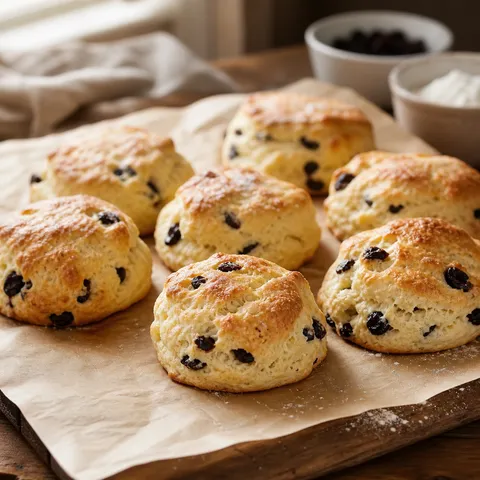 Bakery Lens Verified Images are for illustrative purposes only, may be inaccurate, and do not guarantee the presence or absence of specific ingredients.
 Scones
Flaky and buttery British baked goods, often with currants or berries.
 Bakery Lens Verified Images are for illustrative purposes only, may be inaccurate, and do not guarantee the presence or absence of specific ingredients.
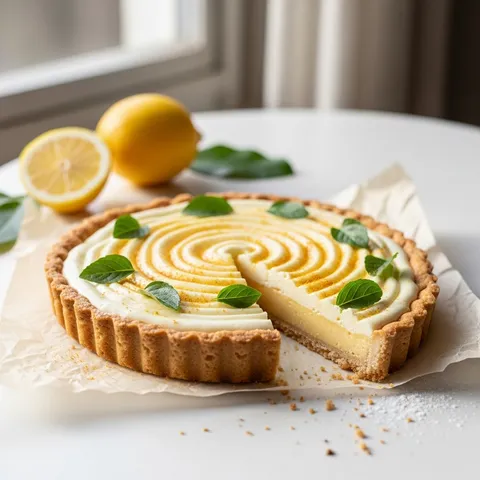
 Lemon Tart
Brighten your dessert spread with this elegant lemon tart, perfectly balancing a brilliantly zesty, silky-smooth lemon curd inside a crisp and buttery sweet pastry shell.
 Bakery Lens Verified Images are for illustrative purposes only, may be inaccurate, and do not guarantee the presence or absence of specific ingredients.
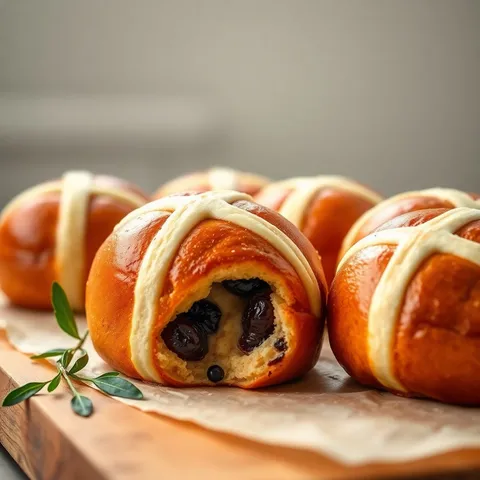
 Hot Cross Buns
Spiced sweet buns studded with raisins and marked with a cross.