 Nordic Images are for illustrative purposes only, may be inaccurate, and do not guarantee the presence or absence of specific ingredients.
  Serving Images are for illustrative purposes only, may be inaccurate, and do not guarantee the presence or absence of specific ingredients.
 Lussekatter
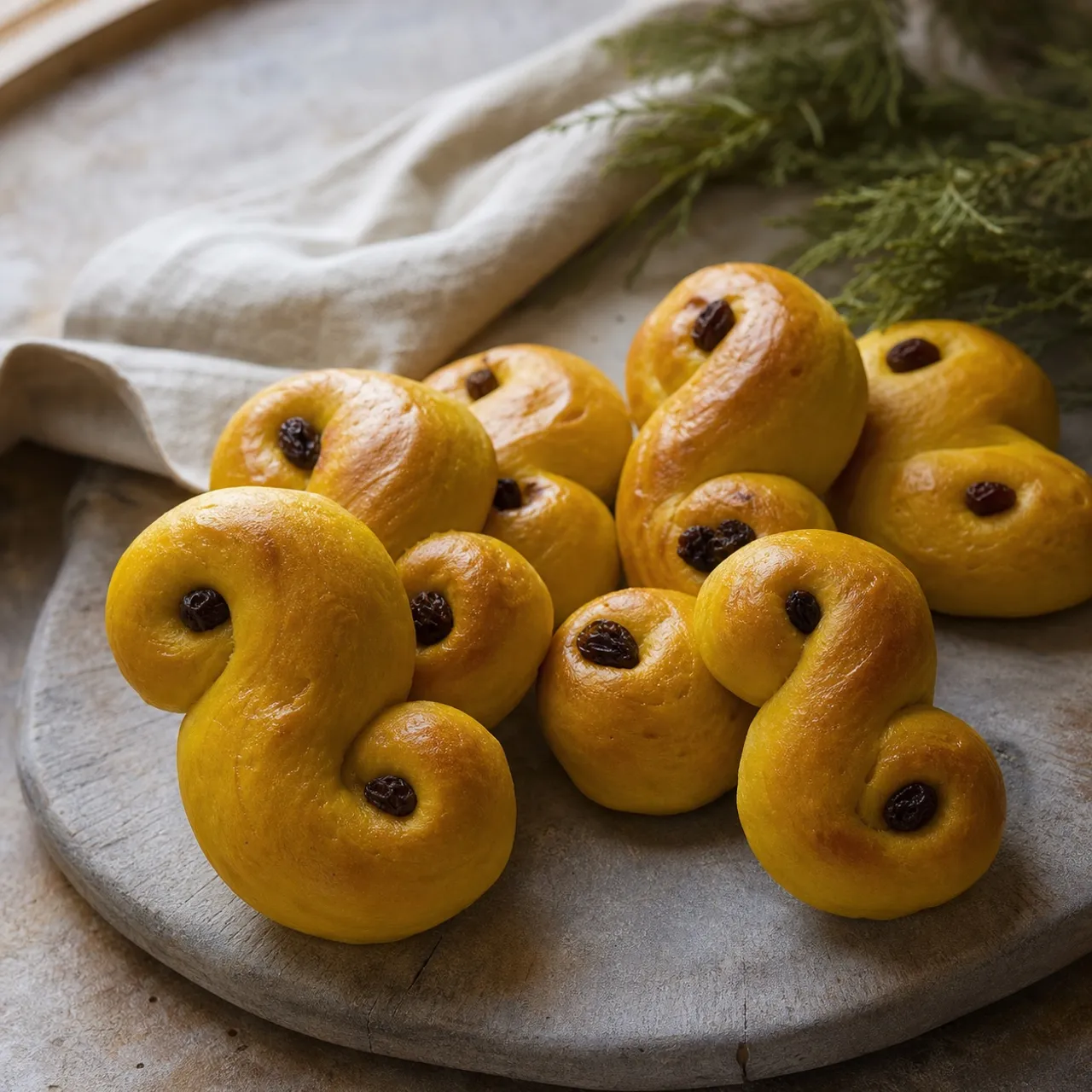
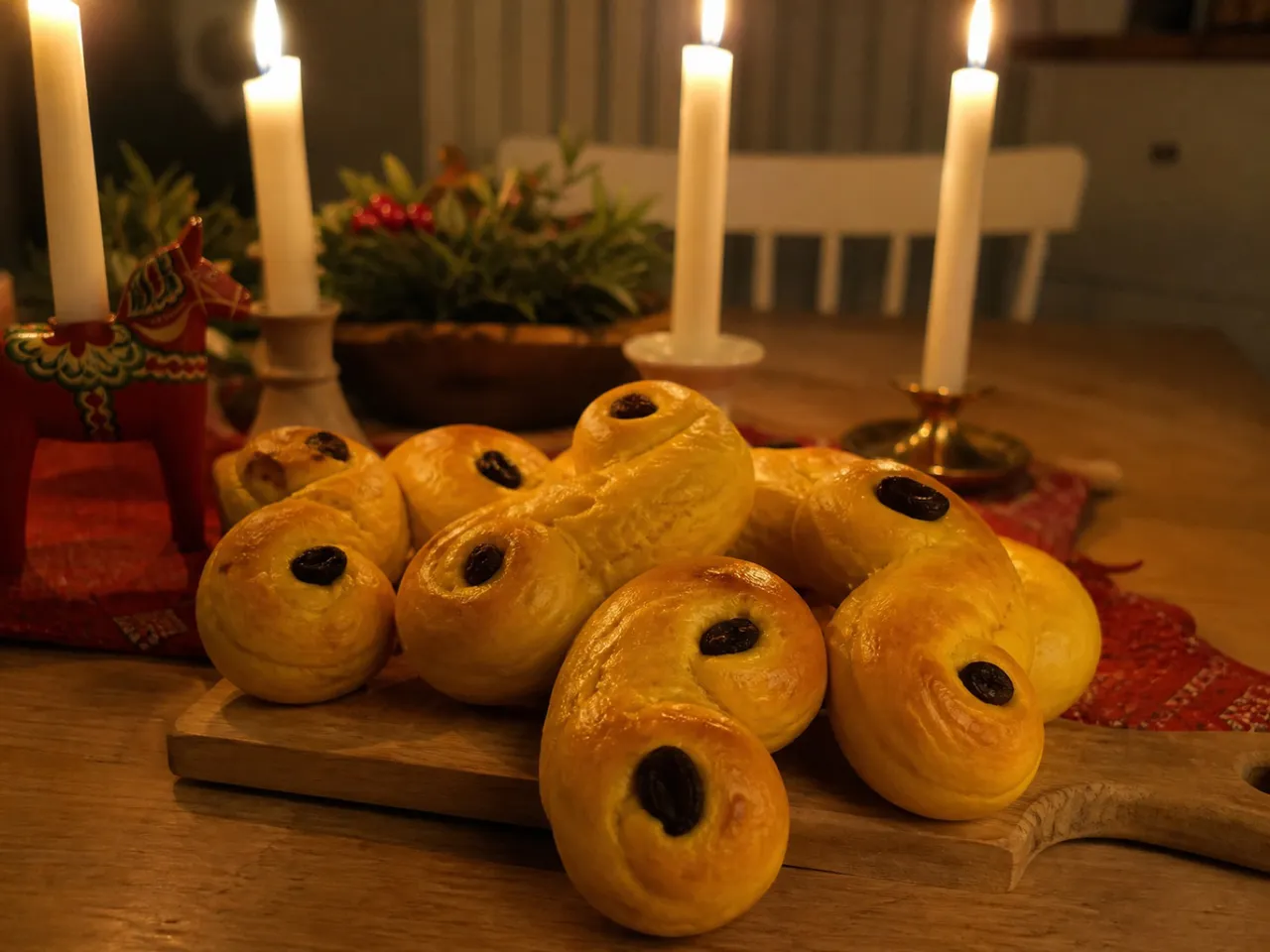
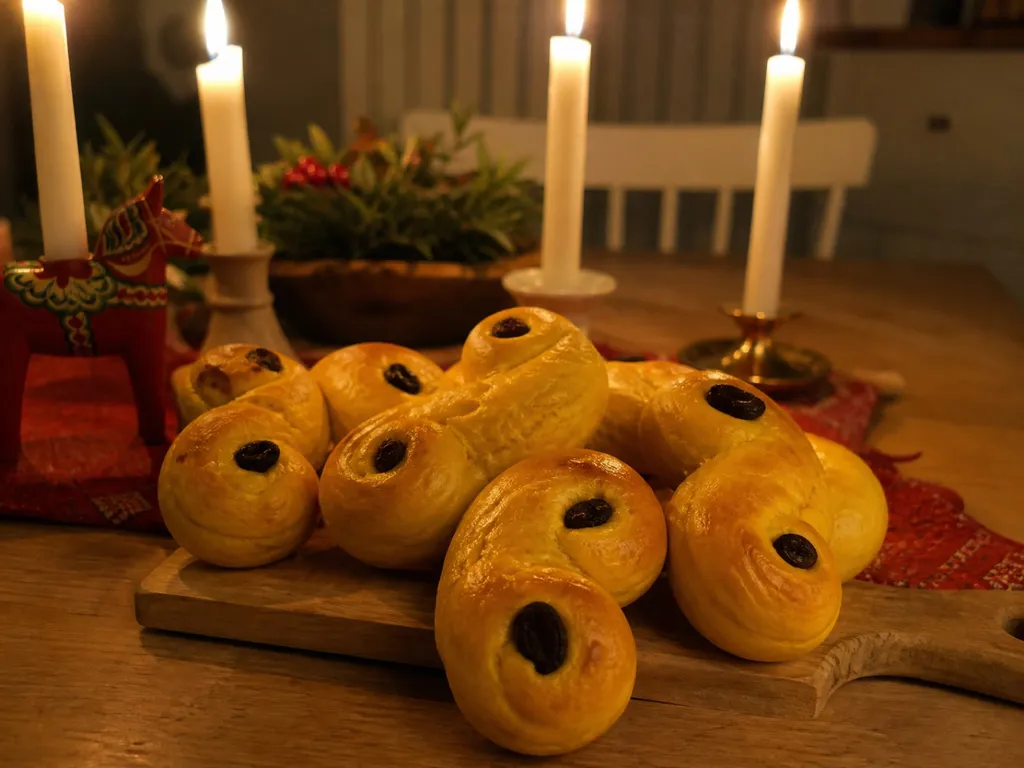
Sweden's glowing saffron buns, twisted into S-shapes and dotted with raisins — baked for St. Lucia's Day on December 13th and filling every Scandinavian kitchen with golden warmth.
Contains common allergens
In the app, Listahan checks these against your household automatically.
Instructions
7 steps- 1
Crush the saffron threads with a pinch of sugar using a mortar and pestle, then steep in the warm milk for 10 minutes to release its color and aroma.
- 2
Stir the yeast into the saffron milk and let stand until foamy, about 5 minutes.
- 3
In a large bowl, combine the flour, sugar, and salt, then add the saffron milk mixture, butter, and egg, and knead for 8 to 10 minutes until smooth and elastic.
- 4
Cover and let rise in a warm place for about 1 hour, until doubled.
- 5
Divide the dough into 12 pieces, roll each into a rope about 10 inches long, and curl both ends in opposite directions to form an S-shape.
- 6
Press a raisin firmly into the center of each curl, place the buns on lined baking sheets, and let rise for another 30 to 40 minutes.
- 7
Brush with beaten egg and bake at 400 F for 10 to 12 minutes, until golden brown, then cool on a wire rack before serving.
 Images are for illustrative purposes only, may be inaccurate, and do not guarantee the presence or absence of specific ingredients.
 Listahan Family Score™
63/100
Works for many families
Score reflects how well this recipe fits a typical busy household. In the app, your Family Score is personalized to your household's allergens, kids, and pantry.
Nutrition
per serving405
Calories
10 g
Protein
88 g
Carbs
1 g
Fat
Estimated per serving. Actual values depend on the brands and portions you use.
Listahan cooking guide
Chef notes & practical guide
Technique notes, ingredient swaps, serve-alongside ideas, storage guidance, and equipment for this recipe.
Cultural context
Lussekatter — Swedish saffron buns, literally 'Lucia cats' — are the defining food of Saint Lucia Day on December 13th, the Swedish festival of light that marks the beginning of the Christmas season. The bright yellow buns shaped into an S-curve with raisins at each coil represent stylized cats and have been associated with the Lucia celebration since at least the 18th century. In Swedish homes and schools, Lucia morning begins with someone dressed in white carrying candles and bringing lussekatter and coffee, one of the most deeply embedded food rituals in Nordic culture.
Listahan note
This version blooms the saffron in warm milk before adding it to the dough, which extracts significantly more color and flavor than stirring it in directly. The vivid yellow color is the visual signature of good lussekatter.
Technique cues
- Saffron requires heat and fat or liquid to release its color and flavor compounds; crush the threads in a small mortar, steep in warm butter or warm milk for at least 15 minutes before adding to the dough, and the buns will turn a deep, even gold rather than a pale yellow.
- This is an enriched yeast dough that benefits from a long, slow proof in the refrigerator overnight after the initial mix; cold fermentation develops more complex flavor and makes the dough easier to shape, as the butter firms up and the dough becomes less sticky.
- The S-shape is formed by rolling each piece of dough into a rope about 30cm long and coiling both ends inward in opposite directions; keep the coils tight and the rope even in thickness so the buns bake uniformly — thick centers and thin ends will produce uneven coloring.
Kitchen flow
- Parallel prep
- Bloom the saffron in warm butter while weighing and measuring the remaining ingredients; the 15-minute steep fits perfectly into the dough setup time.
- Make-ahead
- Mix the dough the evening before Lucia morning, do the first proof in the refrigerator overnight, then shape, proof at room temperature, and bake in the morning.
- Leftover move
- Day-old lussekatter are best split, buttered, and toasted lightly; the saffron flavor intensifies slightly with time and the toasted surface crisps nicely.
- Cleanup rhythm
- The stand mixer bowl and hook are the main items; the shaping produces minimal mess if you work on a lightly floured surface.
Ingredient brief
Role, handling, and swap guidance for each key ingredient.
Flour
dough structure
Purpose: All-purpose flour gives a tender crumb; bread flour produces a chewier bun — most Swedish recipes use all-purpose for the soft, pillowy texture traditional lussekatter should have.
Handling: Measure by weight rather than volume for consistent dough hydration; the butter and egg add enough richness that the dough should feel soft but not sticky after kneading.
Adaptation: A 50/50 mix of bread flour and all-purpose flour produces a slightly chewier bun that holds its shape well during the second proof.
Saffron
color, flavor, and identity
Purpose: Saffron is not optional in lussekatter — it is the defining ingredient; both the vivid yellow color and the distinctive floral, slightly medicinal aroma are inseparable from the bun's identity.
Handling: Use about 0.5g (a generous pinch) of threads per 500g flour; crush in a mortar and steep in 2 tbsp warm melted butter for 15 minutes before adding to the dough.
Adaptation: There is no adequate substitute for saffron in this application; turmeric will produce color but none of the flavor.
Raisins
garnish and visual marker
Purpose: Two raisins pressed into the center of each coil mark the traditional cat's-eye decoration and are the standard garnish on authentic lussekatter.
Handling: Press each raisin firmly into the dough after shaping and before the final proof so they sink in slightly; raisins placed on top without pressing will fall off during baking.
Adaptation: Dried currants or small dried cranberries can substitute for raisins; candied orange peel is a modern alternative.
Technique notes
- Brush with an egg wash (1 egg beaten with 1 tbsp milk) just before baking rather than after shaping — baking without an egg wash gives a matte, bread-like surface; the egg wash produces the shiny, golden exterior that makes lussekatter look like bakery buns.
- Do not over-bake — lussekatter are done when the internal temperature reaches 88C / 190F and they are a light golden brown, not a deep amber; they continue to firm as they cool and over-baked buns become dry quickly.
- The shaped buns need 45 to 60 minutes of final proof at warm room temperature; they should look visibly puffed and feel airy to a gentle touch before they go in the oven.
Ingredient swaps
- Dairy-free option
- Replace milk with oat milk and butter with vegan butter; oat milk is a particularly good substitute here as its mild sweetness complements the saffron.
- Vegan direction
- Use plant-based milk and vegan butter in the dough, and brush with oat milk instead of egg wash before baking; the color will be slightly less golden but still attractive.
- Budget saffron swap
- If cost is a concern, use 0.3g saffron and add 1/4 tsp of ground saffron (or additional threads) — never substitute saffron with food coloring alone as the flavor is the point.
Serve alongside
- room-temperature salted butter for spreading
- Swedish glogg (mulled wine) alongside for a Lucia spread
- simple sliced hard cheese such as Vasterbotten
- strong Swedish coffee (filter or press)
- hot chocolate for children on Lucia morning
Serving suggestions only — check pairings for your household's allergens.
Storage & reheating
- Store at room temperature in an airtight bag up to 2 days; enrich buns stale faster than lean bread.
- Freeze baked lussekatter in a zip bag up to 1 month; thaw at room temperature and warm briefly in the oven for best texture.
- Do not refrigerate — cold air dries enriched dough rapidly and the crumb becomes tough.
Equipment
- stand mixer with dough hook
- small mortar and pestle for crushing saffron threads
- baking sheets lined with parchment
- pastry brush for egg wash
Make this household-aware
Listahan Pro checks this recipe against your household's allergens, finds pantry-aware swaps, builds the shopping list, and helps you plan the week around it.
Plan it in Listahan
Add Lussekatter to your week, check it against your household's allergens, and build the shopping list automatically.
More Nordic recipes
 Nordic Lens Verified Images are for illustrative purposes only, may be inaccurate, and do not guarantee the presence or absence of specific ingredients.
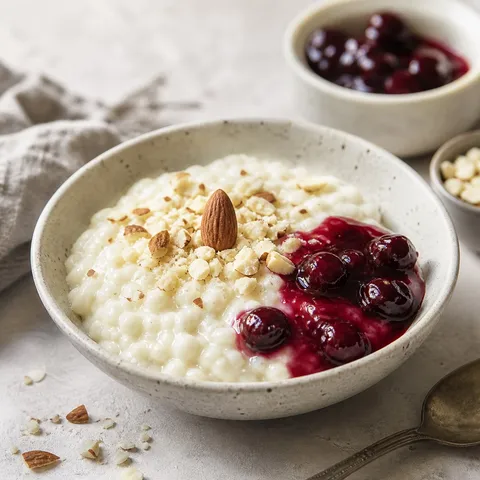
 Risalamande
A creamy Danish cold rice pudding folded with whipped cream and chopped almonds, served with a glossy warm cherry sauce on Christmas Eve.
 Nordic Lens Verified Images are for illustrative purposes only, may be inaccurate, and do not guarantee the presence or absence of specific ingredients.
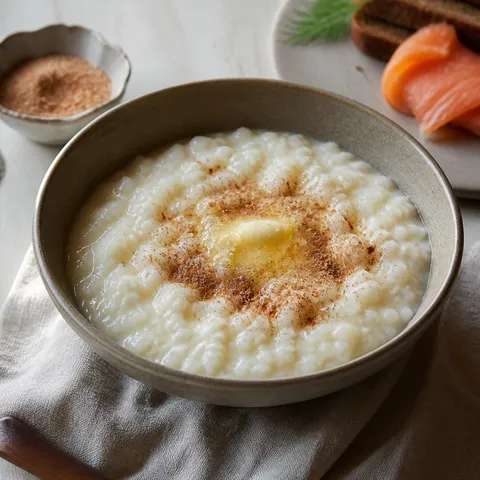
 Risgrynsgröt
Creamy Nordic rice porridge, slow-cooked until thick and comforting, scented with cinnamon and served with a pat of melting butter — Christmas morning in a bowl.
 Nordic Lens Verified Images are for illustrative purposes only, may be inaccurate, and do not guarantee the presence or absence of specific ingredients.
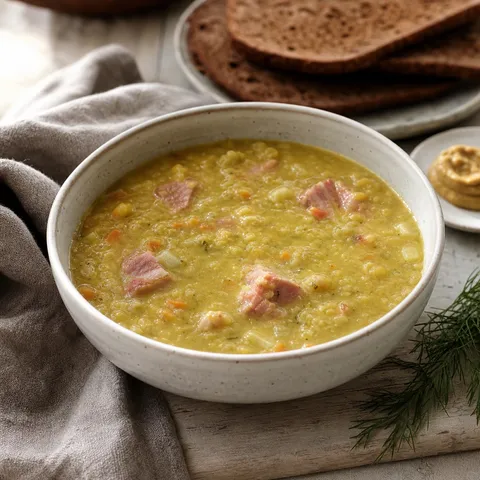
 Hernekeitto
Finland's beloved Thursday pea soup — yellow split peas simmered with smoky ham until thick and hearty, traditionally served with a shot of Finnish mustard and pancakes.