Road trip Checklist
A long drive — car prep, snacks, entertainment, and comfort.
Before you go
- Check your tires, oil, and washer fluid before a long drive, and top up the tank the night before so a late start doesn’t cost you daylight.
- Plan roughly a 10-minute break every two hours — driver fatigue creeps in quietly, and a short walk resets your focus better than caffeine alone.
- Download maps, music, and podcasts before you leave; long stretches of highway drop cell signal right when you’d reach for them.
Car & documents
- License & registration
Your driver's license and the vehicle's registration paperwork.
Why it's on the list & how to choose
Why pack it: Required by law if you're pulled over or in an accident anywhere along the route.
How to choose: Check both haven't expired before a long trip.
Good to know: An expired registration or license is an easy thing to overlook and a common reason for a routine traffic stop to escalate — both are worth checking before a long drive.
Tip: Keep them together in the glovebox so you're not searching under pressure.
- Insurance card
Proof of your auto insurance coverage.
Why it's on the list & how to choose
Why pack it: Required alongside your registration in a traffic stop or accident, and needed to file a claim.
How to choose: Confirm your coverage is current and covers the states you're driving through.
Good to know: Most insurers accept a photo or app copy of your card at a stop, but crossing into another country usually needs separate proof — worth confirming before you go.
Tip: Keep a photo of the card on your phone as a backup to the physical copy.
- Phone mount
A dashboard or vent mount that holds your phone in view while driving.
Why it's on the list & how to choose
Why pack it: Lets you use turn-by-turn navigation safely without holding the phone.
How to choose: Pick a mount that fits your car's vents or dash securely and holds your phone size.
Good to know: Mounting the phone high and near the windshield keeps your eyes closer to the road when you glance at directions, cutting the time they leave it.
Tip: Position it so the screen doesn't block your view of the road.
- Car charger
A charging adapter that plugs into your car's power outlet.
Why it's on the list & how to choose
Why pack it: Keeps phones charged through hours of navigation, music, and calls.
How to choose: Get one with enough ports for everyone in the car, and check the cable lengths reach the back seat.
Good to know: Navigation with the screen bright can drain a phone faster than a car charger refills it, so a higher-output USB charger keeps you from arriving at empty.
Tip: Pack a spare cable — cables are usually the first thing to fail.
- Spare key Nice to have
A duplicate key for the car, kept separate from the main set.
Why it's on the list & how to choose
Why pack it: A lost or locked-in key doesn't have to end the trip if a spare is with you.
How to choose: Get a cut spare (not just a fob) in case a smart key's battery dies.
Good to know: A modern key fob is easy to lock inside or drown in a lake; a cut metal spare still opens the door even when a fob's battery is dead.
Tip: Give the spare to a different person than the one holding the main keys.
Emergency kit
- First-aid kit
A kit with bandages, antiseptic, and basic medication for minor injuries.
Why it's on the list & how to choose
Why pack it: Useful for scrapes, headaches, or minor mishaps far from a pharmacy.
How to choose: Pick a kit sized for your group and check it's not expired.
Good to know: On a road trip you're rarely far from a pharmacy, so the kit mainly buys you the minutes to handle a scrape or headache without hunting for an exit and a store.
Safety: Keep any medications out of children's reach and check the kit hasn't expired before a long trip.
Tip: Store it somewhere accessible, like under a seat, not buried in the trunk.
- Jumper cables
Cables for jump-starting a dead battery from another vehicle.
Why it's on the list & how to choose
Why pack it: A dead battery at a rest stop or hotel parking lot is common and easy to fix with help.
How to choose: Choose cables at least 10-12 feet long and rated for your vehicle's battery size.
Good to know: Connecting jumper cables in the wrong order can spark right at the battery, where hydrogen gas can collect — which is why the last clamp goes on bare metal, not the dead battery.
Safety: Connect red to the dead battery first and black last to a bare metal point away from the battery, and keep the clamps from touching each other while live.
Tip: Learn the correct order to connect them (positive first, negative last) before you need it.
- Tire inflator
A portable pump that inflates tires using the car's power outlet.
Why it's on the list & how to choose
Why pack it: Lets you fix a slow leak or low tire pressure without waiting for roadside help.
How to choose: Pick one that plugs into your 12V outlet and includes a built-in pressure gauge.
Good to know: A plug-in inflator can reseat a slow leak enough to reach a shop, but it can't fix a shredded sidewall — that's still a spare-tire or tow situation.
Tip: Check tire pressure before you leave so you know what 'normal' looks like.
- Flashlight
A handheld flashlight for roadside emergencies or dark rest stops.
Why it's on the list & how to choose
Why pack it: Helps you see under the hood, at a tire, or walking around the car at night.
How to choose: Pick one bright enough to work by and small enough for the glovebox.
Good to know: Fumbling under the hood or at a dark tire is exactly when you need both hands, so a headlamp often beats a handheld flashlight in a roadside emergency.
Tip: Check the batteries before you leave — a dead flashlight is worse than none.
- Blanket
A compact blanket kept in the car for warmth or emergencies.
Why it's on the list & how to choose
Why pack it: Useful if you're stranded in cold weather or someone gets chilly on a long drive.
How to choose: Pick a compact, warm blanket that packs down small enough to always keep in the car.
Good to know: If you're ever stranded in winter, staying with the car and bundling up is usually safer than walking for help — a blanket turns a cold wait into a manageable one.
Tip: Store it in the trunk so it doesn't take up passenger space unless needed.
Snacks & drinks
- Snacks
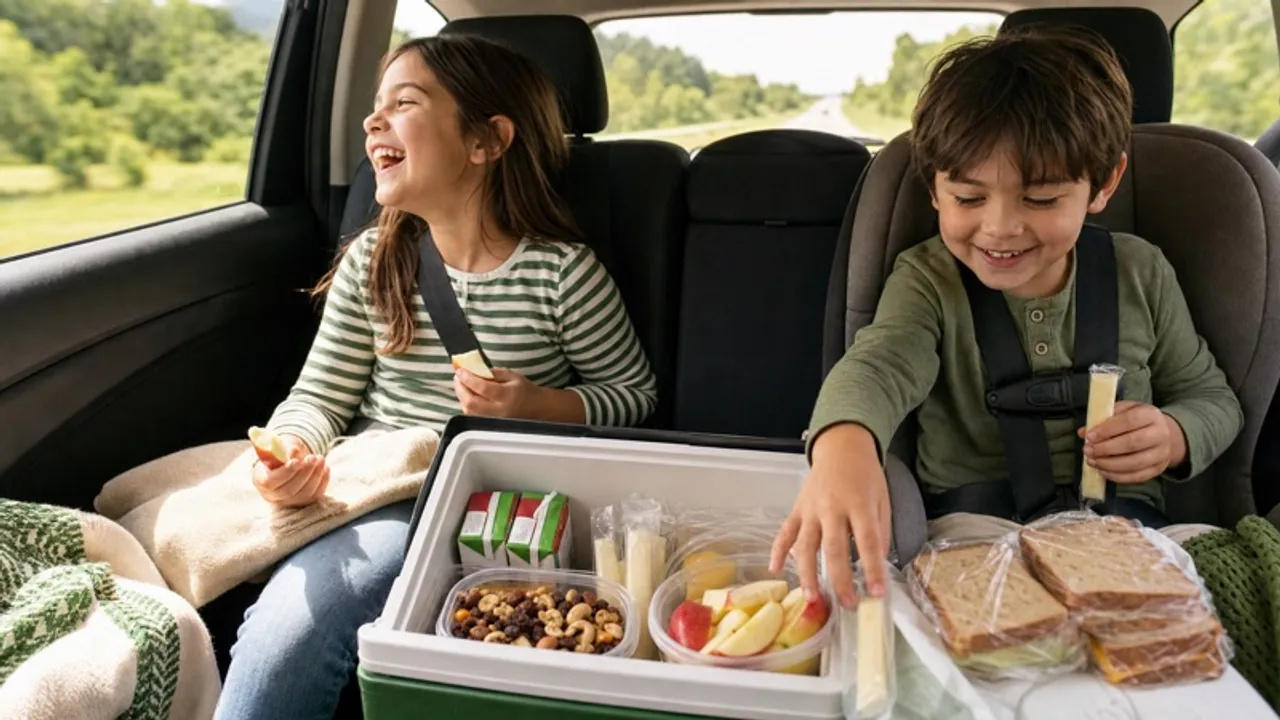
Portable food like chips, crackers, or trail mix for the drive.
Why it's on the list & how to choose
Why pack it: Keeps everyone fed between meal stops and cuts down on unplanned food stops.
How to choose: Pick snacks that don't melt, crumble too much, or need refrigeration.
How many: Plan a couple of snacks per person for every few hours on the road.
Good to know: Sugary snacks give a quick lift and a quick crash; pairing them with protein or nuts keeps energy — and backseat moods — steadier across a long drive.
Tip: Pack a variety so pickier eaters (and kids) have something they'll actually eat.
- Water bottles
Bottled water for everyone in the car.
Why it's on the list & how to choose
Why pack it: Staying hydrated on a long drive keeps everyone more alert and comfortable.
How to choose: Pack enough for the whole drive plus extra in case of delays.
How many: Roughly a liter per person for a half-day drive, more in summer heat.
Good to know: It's easy to under-drink on a drive to avoid bathroom stops, but mild dehydration dulls focus — the opposite of what you want behind the wheel.
Tip: Keep a couple bottles within arm's reach so no one has to dig through the trunk.
- Cooler Nice to have
An insulated cooler for perishable snacks and drinks.
Why it's on the list & how to choose
Why pack it: Lets you bring fresh food and cold drinks instead of relying only on gas station stops.
How to choose: Pick a small cooler that fits in the back seat or trunk without taking over the space.
Good to know: A cooler in a hot car is fighting the cabin temperature, so parking it out of direct sun and keeping the lid shut does more than piling in extra ice.
Tip: Freeze a couple of water bottles to use as ice packs you can drink once thawed.
- Napkins
Paper napkins for cleaning up spills and messy snacks.
Why it's on the list & how to choose
Why pack it: Car snacking gets messy, and there's no sink until the next stop.
How to choose: Pack more than you think you'll need — a full stack takes almost no space.
Good to know: There's no sink between exits, so a napkin stash handles the small spills that would otherwise sit sticky on a seat for the rest of the drive.
Tip: Keep a stack in the door pocket or glovebox for quick access.
- Trash bags
Small bags for collecting trash during the drive.
Why it's on the list & how to choose
Why pack it: Keeps wrappers and cups from piling up loose on the car floor.
How to choose: A small bag that hangs from the seatback or console works best in a car.
Good to know: A small bag hung from a headrest or console keeps wrappers off the floor, and emptying it at each fuel stop stops the car from filling with clutter.
Tip: Empty it at every gas stop so it never overflows mid-drive.
Comfort & fun
- Sunglasses
UV-protective eyewear for glare while driving.
Why it's on the list & how to choose
Why pack it: Sun glare, especially at sunrise or sunset, can seriously reduce visibility while driving.
How to choose: Pick polarized lenses to cut glare off the road and other cars.
Good to know: Low sun at dawn and dusk is one of driving’s most dangerous glare conditions, and polarized lenses cut the reflected glare off the road and other cars better than tint alone.
Tip: Keep a pair in the car permanently so you're never caught without them.
- Neck pillow Nice to have
A U-shaped pillow that supports the neck for napping in the car.
Why it's on the list & how to choose
Why pack it: Makes it more comfortable for passengers to sleep during long stretches of driving.
How to choose: Pick a compressible pillow that doesn't take much space between uses.
Good to know: A neck pillow works by stopping your head from lolling as you doze, which is what leaves passengers with a stiff neck after napping upright.
Tip: Memory foam versions hold their shape better than inflatable ones on long trips.
- Phone chargers
Charging cables for everyone's phones and devices.
Why it's on the list & how to choose
Why pack it: Keeps navigation, music, and entertainment running throughout the drive.
How to choose: Match cable types to everyone's devices and bring one spare of each type.
Good to know: Most cars have far fewer power outlets than passengers with devices, so a single multi-port USB charger prevents the constant swapping over one cable.
Tip: Use a multi-port charger so passengers aren't fighting over one outlet.
- Playlist / downloads
Music or podcasts downloaded ahead of time for the drive.
Why it's on the list & how to choose
Why pack it: Keeps everyone entertained through long stretches with no cell signal.
How to choose: Download playlists or podcasts in advance rather than relying on streaming.
Good to know: Long stretches of highway pass through dead zones with no cell signal, so anything you want to hear there has to be downloaded, not streamed, ahead of time.
Tip: Let each passenger pick a stretch of the drive to choose the music.
- Wet wipes
Moist wipes for quick cleanup of hands, faces, and spills.
Why it's on the list & how to choose
Why pack it: Handles sticky hands and spills without needing a sink.
How to choose: Pick unscented, gentle wipes that work for both hands and surfaces.
Good to know: Wet wipes handle the sticky-hands and spilled-drink messes of car snacking that dry napkins just smear around, with no stop and no sink required.
Tip: Keep a pack in the door pocket so it's within reach without stopping the car.
- Travel games Nice to have
Travel-sized games or activities for entertainment during stops or slow traffic.
Why it's on the list & how to choose
Why pack it: Gives kids (and adults) something to do besides watching the road pass by.
How to choose: Pick compact games that don't have small pieces that roll under the seats.
Good to know: Games that don’t need looking down — I-spy, the license-plate game, twenty questions — keep kids busy without the carsickness that reading or screens can trigger.
Tip: License plate games or road-trip bingo work well without any extra gear at all.
Common questions
What documents do I need for a road trip?
What should be in a car emergency kit for a long drive?
How do I keep kids entertained on a long car ride?
Get it in the app to check off & save
Start this checklist in Listahan, tick items off as they go in the bag, and it's saved for the next trip — pre-filled instead of starting over. Free to start, no card.