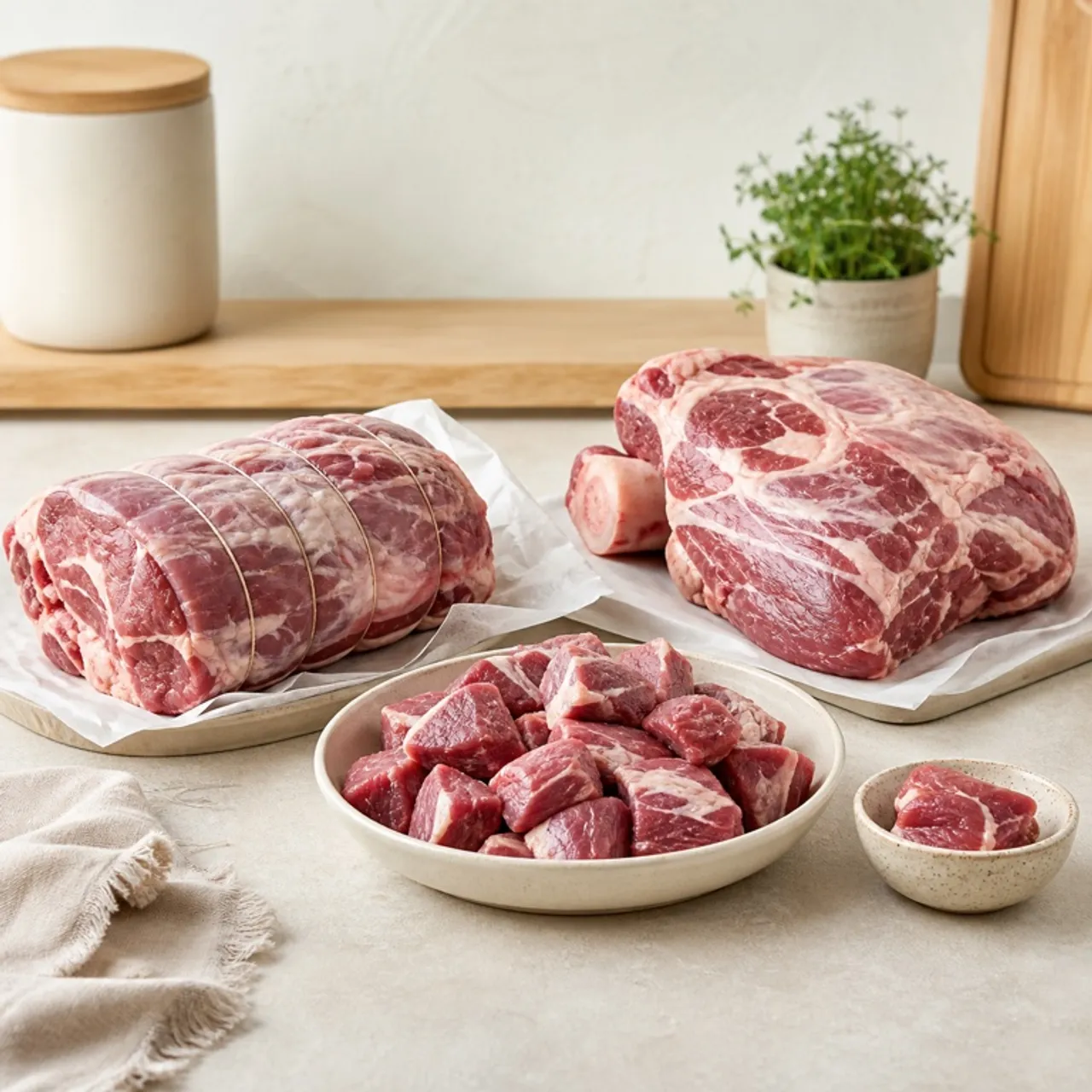
 Food Lens Images are for illustrative purposes only, may be inaccurate, and do not guarantee the presence or absence of specific ingredients.
 Food Lens · Recipe ingredients
Lamb Shoulder
Rich, deep, and distinctly gamey in the best sense — earthy and savory with a fat that turns sweet and silky after long cooking. Less bold than mutton, more complex than beef.
Lens VerifiedThe well-marbled, richly flavored front shoulder of a lamb — loaded with connective tissue and fat that render down to silky tenderness over long, slow cooking. It is the cut behind North African tagine, Greek kleftiko, and Middle Eastern slow-roasted lamb feasts.
Where it comes from
Sheep were among the first animals domesticated by humans, likely in the Fertile Crescent around 10,000 BCE, and lamb has been at the center of celebratory and everyday cooking across the Middle East, North Africa, and the Mediterranean ever since. Shoulder cuts traveled to North America with Greek, Lebanese, Moroccan, and South Asian immigrant communities and are now increasingly available in mainstream supermarkets as interest in diverse slow-cook traditions has grown.
Varieties — Bone-in shoulder (more flavor, harder to carve), boneless rolled shoulder (easier to portion), and diced shoulder (perfect for tagines and stews). Lamb shoulder vs leg: shoulder has more fat and connective tissue, making it better for braises and slow roasting.
In Greece, kleftiko (foil-wrapped slow-roasted lamb shoulder with lemon, garlic, and oregano) is a festive centerpiece — the name means 'stolen meat,' referencing the brigands who once cooked it buried in coals.
In a modern kitchen — Do not rush lamb shoulder — 160°C (325°F) for 4 hours beats 200°C (400°F) for 2 hours every time; the connective tissue needs sustained low heat to convert to gelatin.
Buying it
Look for deep pink-red meat with white (not yellow) fat — ivory fat can indicate older animal or poor feed. A bone-in shoulder will have more flavor; boneless is more practical for entertaining. Fresh is preferable; if frozen, thaw slowly in the refrigerator.
Storing it
Keep refrigerated in its packaging and use within a few days, or freeze for longer storage. A sticky surface or off smell means it should be discarded.
Keeps about 3 days in the fridge.
Out of lamb shoulder? Good swaps
- Lamb leg (bone-in) — 1:1 by weight; leaner, less connective tissue — better for medium-rare roasting, less ideal for braising
- Beef chuck roast — 1:1 by weight; similar connective tissue and slow-cook profile, milder flavor — works in most braises and stews
- Goat shoulder — 1:1; the closest comparison — similar fat-and-collagen profile with a slightly leaner, earthier result
General cooking guidance — always check the labels on the products you use. Listahan’s allergen checks run automatically when you plan a recipe in the app. Not medical advice.
Recipes that use lamb shoulder
Common questions about lamb shoulder
What can I use instead of lamb shoulder?
Good swaps include Lamb leg (bone-in), Beef chuck roast, Goat shoulder. Each behaves a little differently — see the swaps above for notes, and always check labels for allergens.
How do I store lamb shoulder?
Keep refrigerated in its packaging and use within a few days, or freeze for longer storage. A sticky surface or off smell means it should be discarded. It keeps about 3 days in the fridge.
More recipe ingredients
See all


Make lamb shoulder about your kitchen — with Listahan Pro
Everything above is free, forever. Pro adds the Household Lens — the same food, seen for your family:
-
Checked for each member
Flags lamb shoulder per person against your household's allergies and school rules — not just a generic "contains" tag.
-
Pantry-aware
Knows whether you already have it, what is running low, and the best swap from what is in your kitchen tonight.
-
What it costs near you
A real price from the Presyo community index, so you can plan the budget — not guess.
-
Your household memory
Who likes it, plus your own private notes — brand, where you keep it, who skips it.
Allergen safety is always free — Pro adds the automation, never the safety.
Cook with lamb shoulder — safely
Plan a recipe in Listahan and the household allergen check runs automatically — every plan, every swap, every lunchbox. Safety is never paywalled.