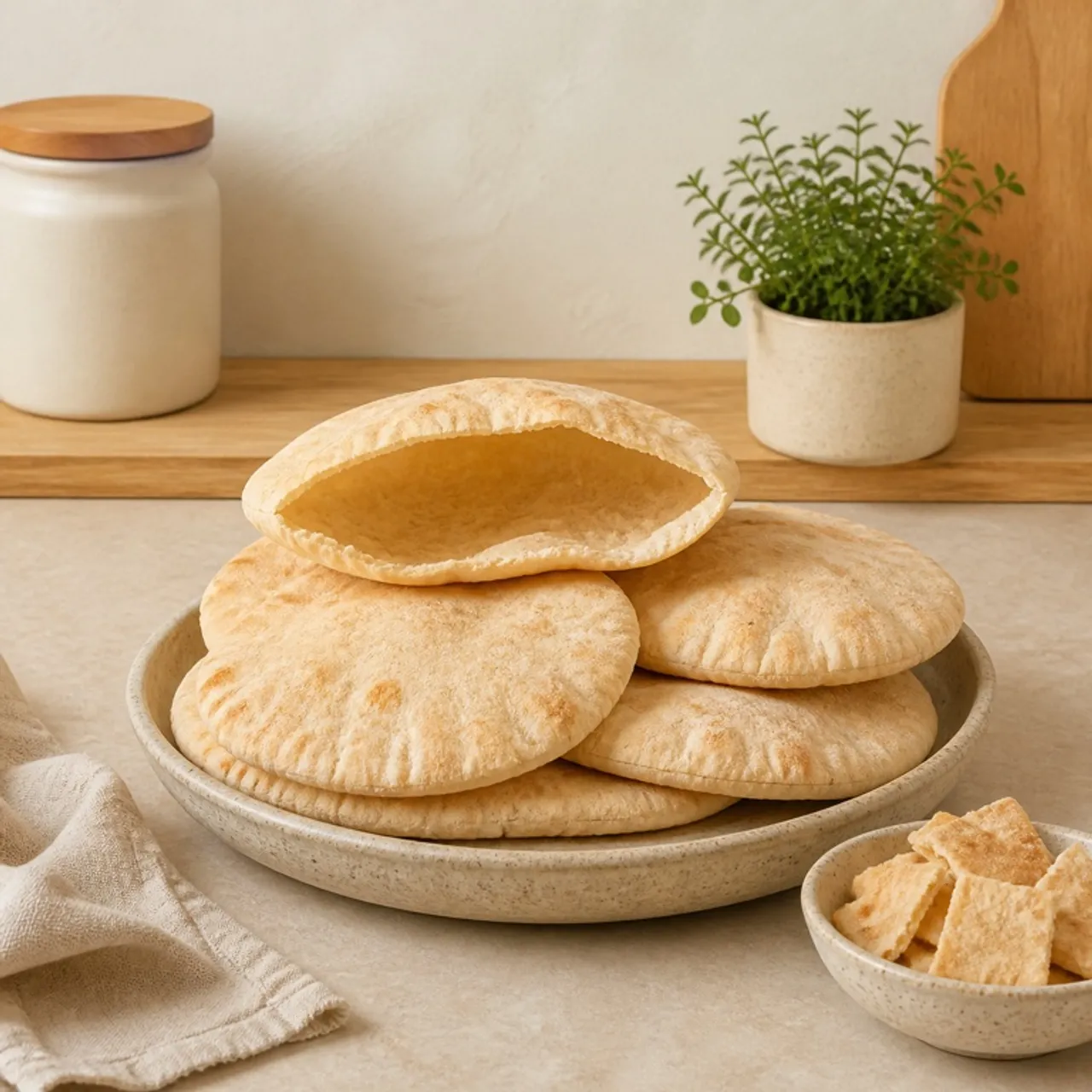
 Food Lens Images are for illustrative purposes only, may be inaccurate, and do not guarantee the presence or absence of specific ingredients.
 Food Lens · Recipe ingredients
Pita Breads
Mild, slightly yeasty, and wheaty with a soft, springy interior and a thin, slightly chewy crust. The pocket interior is tender and smooth.
Lens VerifiedPita is a round, leavened flatbread from the Middle East and Eastern Mediterranean, famous for the hollow pocket that forms when steam puffs the dough during baking. Soft and slightly chewy, it is one of the most practical breads in the world — the pocket can hold fillings, or the bread can be torn into pieces for scooping dips. It is a daily staple across Lebanon, Israel, Palestine, Greece, Turkey, and throughout the Arab world.
Where it comes from
Baked in clay ovens for thousands of years across the ancient Levant, pita's humble pocket has held together meals, cultures, and evening tables from Beirut to Athens.
Varieties — Standard pocket pita puffs into a hollow pouch during baking. Greek pita (used for gyros) is thicker and does not form a pocket. Whole wheat versions are common in health-oriented markets. Thin, cracker-like pita chips are made from baked or fried cut pieces.
Breaking bread — literally tearing pita at a shared table — is a powerful act of hospitality across the Middle East. In many homes, no meal is considered complete without it on the table.
In a modern kitchen — Warm pita in a dry skillet or directly over a gas flame for 30 seconds per side — it goes from forgettable to irresistible instantly.
Buying it
Look for pita that is soft and pliable with no dry or cracked edges. Freshness matters — day-old pita begins to stiffen. Whole wheat varieties should smell nutty, not musty. In Middle Eastern bakeries, fresh-baked pita is incomparably better than supermarket versions.
Storing it
Keep pita bread in a sealed bag at room temperature and use within a few days — refrigerating dries it out faster. For longer storage, freeze the pitas in a sealed bag and warm them straight from frozen.
Keeps about 1 year in the pantry.
Out of pita breads? Good swaps
- Lavash — Thinner and without a pocket — works as a wrap but won't hold fillings the same way
- Naan — Softer and richer due to yogurt in the dough — a reasonable swap for scooping dips
- Flour tortilla — More neutral in flavor but works structurally for wrapping fillings
General cooking guidance — always check the labels on the products you use. Listahan’s allergen checks run automatically when you plan a recipe in the app. Not medical advice.
Recipes that use pita breads
Common questions about pita breads
Is pita breads vegan?
Pita Breads is generally plant-based and suitable for a vegan diet, but brands differ — confirm on the label.
What can I use instead of pita breads?
Good swaps include Lavash, Naan, Flour tortilla. Each behaves a little differently — see the swaps above for notes, and always check labels for allergens.
How do I store pita breads?
Keep pita bread in a sealed bag at room temperature and use within a few days — refrigerating dries it out faster. For longer storage, freeze the pitas in a sealed bag and warm them straight from frozen. It keeps about 1 year in the pantry.
More recipe ingredients
See all


Make pita breads about your kitchen — with Listahan Pro
Everything above is free, forever. Pro adds the Household Lens — the same food, seen for your family:
-
Checked for each member
Flags pita breads per person against your household's allergies and school rules — not just a generic "contains" tag.
-
Pantry-aware
Knows whether you already have it, what is running low, and the best swap from what is in your kitchen tonight.
-
What it costs near you
A real price from the Presyo community index, so you can plan the budget — not guess.
-
Your household memory
Who likes it, plus your own private notes — brand, where you keep it, who skips it.
Allergen safety is always free — Pro adds the automation, never the safety.
Cook with pita breads — safely
Plan a recipe in Listahan and the household allergen check runs automatically — every plan, every swap, every lunchbox. Safety is never paywalled.