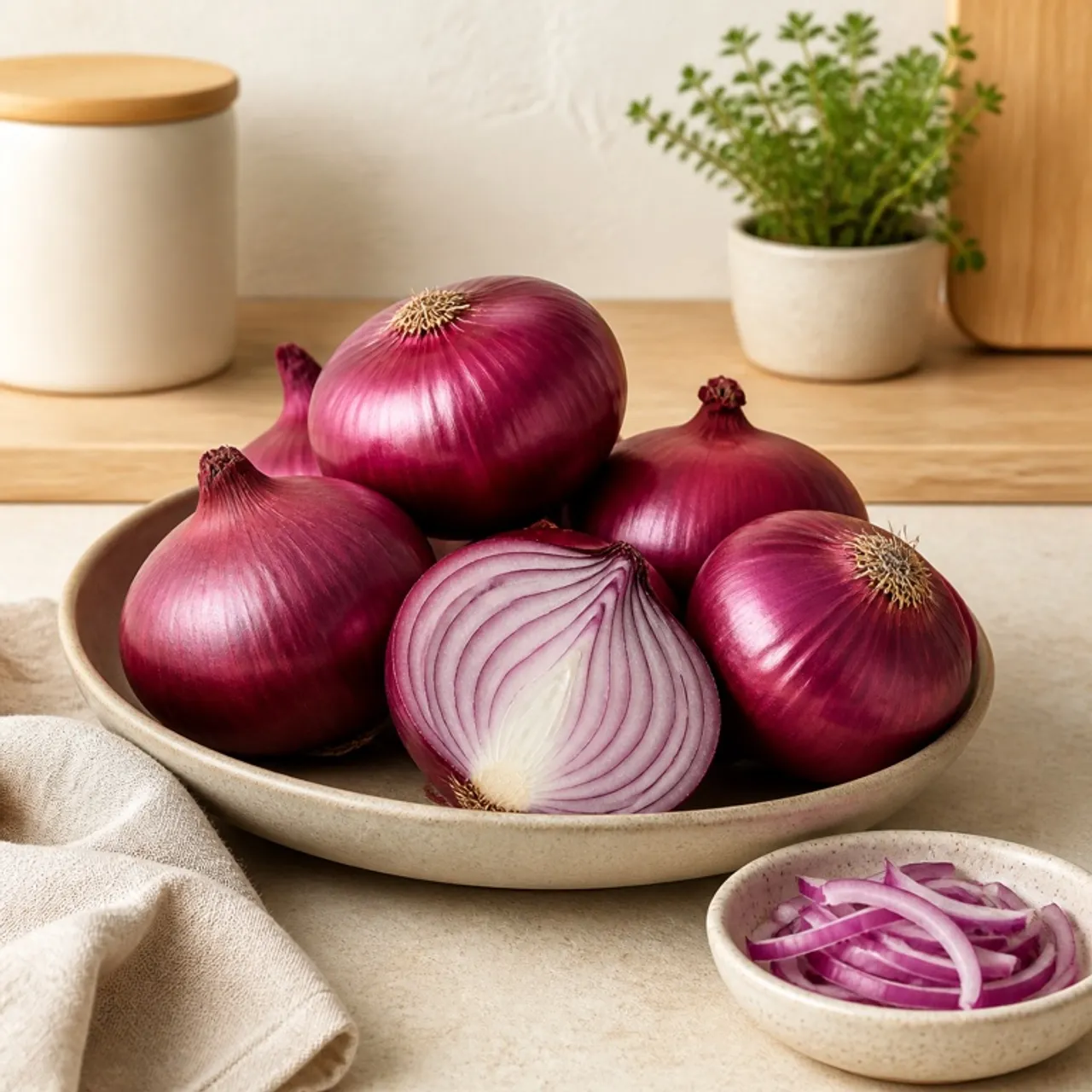
 Food Lens Images are for illustrative purposes only, may be inaccurate, and do not guarantee the presence or absence of specific ingredients.
 Food Lens · Recipe ingredients
Red Onions
Mild and faintly sweet when raw with a gentle sharpness; less pungent than yellow onions raw; caramelizes to a deep sweetness when cooked.
Lens VerifiedRed onions are a mild, slightly sweet allium with striking purple-red skin and crisp, magenta-tinged layers, preferred raw in salads and sandwiches or quick-pickled as a vibrant condiment.
Where it comes from
Onions are among the oldest cultivated vegetables in human history, originating in Central Asia and spreading across every inhabited continent. Red varieties were prized across the Mediterranean and in India for their milder, sweeter character compared to white and yellow onions. European settlers and Asian immigrants brought their preferred onion types to North America, and red onions gradually became a distinct grocery category by the 20th century, appreciated for their visual appeal and gentler raw flavor. Today they are a versatile staple in both traditional recipes and contemporary restaurant cooking.
Varieties — Most red onions in North American stores are the standard large round type. Tropea onions from Calabria, Italy, are elongated, sweeter, and celebrated locally. Small red onion varieties are common in South and Southeast Asian cooking, where they overlap with shallots.
Quick-pickled red onion is a staple topping in Mexican tacos and tortas; fattoush and Lebanese tabbouleh often feature raw red onion; South Asian fried red onion is the crunchy topping on biryanis and haleem.
In a modern kitchen — To mellow raw red onion's sharpness without cooking, soak thinly sliced rings in cold water with a splash of white vinegar for 10–15 minutes, then drain. For quick pickled red onion, pour hot rice or apple cider vinegar brine (with a pinch of sugar and salt) over thin-sliced onion and let sit 20 minutes — it's ready to use and keeps in the fridge for up to 2 weeks.
Buying it
Choose firm, heavy onions with dry, papery outer skins that are deep purple-red and crackle when squeezed. No soft spots, dampness, or sprouting. Smaller red onions are often milder and sweeter than very large ones. Avoid any with mold, cuts, or green sprouts pushing through the skin.
Storing it
Store red onions in a cool, dry, well-ventilated spot, ideally not sealed in plastic, which traps moisture and speeds spoilage. Keep them away from potatoes, which can make onions sprout or soften faster.
Keeps about 1 year in the pantry.
Out of red onions? Good swaps
- Shallots — Milder and more refined; use same amount in raw preparations and vinaigrettes
- Yellow onion — More pungent and harsh raw; better for cooked applications — soak in water first if using raw
- White onion — Sharper raw but similar sharpness; use 1:1 — good in Mexican and Latin preparations
General cooking guidance — always check the labels on the products you use. Listahan’s allergen checks run automatically when you plan a recipe in the app. Not medical advice.
Recipes that use red onions
Common questions about red onions
Is red onions vegan?
Red Onions is generally plant-based and suitable for a vegan diet, but brands differ — confirm on the label.
What can I use instead of red onions?
Good swaps include Shallots, Yellow onion, White onion. Each behaves a little differently — see the swaps above for notes, and always check labels for allergens.
How do I store red onions?
Store red onions in a cool, dry, well-ventilated spot, ideally not sealed in plastic, which traps moisture and speeds spoilage. Keep them away from potatoes, which can make onions sprout or soften faster. It keeps about 1 year in the pantry.
More recipe ingredients
See all


Make red onions about your kitchen — with Listahan Pro
Everything above is free, forever. Pro adds the Household Lens — the same food, seen for your family:
-
Checked for each member
Flags red onions per person against your household's allergies and school rules — not just a generic "contains" tag.
-
Pantry-aware
Knows whether you already have it, what is running low, and the best swap from what is in your kitchen tonight.
-
What it costs near you
A real price from the Presyo community index, so you can plan the budget — not guess.
-
Your household memory
Who likes it, plus your own private notes — brand, where you keep it, who skips it.
Allergen safety is always free — Pro adds the automation, never the safety.
Cook with red onions — safely
Plan a recipe in Listahan and the household allergen check runs automatically — every plan, every swap, every lunchbox. Safety is never paywalled.