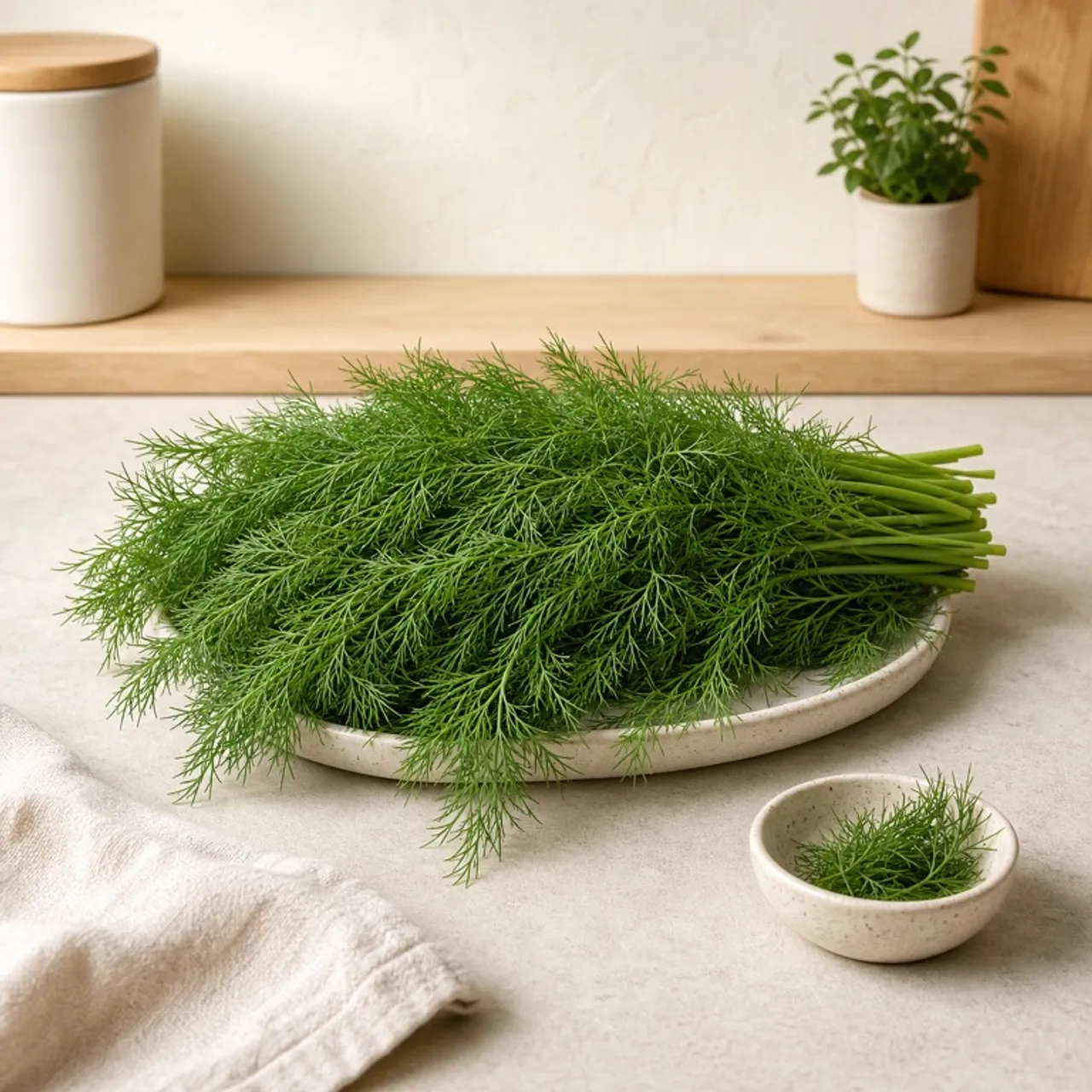
 Food Lens Images are for illustrative purposes only, may be inaccurate, and do not guarantee the presence or absence of specific ingredients.
 Food Lens · Produce
Dill
Bright, grassy, and lightly anise-like with a clean, fresh finish; slightly tangy when combined with dairy.
Lens VerifiedDill is a feathery, aromatic herb with a bright, grassy-anise flavor used extensively in Scandinavian, Eastern European, and Middle Eastern cooking. Both its fronds and seeds are edible, though fresh fronds are most common in home kitchens.
Where it comes from
Dill has been found in Egyptian tombs and was prized by ancient Greeks and Romans as both a culinary herb and a remedy. Traders carried it along spice routes into Northern and Eastern Europe, where it became embedded in pickling traditions that defined food preservation for centuries. Immigrants from those regions brought their dill-forward recipes to North America, and it remains a staple in delicatessen and Eastern European cooking across the continent.
Varieties — Fernleaf dill is a compact variety; Bouquet dill is the tall standard type common in supermarkets. Dill seed (dried) has a more concentrated flavor and is a distinct pantry item.
Dill is the key herb in Scandinavian gravlax, Russian solyanka soup, and Georgian walnut sauces; in Iranian cuisine it seasons rice (shevid polo) and herb frittata (kuku sabzi).
In a modern kitchen — Add fresh dill at the very end of cooking — heat destroys its volatile oils quickly. Store stems in a jar of water like cut flowers, loosely covered with a bag in the fridge, for up to a week.
Buying it
Choose bright green, feathery fronds with no yellowing or wilting. Stems should smell strongly of dill when gently crushed. Avoid bunches with slimy stems or brown tips.
Storing it
Refrigerate wrapped loosely in a damp paper towel or standing in a glass of water like fresh-cut flowers. Fronds that turn yellow or slimy have passed their best.
Keeps about 7 days in the fridge.
In season
Peak season is May–August, though it's available year-round.
Fresh dill is locally abundant from late spring through summer; greenhouse and shipped herbs fill the rest of the year.
Out of dill? Good swaps
- Fennel fronds — Closest texture and flavor; use 1:1 — slightly sweeter but works well in fish and salads
- Tarragon — More pronounced anise note; use about half the amount; best in cream sauces
- Fresh parsley + a pinch of dried dill seed — Mimics the fresh green color with a hint of dill flavor; useful when fresh dill is unavailable
General cooking guidance — always check the labels on the products you use. Listahan’s allergen checks run automatically when you plan a recipe in the app. Not medical advice.
Recipes that use dill
Common questions about dill
Is dill vegan?
Dill is generally plant-based and suitable for a vegan diet, but brands differ — confirm on the label.
What can I use instead of dill?
Good swaps include Fennel fronds, Tarragon, Fresh parsley + a pinch of dried dill seed. Each behaves a little differently — see the swaps above for notes, and always check labels for allergens.
How do I store dill?
Refrigerate wrapped loosely in a damp paper towel or standing in a glass of water like fresh-cut flowers. Fronds that turn yellow or slimy have passed their best. It keeps about 7 days in the fridge.
More produce
See all


Make dill about your kitchen — with Listahan Pro
Everything above is free, forever. Pro adds the Household Lens — the same food, seen for your family:
-
Checked for each member
Flags dill per person against your household's allergies and school rules — not just a generic "contains" tag.
-
Pantry-aware
Knows whether you already have it, what is running low, and the best swap from what is in your kitchen tonight.
-
What it costs near you
A real price from the Presyo community index, so you can plan the budget — not guess.
-
Your household memory
Who likes it, plus your own private notes — brand, where you keep it, who skips it.
Allergen safety is always free — Pro adds the automation, never the safety.
Cook with dill — safely
Plan a recipe in Listahan and the household allergen check runs automatically — every plan, every swap, every lunchbox. Safety is never paywalled.