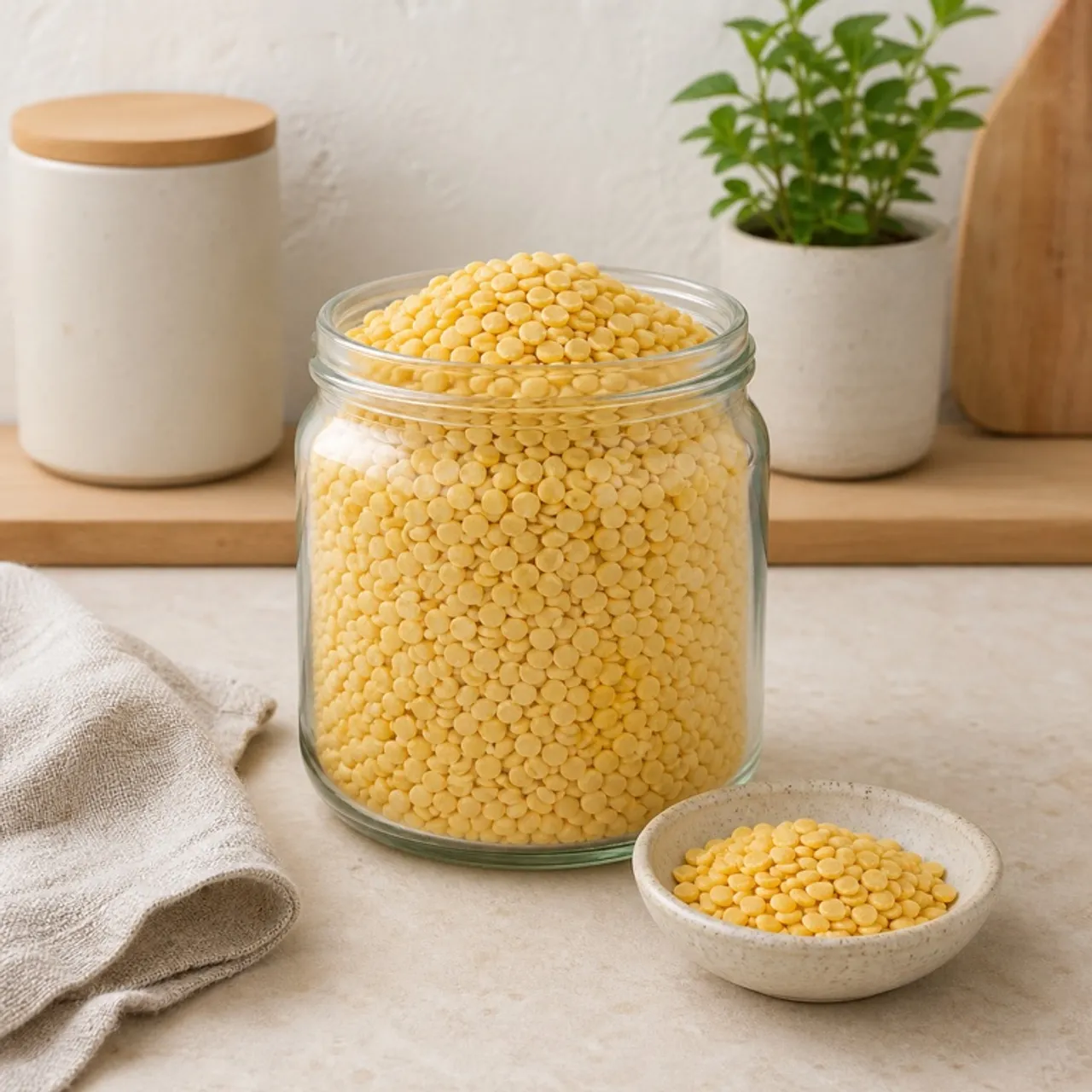
 Food Lens Images are for illustrative purposes only, may be inaccurate, and do not guarantee the presence or absence of specific ingredients.
 Food Lens · Recipe ingredients
Split Mung Beans
Mild, earthy, and slightly sweet with a creamy, soft texture after cooking. The flavor is subtle enough to take on the character of whatever it's cooked with — coconut milk, garlic, ginger, or chili.
Lens VerifiedSplit mung beans — called moong dal in South Asian cooking and munggo in the Philippines — are hulled, halved mung beans that cook far faster than their whole counterparts. Without the green hull, they reveal a soft golden interior that turns creamy and silky when simmered. They are one of the most versatile legumes in tropical and South Asian kitchens, equally at home in savory soups and sweet porridges.
Where it comes from
From South Asia's ancient fields to the Friday supper tables of the Philippines, split mung beans have fed families across centuries and continents.
Varieties — Yellow split mung beans (hulled) are the most common form; green whole mung beans still have their hull on. In South Asia the hulled form is called 'moong dal'; in the Philippines the whole bean is called 'munggo' but split forms are increasingly available and used interchangeably in simple dishes.
In the Philippines, Friday monggo soup is almost a cultural ritual, tied to Catholic meatless traditions and carried across generations. In Ayurvedic cooking, split mung beans are considered one of the most digestible foods.
In a modern kitchen — Split mung beans need no soaking — a 20-minute simmer is enough — making them one of the fastest-cooking legumes for weeknight meals.
Buying it
Look for bright yellow, uniform split beans with no visible moisture or off smell. Freshness matters — older stock can take longer to soften and may taste slightly stale. Sold in Asian grocery stores, Indian markets, and increasingly mainstream supermarkets, often labeled 'moong dal' or 'split mung beans.'
Storing it
Store split mung beans (moong dal) in a sealed container in a cool, dry spot away from humidity and pests. They keep indefinitely from a safety standpoint, but older beans take longer to cook soft.
Keeps about 1 year in the pantry.
Out of split mung beans? Good swaps
- Red lentils (masoor dal) — Closest swap — similar quick cook time and creamy result, slightly earthier flavor
- Yellow split peas — Takes longer to cook but gives a similar thick, comforting result
- Whole mung beans — Need soaking and longer cooking, but the flavor is essentially the same
General cooking guidance — always check the labels on the products you use. Listahan’s allergen checks run automatically when you plan a recipe in the app. Not medical advice.
Recipes that use split mung beans
Common questions about split mung beans
Is split mung beans vegan?
Split Mung Beans is generally plant-based and suitable for a vegan diet, but brands differ — confirm on the label.
What can I use instead of split mung beans?
Good swaps include Red lentils (masoor dal), Yellow split peas, Whole mung beans. Each behaves a little differently — see the swaps above for notes, and always check labels for allergens.
How do I store split mung beans?
Store split mung beans (moong dal) in a sealed container in a cool, dry spot away from humidity and pests. They keep indefinitely from a safety standpoint, but older beans take longer to cook soft. It keeps about 1 year in the pantry.
More recipe ingredients
See all


Make split mung beans about your kitchen — with Listahan Pro
Everything above is free, forever. Pro adds the Household Lens — the same food, seen for your family:
-
Checked for each member
Flags split mung beans per person against your household's allergies and school rules — not just a generic "contains" tag.
-
Pantry-aware
Knows whether you already have it, what is running low, and the best swap from what is in your kitchen tonight.
-
What it costs near you
A real price from the Presyo community index, so you can plan the budget — not guess.
-
Your household memory
Who likes it, plus your own private notes — brand, where you keep it, who skips it.
Allergen safety is always free — Pro adds the automation, never the safety.
Cook with split mung beans — safely
Plan a recipe in Listahan and the household allergen check runs automatically — every plan, every swap, every lunchbox. Safety is never paywalled.