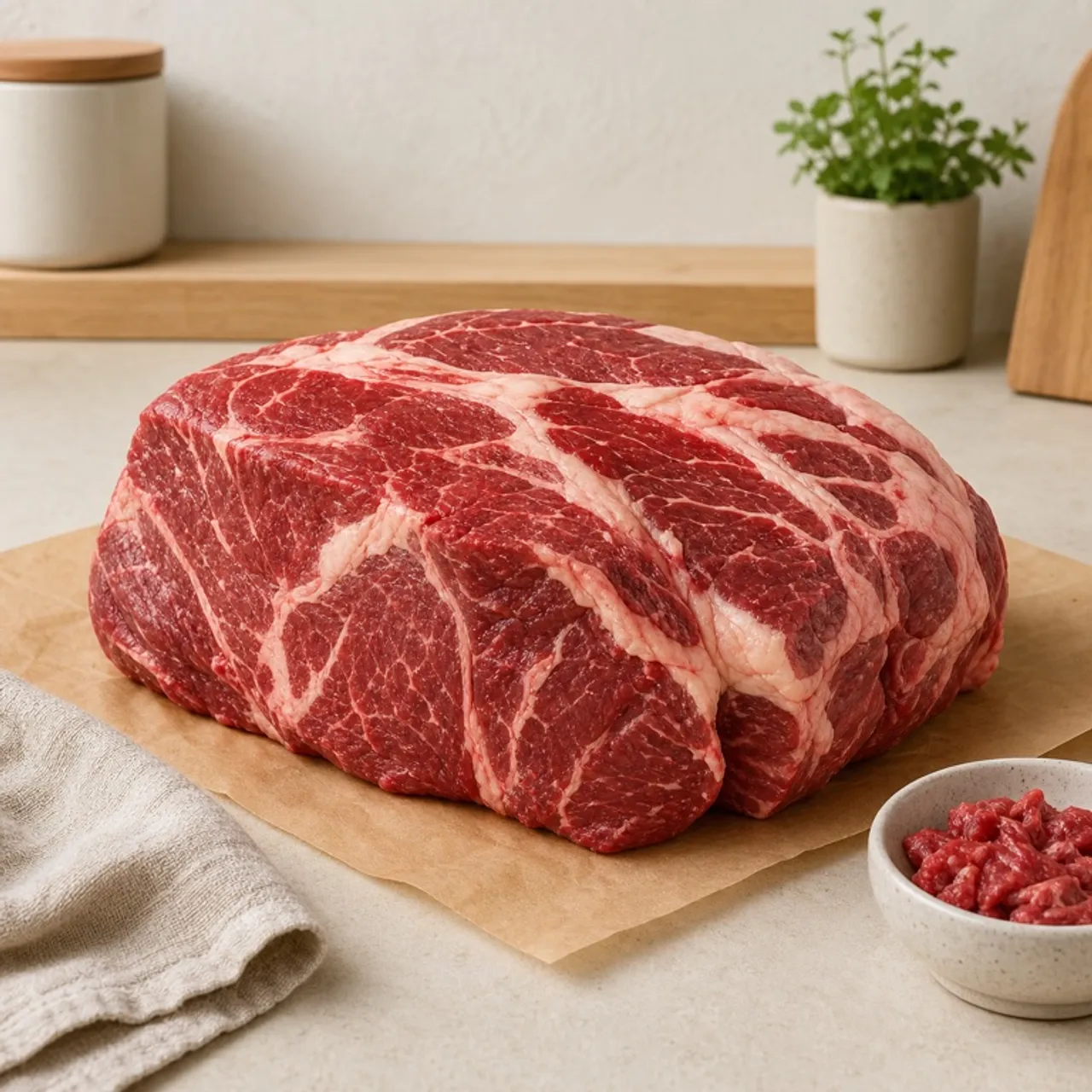
 Food Lens Images are for illustrative purposes only, may be inaccurate, and do not guarantee the presence or absence of specific ingredients.
 Food Lens · Protein
Chuck roast
Deeply beefy, rich, and savory; falls apart tender after braising; cooking liquid becomes a glossy, gelatin-rich sauce.
Lens VerifiedChuck roast is a well-marbled cut from the shoulder and neck region of the steer. Its abundant connective tissue makes it tough when undercooked, but low-and-slow braising transforms it into fork-tender, richly flavored meat — it is the classic pot roast cut.
Where it comes from
Chuck roast has fed families economically for centuries because shoulder muscles work hard and need long cooking to become tender. European immigrant cooking traditions — Irish, Italian, Jewish brisket cookery — all converged in North America around the slow-braised shoulder roast. It became the backbone of classic American pot roast, a dish that defined mid-twentieth century home cooking.
Varieties — Sold bone-in or boneless. Sub-cuts include chuck eye (more tender, near the rib), flat-iron (lean muscle within the shoulder), and blade roast. Often labeled 'beef chuck' or 'shoulder roast' interchangeably.
The Sunday pot roast is a deeply nostalgic North American tradition — chuck roast slow-braised with root vegetables has anchored family tables for over a century.
In a modern kitchen — Collagen converts to gelatin at low temperatures over long time — around 160–180°F (71–82°C) for several hours. Braising at a gentle simmer (not a rolling boil) is key; high heat toughens the protein fibers before the collagen has time to dissolve.
Buying it
Look for generous marbling throughout the flesh — fat streaks mean gelatin-rich connective tissue that melts into the braise. A 3–4 lb roast is ideal for 4–6 servings. Avoid very lean pieces labeled 'chuck' — they will not braise as well.
Storing it
Keep refrigerated in its packaging and cook or freeze within a few days. A tacky surface, gray color throughout, or sour smell signal it's no longer good.
Keeps about 4 days in the fridge.
Out of chuck roast? Good swaps
- Beef brisket — Similar connective tissue content; longer cook time; 1:1 by weight in braises
- Bone-in short ribs — Richer fat and more luxurious texture; higher price; works beautifully in the same braising liquid
- Beef round roast — Leaner and less marbled; will not shred as tenderly; acceptable in stews where texture is less critical
General cooking guidance — always check the labels on the products you use. Listahan’s allergen checks run automatically when you plan a recipe in the app. Not medical advice.
Recipes that use chuck roast
Common questions about chuck roast
What can I use instead of chuck roast?
Good swaps include Beef brisket, Bone-in short ribs, Beef round roast. Each behaves a little differently — see the swaps above for notes, and always check labels for allergens.
How do I store chuck roast?
Keep refrigerated in its packaging and cook or freeze within a few days. A tacky surface, gray color throughout, or sour smell signal it's no longer good. It keeps about 4 days in the fridge.
More protein
See all


Make chuck roast about your kitchen — with Listahan Pro
Everything above is free, forever. Pro adds the Household Lens — the same food, seen for your family:
-
Checked for each member
Flags chuck roast per person against your household's allergies and school rules — not just a generic "contains" tag.
-
Pantry-aware
Knows whether you already have it, what is running low, and the best swap from what is in your kitchen tonight.
-
What it costs near you
A real price from the Presyo community index, so you can plan the budget — not guess.
-
Your household memory
Who likes it, plus your own private notes — brand, where you keep it, who skips it.
Allergen safety is always free — Pro adds the automation, never the safety.
Cook with chuck roast — safely
Plan a recipe in Listahan and the household allergen check runs automatically — every plan, every swap, every lunchbox. Safety is never paywalled.