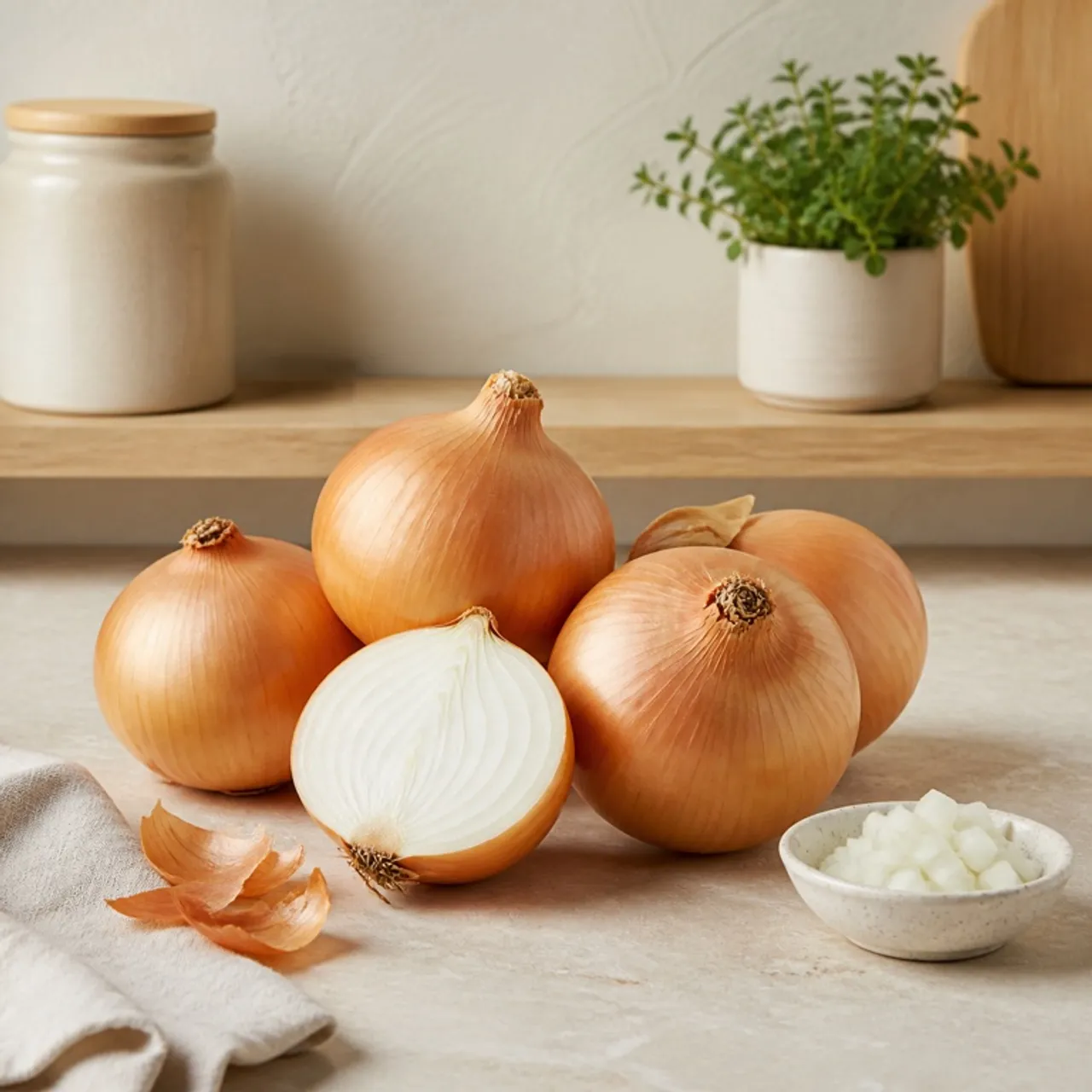
 Food Lens Images are for illustrative purposes only, may be inaccurate, and do not guarantee the presence or absence of specific ingredients.
 Food Lens · Recipe ingredients
Yellow Onions
Pungent and sharp when raw, with a sulfurous bite; transforms into deep, sweet, and almost jammy richness after long cooking.
Lens VerifiedThe workhorse onion of North American kitchens — yellow-skinned with a pungent raw bite that mellows into deep, sweet savouriness when cooked. It is the foundation of soffritto, mirepoix, and caramelized-onion everything.
Where it comes from
Yellow onions trace their cultivation back thousands of years across Central Asia and the Mediterranean, arriving in North America with European settlers who prized their long shelf life through harsh winters. Today they are the default "onion" in virtually every North American supermarket and the unsung hero behind soups, stews, and braises across every cuisine.
Varieties — Standard yellow storage onions are the everyday choice; sweet onions (Vidalia, Walla Walla) are a milder seasonal cousin; shallots and red onions are separate entries.
The backbone of French onion soup and the essential start of Italian soffritto — both cuisines built their flavor architecture around slowly cooked yellow onions.
In a modern kitchen — For faster caramelization, add a small pinch of baking soda to the pan — it accelerates browning without burning.
Buying it
Choose firm bulbs with dry, papery skins and no soft spots or sprouting. Larger onions are easier to dice; smaller ones are good for pickling or roasting whole.
Storing it
Store in a cool, dark, well-ventilated spot, not the fridge, and keep away from potatoes, which make onions spoil faster. Soft spots or sprouting mean it's on its way out.
Keeps about 1 year in the pantry.
Out of yellow onions? Good swaps
- White onions — 1:1 swap; slightly sharper and less sweet, but works in virtually any recipe
- Shallots — Use 3 shallots per 1 medium onion; more delicate and subtly garlicky — great for vinaigrettes and pan sauces
- Leeks (white and light green parts) — 1:1 by volume; milder and sweeter, best in soups and braises
General cooking guidance — always check the labels on the products you use. Listahan’s allergen checks run automatically when you plan a recipe in the app. Not medical advice.
Recipes that use yellow onions
Common questions about yellow onions
Is yellow onions vegan?
Yellow Onions is generally plant-based and suitable for a vegan diet, but brands differ — confirm on the label.
What can I use instead of yellow onions?
Good swaps include White onions, Shallots, Leeks (white and light green parts). Each behaves a little differently — see the swaps above for notes, and always check labels for allergens.
How do I store yellow onions?
Store in a cool, dark, well-ventilated spot, not the fridge, and keep away from potatoes, which make onions spoil faster. Soft spots or sprouting mean it's on its way out. It keeps about 1 year in the pantry.
More recipe ingredients
See all


Make yellow onions about your kitchen — with Listahan Pro
Everything above is free, forever. Pro adds the Household Lens — the same food, seen for your family:
-
Checked for each member
Flags yellow onions per person against your household's allergies and school rules — not just a generic "contains" tag.
-
Pantry-aware
Knows whether you already have it, what is running low, and the best swap from what is in your kitchen tonight.
-
What it costs near you
A real price from the Presyo community index, so you can plan the budget — not guess.
-
Your household memory
Who likes it, plus your own private notes — brand, where you keep it, who skips it.
Allergen safety is always free — Pro adds the automation, never the safety.
Cook with yellow onions — safely
Plan a recipe in Listahan and the household allergen check runs automatically — every plan, every swap, every lunchbox. Safety is never paywalled.