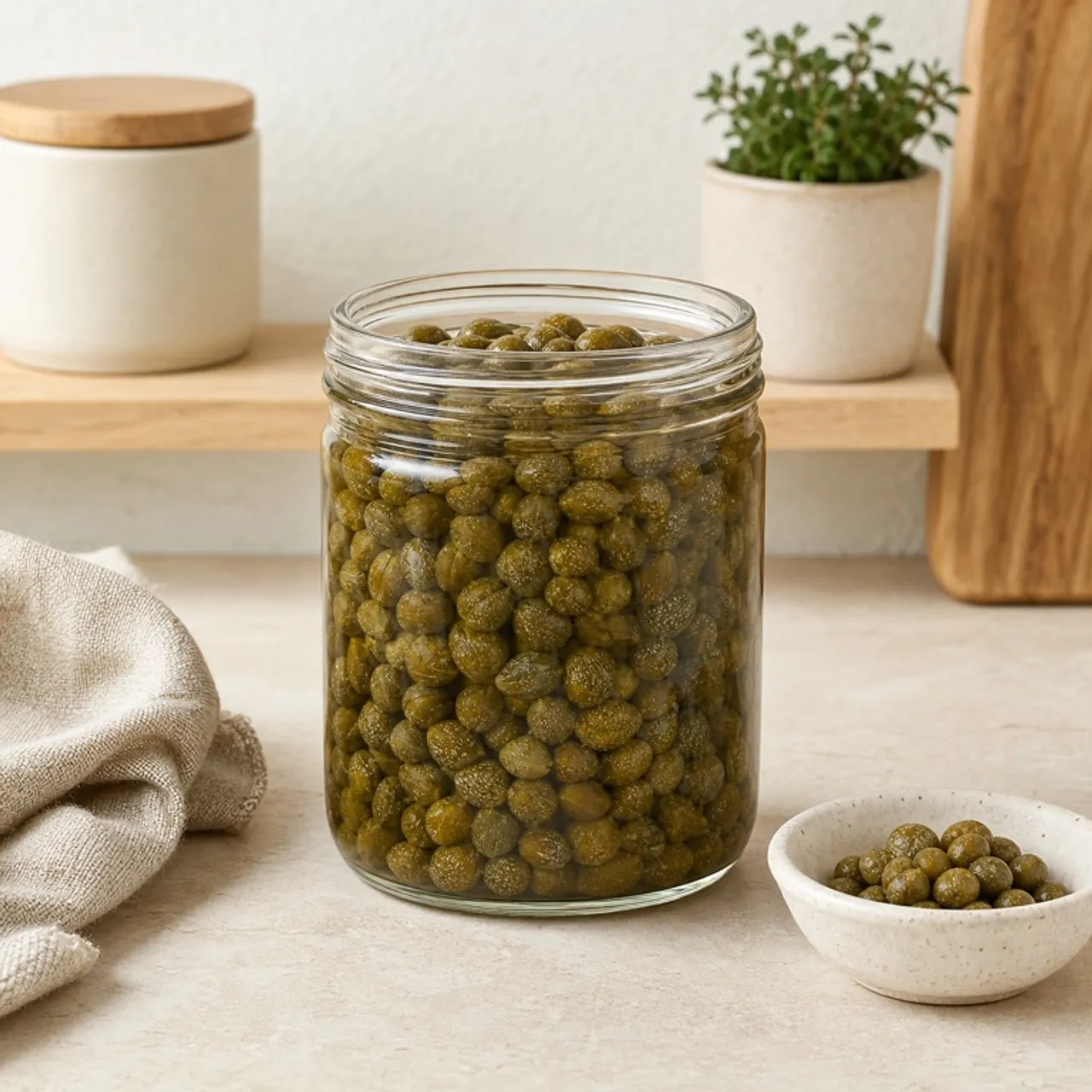
 Food Lens Images are for illustrative purposes only, may be inaccurate, and do not guarantee the presence or absence of specific ingredients.
 Food Lens · Condiments
Capers
Intensely briny and tangy with a delicate floral bitterness and a firm, satisfying pop when bitten.
Lens VerifiedCapers are the small, pickled flower buds of the Capparis spinosa plant, native to the Mediterranean, with an intensely briny, slightly floral, and pleasantly sharp flavor that punches far above their size. They are essential in Italian, Spanish, and Greek cooking, appearing in pasta puttanesca, chicken piccata, and smoked salmon boards.
Where it comes from
Growing wild on rocky coastal cliffs from Spain to Turkey, the caper bush has fed Mediterranean cooks for thousands of years — the buds hand-picked each morning before they flower, then preserved in salt or brine to carry their bright, pickled character through every season. Sicilian and Spanish immigrants carried this pantry staple to North America, and capers are now found in most mainstream grocery stores, usually near the olives and condiments.
Varieties — Capers are sold in two main forms: brined capers (most common, packed in a vinegar brine) and salt-packed capers (more intensely flavored and firmer, preferred in Italian cooking). Caper berries — the matured fruit — are larger, milder, and also sold in brine.
Pasta puttanesca — a pungent, assertive sauce from Naples made with olives, anchovies, tomatoes, and capers — is considered one of the defining dishes of southern Italian pantry cooking. In Sephardic Jewish cuisine, capers appear in a range of cooked fish and vegetable dishes.
In a modern kitchen — Brined capers can go straight into a dish, but salt-packed capers need a 15-minute soak in cold water and a rinse before use to remove excess salt. A brief sauté in olive oil makes either form pop with intensified flavor.
Buying it
Look for firm, tightly closed buds — open or mushy capers have lost texture. Brined capers should be packed in a clear vinegar-water brine, not an oily sauce. Salt-packed Pantelleria capers are a premium choice for serious cooking. After opening, keep refrigerated submerged in their liquid.
Storing it
Store unopened jars in a cool, dark pantry. Once opened, keep the jar sealed and submerged in its brine in the fridge — they dry out and darken if left exposed to air.
Keeps about 1 year in the pantry.
Out of capers? Good swaps
- Green olives (chopped) — Use an equal volume of finely chopped pitted green olives — briny and salty, though less floral.
- Pickled green peppercorns — Use 1:1 — different flavor (peppery) but similar brine intensity and small size work well in sauces.
- Finely chopped dill pickles — Use 1.5:1 by volume — adds vinegar brightness and brininess, works well in tartar sauce and dressings.
General cooking guidance — always check the labels on the products you use. Listahan’s allergen checks run automatically when you plan a recipe in the app. Not medical advice.
Recipes that use capers
Common questions about capers
Is capers vegan?
Capers is generally plant-based and suitable for a vegan diet, but brands differ — confirm on the label.
What can I use instead of capers?
Good swaps include Green olives (chopped), Pickled green peppercorns, Finely chopped dill pickles. Each behaves a little differently — see the swaps above for notes, and always check labels for allergens.
How do I store capers?
Store unopened jars in a cool, dark pantry. Once opened, keep the jar sealed and submerged in its brine in the fridge — they dry out and darken if left exposed to air. It keeps about 1 year in the pantry.
More condiments
See all


Make capers about your kitchen — with Listahan Pro
Everything above is free, forever. Pro adds the Household Lens — the same food, seen for your family:
-
Checked for each member
Flags capers per person against your household's allergies and school rules — not just a generic "contains" tag.
-
Pantry-aware
Knows whether you already have it, what is running low, and the best swap from what is in your kitchen tonight.
-
What it costs near you
A real price from the Presyo community index, so you can plan the budget — not guess.
-
Your household memory
Who likes it, plus your own private notes — brand, where you keep it, who skips it.
Allergen safety is always free — Pro adds the automation, never the safety.
Cook with capers — safely
Plan a recipe in Listahan and the household allergen check runs automatically — every plan, every swap, every lunchbox. Safety is never paywalled.