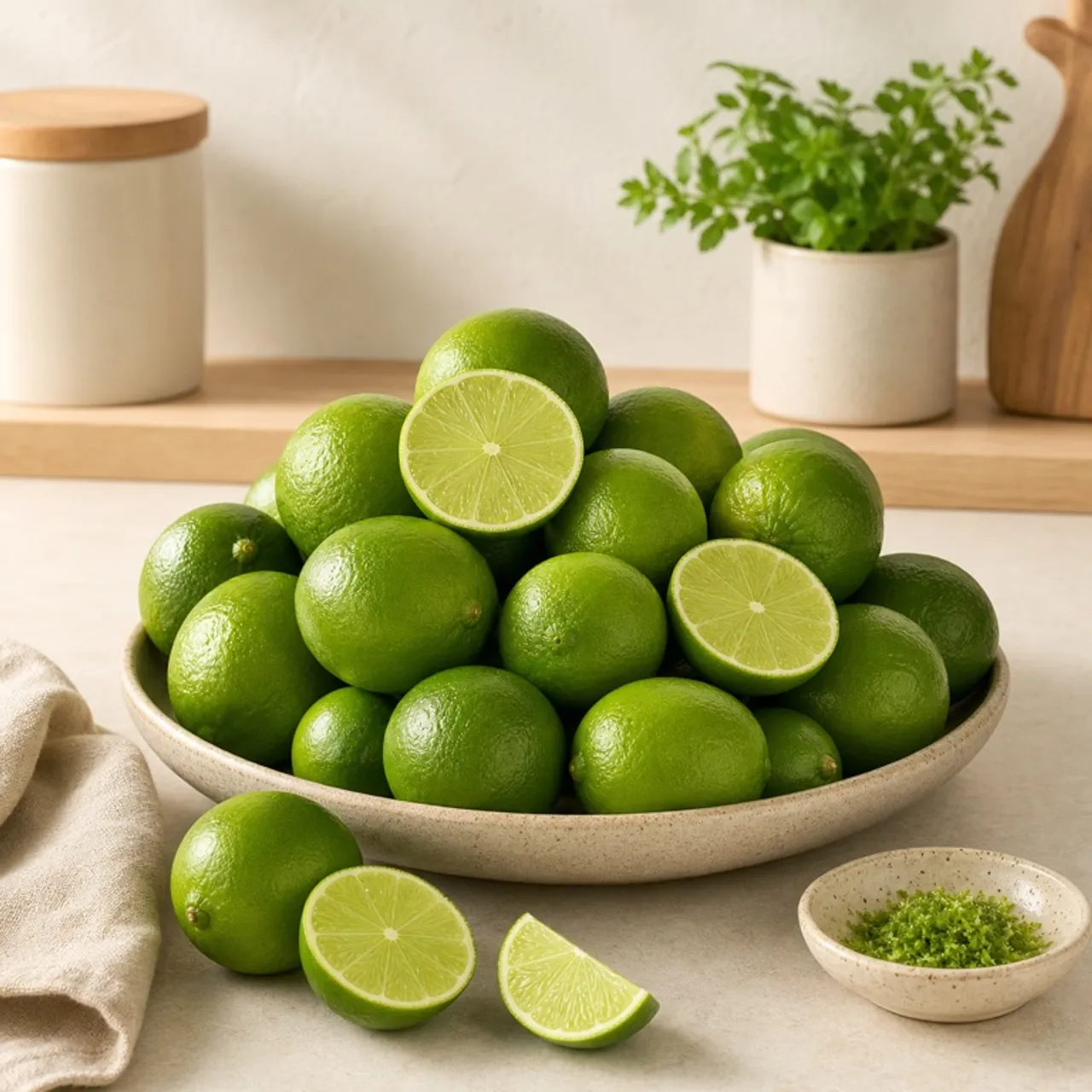
 Food Lens Images are for illustrative purposes only, may be inaccurate, and do not guarantee the presence or absence of specific ingredients.
 Food Lens · Produce
Limes
Sharply tart and bright with a floral citrus aroma; Persian limes are clean and acidic; Key limes are slightly more complex with a gentle floral sweetness behind the tartness.
Lens VerifiedLimes are intensely tart, aromatic citrus fruits used as a souring agent and flavoring across Latin American, Southeast Asian, Caribbean, and South Asian cuisines — their juice and zest brighten everything they touch.
Where it comes from
Limes are native to Southeast Asia and were carried westward by Arab traders, becoming an important crop in the Middle East and eventually in the Mediterranean and Africa. Spanish and Portuguese explorers brought them to the Americas in the 15th and 16th centuries, where the climate of Mexico, the Caribbean, and Florida proved ideal for cultivation. Key limes, now associated with Florida, actually became widely grown there after seeds arrived from the Caribbean. Persian limes — a seedless hybrid — became the commercial standard by the 20th century, dominating supermarket shelves across North America.
Varieties — Persian lime (Tahitian lime) is the large, seedless, thick-skinned variety available year-round in North American supermarkets — the standard 'lime' you see everywhere. Key lime (Mexican lime) is smaller, rounder, more aromatic, and more floral, with a thinner skin and a sweeter-tart balance — famous in Key lime pie.
Lime is foundational to Mexican guacamole, ceviche across Latin America, Thai tom yum and green papaya salad, Filipino sinigang and kinilaw, Vietnamese pho garnishes, and the Mojito and Daiquiri cocktail families.
In a modern kitchen — Microwave a lime for 10–15 seconds and roll it firmly on the counter before juicing — this breaks down the inner membranes and extracts up to 50% more juice. Zest before cutting and juicing; zesting a juiced lime is much harder.
Buying it
Choose limes that feel heavy and dense for their size — lightweight limes have dried out inside and yield little juice. Skin should be smooth and bright green (some yellow is fine and may indicate higher ripeness and sweetness). Firm limes are fine for zesting; limes that yield slightly to pressure have more juice.
Storing it
Keep limes in the fridge crisper for the longest life, though they'll also hold a few days on the counter. Softening, wrinkled skin or mold spots are signs they're past their best.
Keeps about 21 days in the fridge.
In season
Peak season is May–August, though it's available year-round.
Limes are mostly imported and broadly available all year, with better supply often in late spring through summer.
Out of limes? Good swaps
- Lemon juice — Use 1:1 — slightly less floral and more straightforwardly tart; fine in most savory dishes and cocktails
- Rice vinegar — For souring Asian dishes; use ½ the amount and dilute slightly — no citrus aroma
- White wine vinegar — For Latin applications; use ½ the amount — adds tartness without the lime flavor
General cooking guidance — always check the labels on the products you use. Listahan’s allergen checks run automatically when you plan a recipe in the app. Not medical advice.
Recipes that use limes
- Pla Pao
- Saltfish Buljol
- Khanom Jeen Nam Ya
- Elote (Mexican Street Corn)
- Black Bean Dip
- Tom Kha Gai
- Phở Gà (Chicken Noodle Soup)
- Gỏi Gà Trộn Hành Tây (Chicken and Onion Salad)
- Beef Serunding
- Peanut Satay Sauce
- Bún Đậu Mắm Tôm (Noodles with Tofu and Shrimp Paste)
- Betty Crocker's Southwestern Guacamole Dip
Common questions about limes
Is limes vegan?
Limes is generally plant-based and suitable for a vegan diet, but brands differ — confirm on the label.
What can I use instead of limes?
Good swaps include Lemon juice, Rice vinegar, White wine vinegar. Each behaves a little differently — see the swaps above for notes, and always check labels for allergens.
How do I store limes?
Keep limes in the fridge crisper for the longest life, though they'll also hold a few days on the counter. Softening, wrinkled skin or mold spots are signs they're past their best. It keeps about 21 days in the fridge.
More produce
See all


Make limes about your kitchen — with Listahan Pro
Everything above is free, forever. Pro adds the Household Lens — the same food, seen for your family:
-
Checked for each member
Flags limes per person against your household's allergies and school rules — not just a generic "contains" tag.
-
Pantry-aware
Knows whether you already have it, what is running low, and the best swap from what is in your kitchen tonight.
-
What it costs near you
A real price from the Presyo community index, so you can plan the budget — not guess.
-
Your household memory
Who likes it, plus your own private notes — brand, where you keep it, who skips it.
Allergen safety is always free — Pro adds the automation, never the safety.
Cook with limes — safely
Plan a recipe in Listahan and the household allergen check runs automatically — every plan, every swap, every lunchbox. Safety is never paywalled.