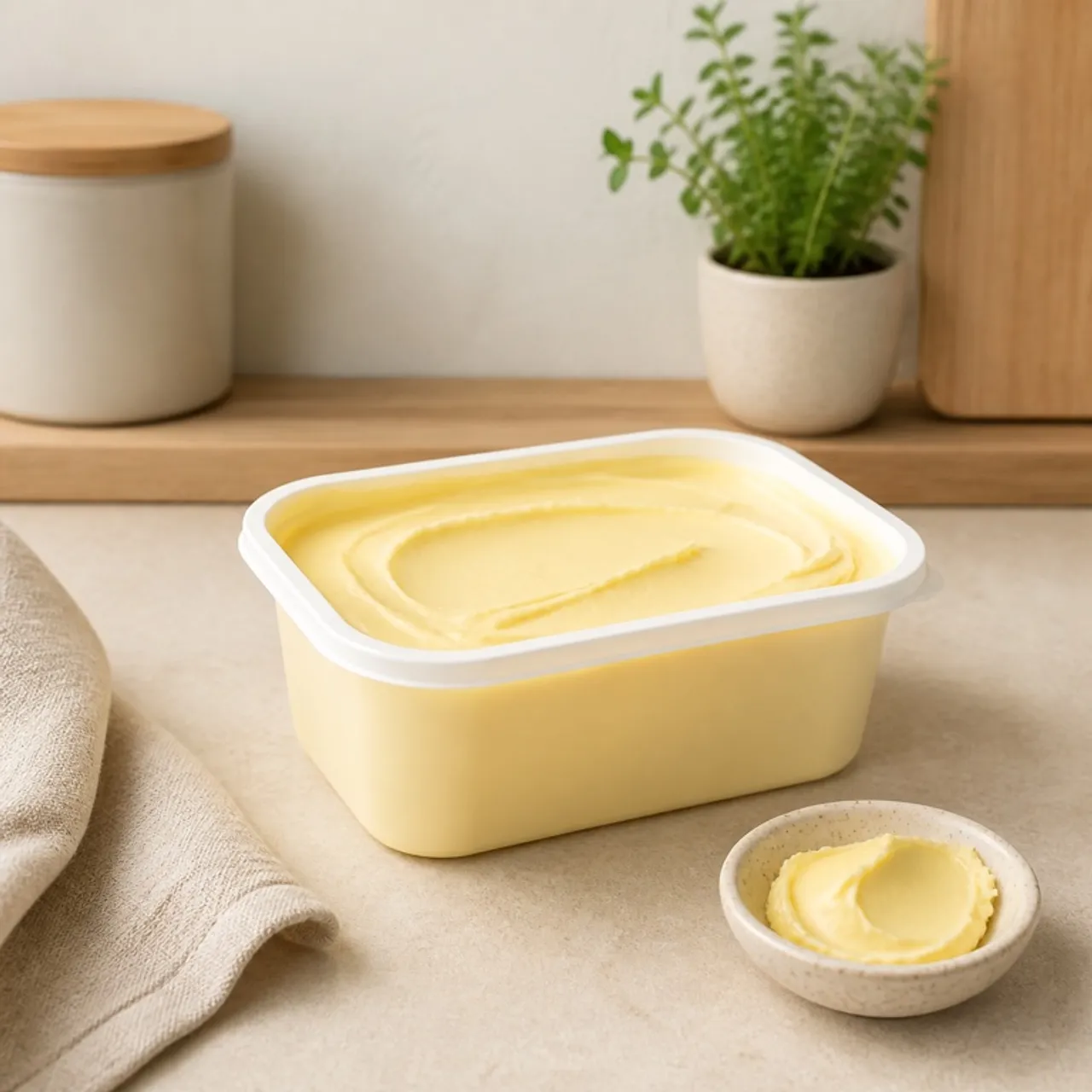
 Food Lens Images are for illustrative purposes only, may be inaccurate, and do not guarantee the presence or absence of specific ingredients.
 Food Lens · Dairy
Margarine
Mild, creamy, lightly salty (when salted), and neutral — some versions have a faint artificial flavor compared to butter.
Lens VerifiedMargarine is a butter-alternative spread made primarily from vegetable oils, water, and emulsifiers. It spreads, melts, and cooks similarly to butter in many applications, though baking results can differ depending on fat content.
Where it comes from
Margarine was developed in 19th-century France as a butter substitute and spread across North American kitchens in the 20th century as an affordable alternative. Modern margarines are typically made from refined vegetable oils and are formulated to spread at refrigerator temperature, a property butter lacks.
Varieties — Soft tub margarine spreads at refrigerator temperature; stick margarine behaves more like butter in baking; modern plant-based spreads are formulated to mimic butter more closely.
Margarine was a budget kitchen staple through much of the 20th century in North American and European kitchens, and many home bakers grew up using it as a default butter substitute.
In a modern kitchen — Water content in margarine varies widely; high-water margarines can make baked goods dense. Check the fat percentage if baking results are inconsistent.
Buying it
Check the label for fat content — margarine ranges from 35% to 80% fat, and baking results differ significantly. Stick margarine is more reliable for baking than soft tub versions. Ingredient lists vary by brand.
Storing it
Keep refrigerated in its original tub with the lid pressed on tight so it doesn't pick up fridge odors. Discard if the surface discolors or it smells off.
Keeps about 2 months in the fridge.
Smoke point
300–350°F
commonly cited around 300-350°F, varying by formula and not ideal for very high heat.
Out of margarine? Good swaps
- Butter — Richer flavor and better for most pastry; use one-for-one in most recipes.
- Coconut oil — Solid at room temperature; works in some baking with flavor changes.
- Vegan butter — Modern plant-based options often behave closer to butter than traditional margarine.
General cooking guidance — always check the labels on the products you use. Listahan’s allergen checks run automatically when you plan a recipe in the app. Not medical advice.
Recipes that use margarine
Common questions about margarine
What can I use instead of margarine?
Good swaps include Butter, Coconut oil, Vegan butter. Each behaves a little differently — see the swaps above for notes, and always check labels for allergens.
How do I store margarine?
Keep refrigerated in its original tub with the lid pressed on tight so it doesn't pick up fridge odors. Discard if the surface discolors or it smells off. It keeps about 2 months in the fridge.
More dairy
See all


Make margarine about your kitchen — with Listahan Pro
Everything above is free, forever. Pro adds the Household Lens — the same food, seen for your family:
-
Checked for each member
Flags margarine per person against your household's allergies and school rules — not just a generic "contains" tag.
-
Pantry-aware
Knows whether you already have it, what is running low, and the best swap from what is in your kitchen tonight.
-
What it costs near you
A real price from the Presyo community index, so you can plan the budget — not guess.
-
Your household memory
Who likes it, plus your own private notes — brand, where you keep it, who skips it.
Allergen safety is always free — Pro adds the automation, never the safety.
Cook with margarine — safely
Plan a recipe in Listahan and the household allergen check runs automatically — every plan, every swap, every lunchbox. Safety is never paywalled.